Carrollton Viaduct
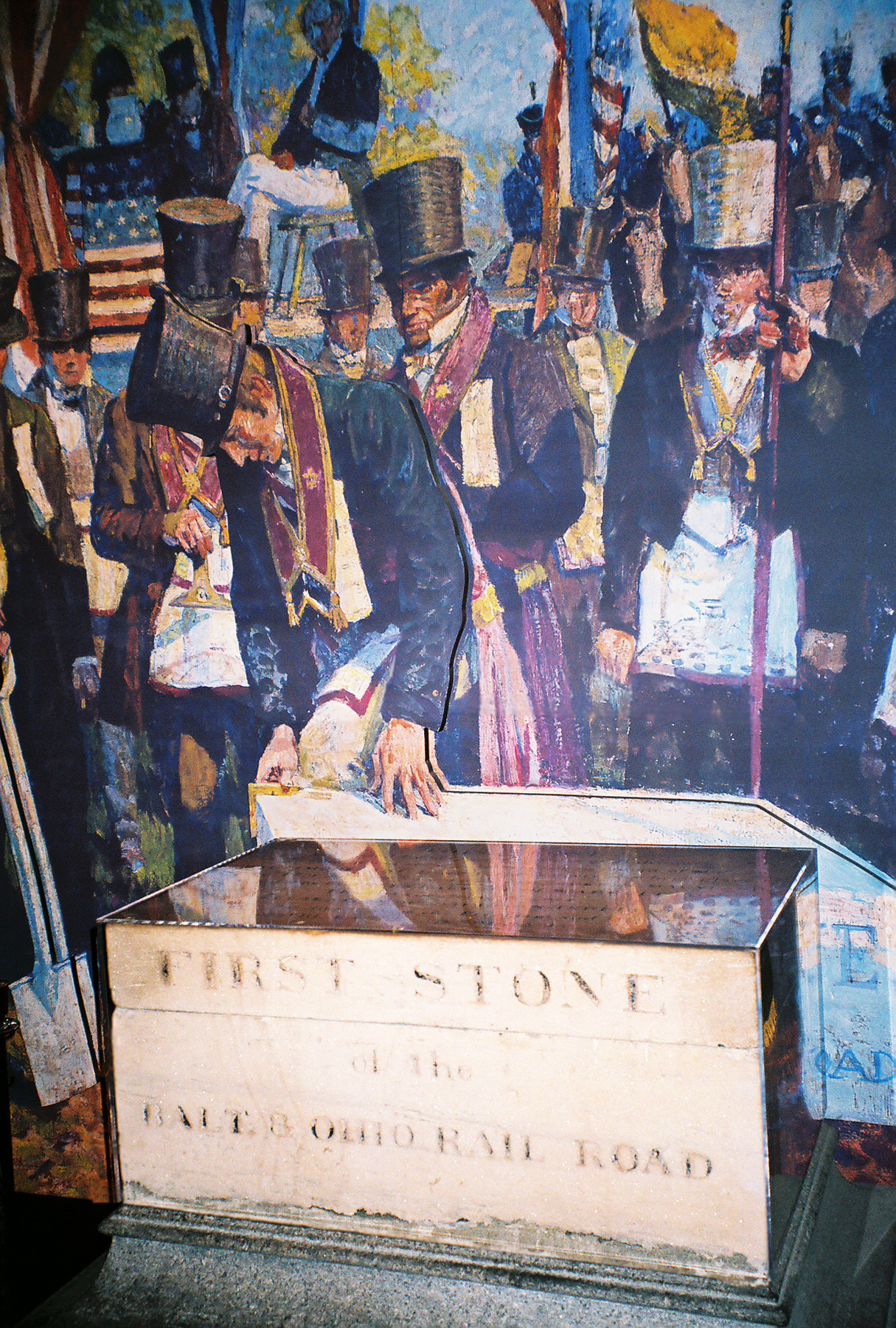
Charles Carroll of Carrollton was eighty-nine years old and running out of history to make. The last surviving signer of the Declaration of Independence, the wealthiest man in the former Thirteen Colonies, and the only Catholic in the Second Continental Congress, Carroll had already lived a life that spanned the entire arc of American independence. On July 4, 1828, he laid the cornerstone of a new stone bridge over Gwynns Falls in southwest Baltimore and declared: "I consider this among the most important acts of my life, second only to my signing the Declaration of Independence." He was not exaggerating. The bridge he christened that day -- the Carrollton Viaduct, named in his honor -- would become the first stone masonry railroad bridge in the United States, and nearly two centuries later, it still carries freight trains across the same creek.
Stone Over Water
Builder Caspar Wever and designer James Lloyd completed the viaduct for the Baltimore and Ohio Railroad in November 1829, at an officially listed cost of $58,106.73 -- though the actual price may have climbed as high as $100,000. The bridge stretches 312 feet across Gwynns Falls near Carroll Park, built from heavy granite blocks quarried at Ellicott's Mills and Port Deposit. A full-centered arch spans the creek, and the deck carries space for two railroad tracks. During construction, a temporary wooden framework supported 1,500 tons of stone for the central span. An arched passageway was built through one of the masonry approaches to provide an underpass for a wagon road. The original design called for a single arch with a shorter chord, but the proprietor of mills upstream feared a narrower opening would cause flooding, so the dimensions were enlarged. A white cornerstone at one end bears the inscription: "James Lloyd of Maryland, Builder A.D. 1829."
A President's Crossing
The Carrollton Viaduct occupies a peculiar place in American transportation history: it is both a monument to the railroad age and a relic of the era before it fully arrived. When Andrew Jackson crossed the bridge on June 6, 1833, traveling between Ellicott's Mills and Baltimore, he became the first sitting President of the United States to ride a railroad train. The bridge beneath his car was barely four years old. The B&O Railroad itself had been founded only in 1827, and the Carrollton Viaduct was among its earliest infrastructure investments -- a bet in stone that railroads would endure. That bet has paid off for nearly two centuries. The bridge has provided continuous service to the Baltimore and Ohio Railroad and its modern corporate successor, CSX Transportation, carrying loads far greater than anything Wever or Lloyd envisioned.
Engineering Landmark
Recognition came slowly but emphatically. On November 11, 1971, the Carrollton Viaduct was designated a National Historic Landmark and simultaneously listed on the National Register of Historic Places. In 1982, the American Society of Civil Engineers designated it a National Historic Civil Engineering Landmark, placing it alongside works like the Brooklyn Bridge and the Panama Canal in the pantheon of American engineering achievements. The viaduct remains one of the oldest railroad bridges in the world still carrying rail traffic. Its longevity is a testament to the quality of its construction -- the granite arches and walls have weathered nearly two hundred years of freight loads, weather, and the vibration of countless trains. Today, CSX Transportation owns and operates the bridge, and its trains rumble across Gwynns Falls along the same route that carried Andrew Jackson into a new era of travel.
From the Air
Located at 39.275N, 76.655W in southwest Baltimore, Maryland, spanning Gwynns Falls near Carroll Park. The viaduct is a stone arch bridge visible as a low crossing over a tree-lined creek in a developed urban area. Recommended viewing altitude: 2,000-3,000 feet AGL. Nearby landmarks include Carroll Park, the B&O Railroad Museum (approximately 1 nm northeast), and the Gwynns Falls Trail. Nearest airports: KBWI (Baltimore-Washington International), approximately 7 nm south; KMTN (Martin State Airport), approximately 10 nm northeast. KDMH (Baltimore Inner Harbor Heliport) is approximately 2 nm northeast.