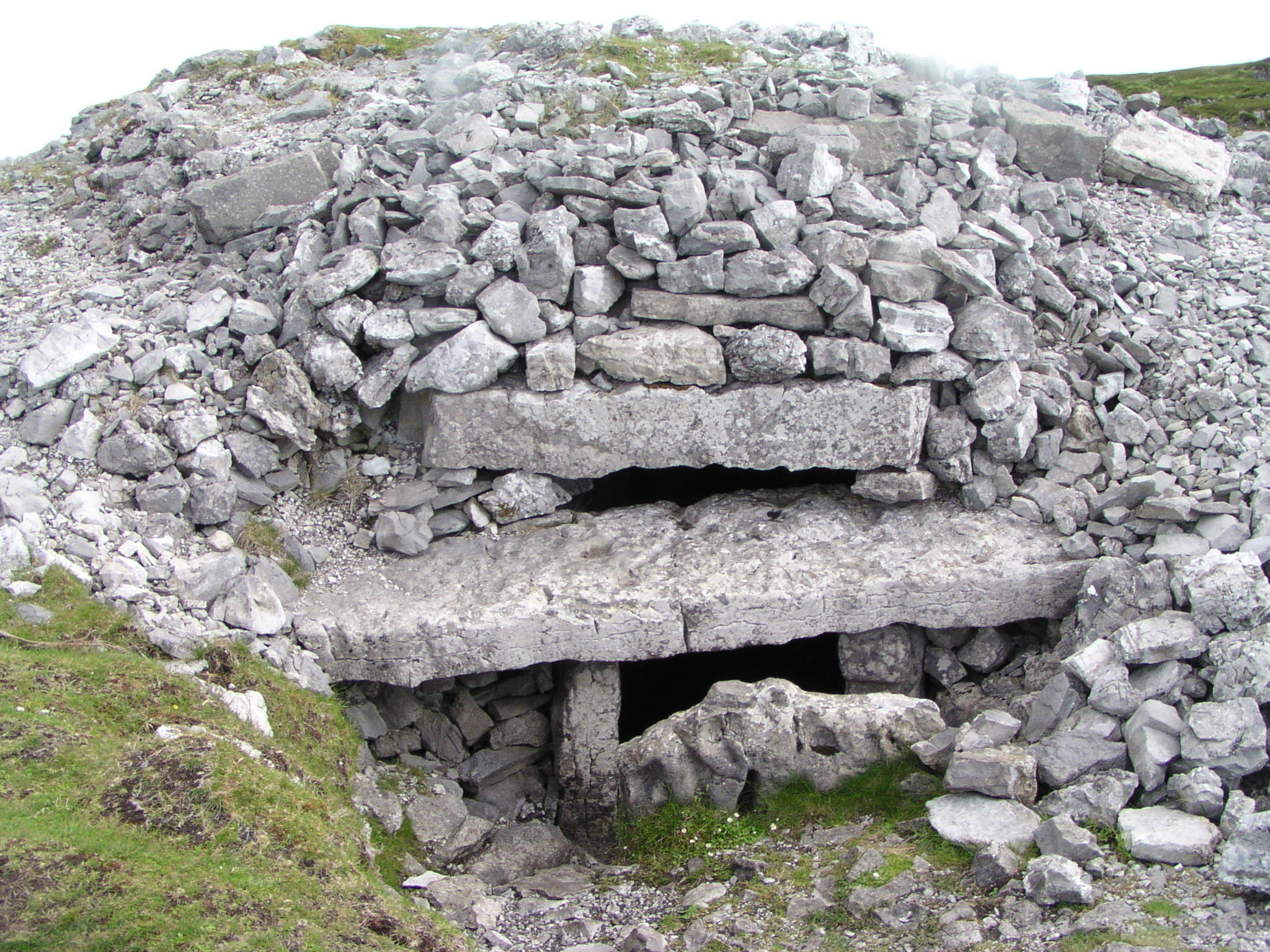
Carrowkeel Megalithic Cemetery
"I lit three candles and stood awhile, to let my eyes accustom themselves to the dim light." So wrote the naturalist Robert Lloyd Praeger in 1911, describing his first entry into a chamber at Carrowkeel that had not been opened in thousands of years. "There was everything, just as the last man had left it, three to four thousand years before. A light brownish dust covered all... beads of stone, bone implements made from Red Deer antlers, and many fragments of much decayed pottery. On little raised recesses in the wall were flat stones, on which reposed the calcinated bones of young children." Five thousand years of silence, ended by three candle flames.
The Speckled Hills
Carrowkeel occupies the high ground of the Bricklieve Mountains -- An Bricshliabh, "the speckled hills" -- overlooking the dark waters of Lough Arrow in south County Sligo. Fourteen passage tombs form the central core of the complex, with twelve more scattered within a six-kilometer radius, including sites on Keshcorran and the giant Heapstown Cairn at the north end of Lough Arrow. Together with Carrowmore, Bru na Boinne (which includes Newgrange), and Loughcrew, Carrowkeel is considered one of Ireland's four great passage tomb cemeteries. The tombs were built between approximately 3500 and 2500 BC, during the Neolithic era, by farming communities whose entrances and passages often orient northwest -- toward Knocknarea and Carrowmore, as though the dead were meant to face their kin across the landscape.
Origins Written in Bone
The 1911 excavation, led by R.A.S. Macalister with Praeger and Edmund Clarence Richard Armstrong, unearthed cremated human remains, animal bones, tools, and a distinctive crude pottery that became known as Carrowkeel Ware -- the first type specimen of its kind recorded from Irish passage tombs. Macalister mistakenly dated the monuments to the Bronze Age, but modern research has corrected this to the Neolithic. Most of the bone assemblage was sent to Cambridge University, where Macalister's father Alexander was a professor. Recent analysis at the Leverhulme Centre for Human Evolutionary Studies has yielded remarkable results: stable isotope analysis of 22 samples suggests the dead grew up in a carboniferous limestone region, likely close to Carrowkeel itself. More striking still, DNA genomes from six individuals revealed ancestral origins in Anatolia, with greater affinity to Mediterranean populations than to the Danubian expansion of early farming.
Gods and Demons
Mythology saturates this landscape. Heapstown Cairn, the massive passage tomb at the northern end of Lough Arrow, stands on the legendary plain of Moytura -- the site of battles between the Tuatha De Danann, the ancient gods of Ireland, and the demonic Fomorians. The nearby Caves of Kesh, limestone caverns in the Keshcorran hillside, feature in tales of the Fianna and are said to be an entrance to the otherworld. Whether the Neolithic builders knew these stories or the stories grew from the monuments is impossible to say. What is clear is that people have been layering meaning onto this landscape for five millennia, and the process continues.
Fragile Stones
Some of the Carrowkeel tombs can still be entered by crawling through a narrow passage into a corbelled chamber. The experience is visceral -- the weight of stone above, the darkness, the sense of being inside something immeasurably old. But the monuments are under threat. Visitors climb on the cairns, scratch names into the stone, and take rocks as keepsakes. There is evidence of treasure hunting at some tombs by people apparently unaware that these sites are over 5,000 years old and predate the use of metals in Ireland. Graffiti can obscure ancient megalithic art that is difficult to see even under ideal conditions. The Office of Public Works is preparing a conservation program, but the Bricklieve Mountains remain open and largely unmonitored. The same remoteness that preserved Carrowkeel for five thousand years now makes it vulnerable.
From the Air
Located at 54.05°N, 8.38°W on the Bricklieve Mountains in south County Sligo. The cairns are visible from moderate altitude as stone formations on exposed hilltops above Lough Arrow. Nearest airport: Ireland West Airport Knock (EIKN), approximately 30 km to the southwest. Sligo Airport (EISG) is roughly 35 km to the northwest. Lough Arrow and the distinctive limestone formations of Keshcorran provide visual landmarks.