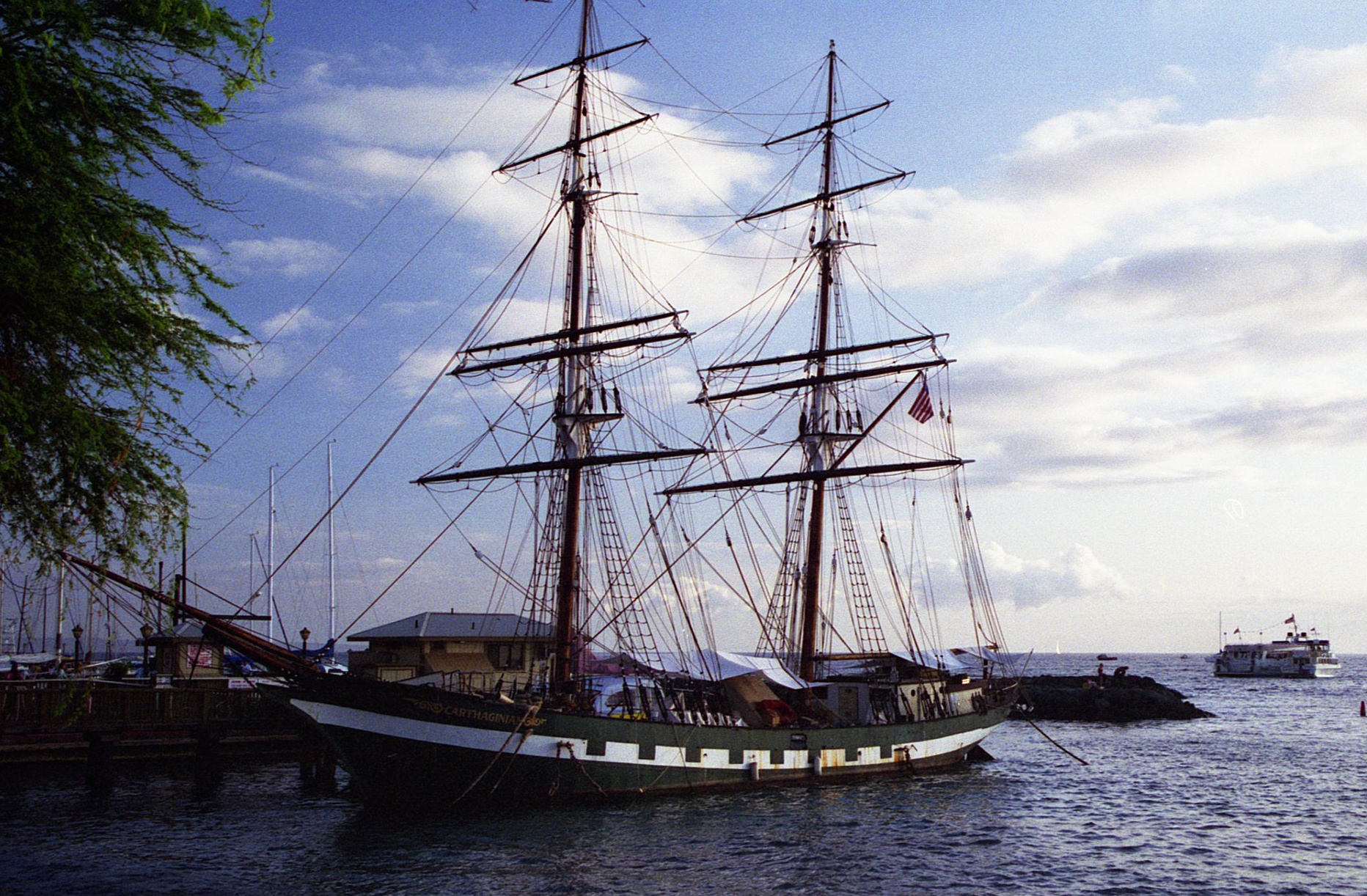
Carthaginian II
She was built from submarine steel. In 1920, the Friedrich Krupp Germaniawerft shipyard in Kiel, Germany, launched a two-masted schooner christened Mary, her hull fabricated from steel originally intended for U-boats that would never be completed after the First World War. That material gave her and her sister ships a reputation for unusual longevity -- a quality that would serve her well through a series of lives that no shipwright in Kiel could have anticipated. She would cross the Atlantic under sail, be renamed, be re-rigged as a whaling brig, spend three decades as a floating museum in a Hawaiian harbor, and finally be sunk on purpose 97 feet below the surface off Maui, where she rests today as one of the most celebrated wreck dives in the world.
From Kiel to Lahaina
The vessel's journey to Hawaii began in 1973, when the non-profit Lahaina Restoration Foundation purchased her in Denmark for approximately $21,000. An all-Lahaina crew motored her from Soby, Denmark, to Hawaii -- a 105-day passage across two oceans. Once in Lahaina, the LRF re-rigged her as a brig to evoke the whaling ships that had made Lahaina one of the Pacific's busiest whaling ports in the mid-nineteenth century. Rechristened Carthaginian II, she replaced the original Carthaginian, a schooner converted into a barque that had served as the harbor's first museum ship since 1967. Moored at the Lahaina waterfront, the Carthaginian II became a whaling museum, her below-decks exhibits telling the story of an industry that had once defined this town.
The Weight of Water
Submarine steel lasts, but nothing lasts forever in salt water. The internal ballast added to stabilize the Carthaginian II created a problem no one had foreseen: moisture condensed between the ballast and the hull, and the steel began to rust from the inside out. By the early 2000s, the hull had corroded to a point where it nearly split in half. The Lahaina Restoration Foundation was spending $50,000 a year on maintenance, a figure that could not be sustained. The ship that Krupp's steel had kept afloat for eight decades was failing at the seams. Something had to change, and the LRF found a solution that was elegant in its finality.
A Deliberate Sinking
In 2003, the LRF approached Atlantis Submarines, a local tourist submarine operator, with a proposal: buy the Carthaginian II and sink her as an underwater attraction. Atlantis invested $350,000 in environmental studies and cleaning, stripping the vessel of anything that could contaminate the marine environment. On December 13, 2005, the boat was towed offshore and sunk near Puamana Beach Park. She settled upright on the sandy bottom at a depth of 97 feet, her masts still pointing toward the surface. Almost immediately, marine life began colonizing the hull. Within five years, the Carthaginian II had become a thriving artificial reef, her decks and rigging encrusted with coral and patrolled by schools of reef fish. Scuba Diving and Sport Diver magazines rated her as one of the top wreck diving locations in the world.
An Empty Berth
The LRF was given 120 days to find a replacement for the Carthaginian II's berth before it would be reclaimed for commercial use. The berth was proposed as a potential home for the Hawaiian voyaging canoe Mo'okiha o Pi'ilani, but that vessel was ultimately berthed at Maalaea Harbor in 2016. The waterfront slip where a German schooner once posed as a New England whaler is empty now, but the ship herself is far from gone. She sits in the clear waters off Lahaina's coast, visited by divers who swim through the same holds that once displayed harpoons and scrimshaw. The Carthaginian II spent 32 years as a museum above the waterline. She may spend centuries as one below it.
From the Air
The wreck site is located at approximately 20.863N, 156.675W, offshore near Puamana Beach Park on the west coast of Maui, south of Lahaina Harbor. At 97 feet depth, the wreck is not visible from the air, but the Lahaina waterfront and harbor where the ship was moored for 32 years is clearly visible. Nearest major airport is Kahului Airport (PHOG), approximately 25 nm east. Kapalua Airport (PHJH) is about 8 nm northwest. Submarine tour boats and dive boats operate from Lahaina Harbor.