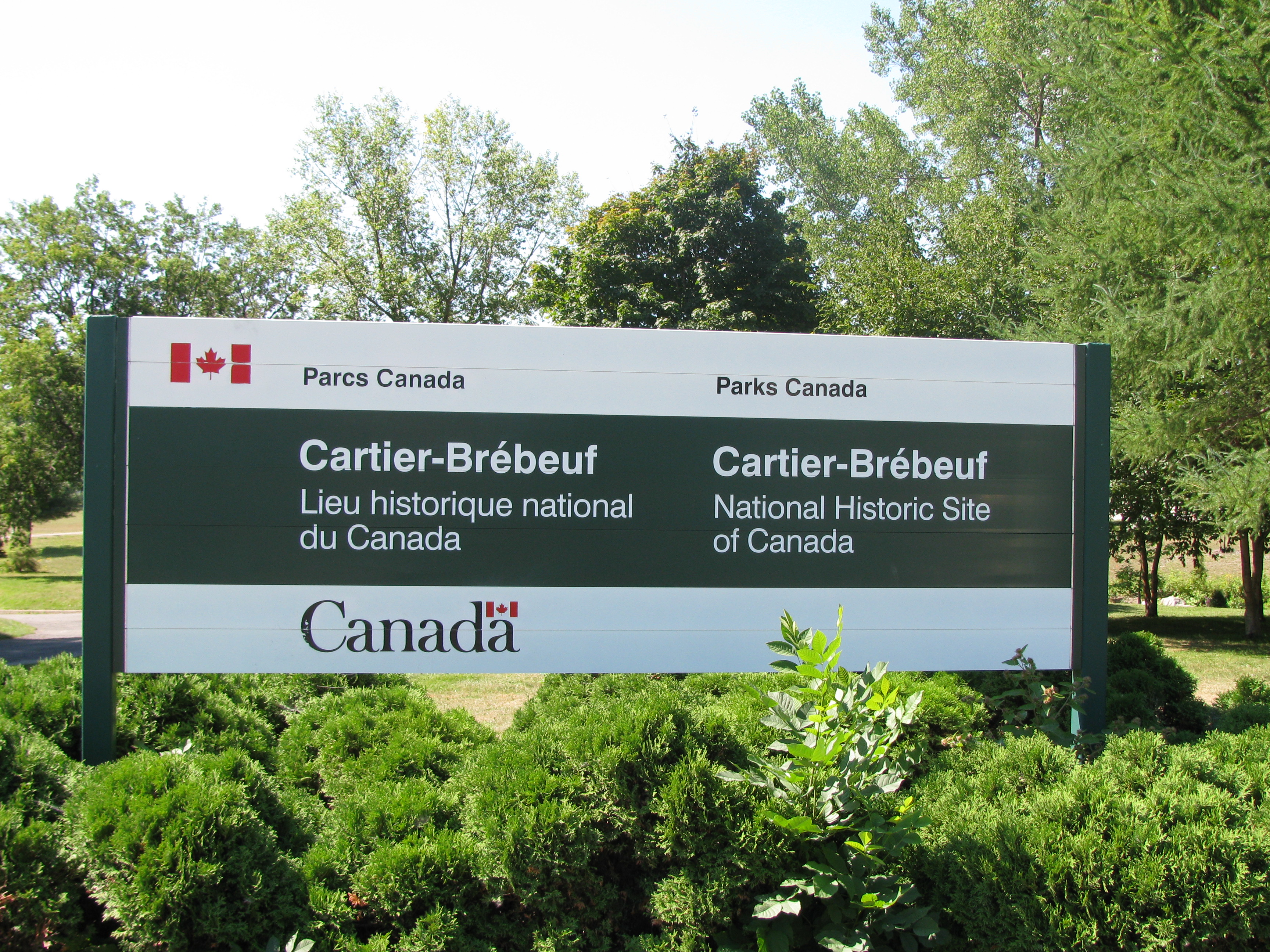
Cartier-Brebeuf National Historic Site
Of the 110 Frenchmen who sailed into the harbor that September, 106 would fall ill before spring. Twenty-five would die and be buried in ground they had crossed an ocean to claim. Jacques Cartier's second voyage to Canada in 1535 was supposed to push further westward, to find the passage to Asia that every European power craved. Instead, it became a brutal lesson in survival at the confluence of the Saint-Charles and Lairet rivers, within sight of the Iroquoian village of Stadacona -- the settlement that would eventually become Quebec City. Today, the Cartier-Brebeuf National Historic Site occupies this exact spot, a 6.8-hectare urban park that commemorates two founding chapters of European presence in Canada: Cartier's desperate wintering and the arrival of the first Jesuit missionaries nearly a century later.
Scurvy, Frost, and an Iroquoian Remedy
Cartier arrived at the confluence on September 8, 1535, searching for a sheltered harbor to leave his two largest ships, the Grande Hermine and Petite Hermine, while he continued upstream to Hochelaga -- present-day Montreal -- aboard the smaller Emerillon. He named the harbor Sainte-Croix, or Holy Cross. When he returned, he found that his crew had built a small fort around the ships, fearful of the Stadaconeans. The French captain decided to winter in place, a choice that nearly destroyed his expedition. Rather than building proper shelters, the crew stayed in the ships' steerage, a catastrophically poor decision against the Canadian winter. Scurvy struck 106 of the 110 men. The survivors owed their lives to the Iroquoians, who shared a remedy called annedda -- an infusion brewed from a Canadian conifer, likely white cedar or balsam fir. Before departing for France in the spring of 1536, Cartier erected a cross honoring King Francis I. He had to abandon the Petite Hermine in the harbor; too many of his sailors had died to crew three ships home.
The First Jesuits in Quebec
The same riverbank that nearly killed Cartier's crew became, in 1625, the first foothold of the Society of Jesus in Quebec. Five Jesuit missionaries -- fathers Jean de Brebeuf, Enemond Masse, and Charles Lalemant, along with coadjutor brothers Francois Chartoin and Gilbert Burel -- established a residence they named Notre-Dame-des-Anges. Their quarters were modest: a main building of wood planks measuring 13 meters by 7.5 meters, and a smaller structure serving as barn, stable, and workshop. The Jesuits set about their mission of evangelizing the Indigenous peoples, but their tenure was interrupted in 1629 when the Kirke brothers seized Quebec City. When the Jesuits returned in 1632, they found their buildings partially destroyed. They rebuilt in 1636, expanding the residence to house a Huron seminary that operated until 1639. The twin legacies of Cartier and Brebeuf at this single location are what give the site its hyphenated name.
Layers Beneath the Park
Archaeologists have searched this ground repeatedly -- in 1959, 1962, 1986, 1993, 2004, and 2007 -- hoping to uncover physical traces of Cartier's 1535 encampment or the Jesuit residence. The results have been tantalizing but elusive. Centuries of industrial use transformed the landscape: a brickyard operated here from 1688 to 1714, a pottery from 1746 to 1752, a shipyard around 1840, another brickyard from 1867 to 1930, and finally a junkyard and municipal snow dump in the mid-twentieth century. Excavations have produced objects from these later periods, but the most sought-after artifacts -- the graves of the 25 sailors, the remains of Cartier's small fort, the foundation ditches -- remain undiscovered. The proof of Cartier's presence rests on written accounts, including Samuel de Champlain's observation, decades later, of what appeared to be chimney remnants and ditch traces along the river.
From Snow Dump to Sacred Ground
The journey from industrial wasteland to national historic site began in 1835, when a wooden cross was erected to commemorate Cartier's voyage. In 1886, the Quebec City Catholic Circle acquired the grounds and erected a metal cross in 1888 -- still standing today. Recognition came formally in 1958, when Prime Minister John Diefenbaker recommended the site to the Historic Sites and Monuments Board of Canada. The federal government acquired the land the following year. When the site opened in 1972, it featured an interpretation center and a full-scale replica of Cartier's Grande Hermine, built in 1966 for Montreal's Expo 67. A reconstructed Iroquoian longhouse was added in 1985 but was destroyed by arson that same year; a second longhouse, surrounded by a palisade, was built in 1986-1987. The Grande Hermine replica was removed in 2001 after 29 years of exposure made it structurally dangerous. Major revitalization work in 2008-2009 brought the channelized Lairet River back to daylight, and the site reopened fully in 2010.
Where Two Rivers Meet
Today, the Cartier-Brebeuf site sits quietly within the La Cite-Limoilou borough, bisected by the Lairet River and divided into eastern and western sectors. Steles marking "the meeting of two cultures in the 16th century" stand near the interpretation center. A Jesuit kiosk, interpretation panels, and the 1888 commemorative cross dot the park. A cycleway and the linear park of the Saint-Charles River cross the grounds, drawing neighborhood residents into a space that holds nearly five centuries of layered history. Beneath the joggers' feet lie the unfound graves of French sailors, the vanished foundations of the first Jesuit house in Quebec, and the soil where an Iroquoian remedy saved the lives of men who had come to claim a continent.
From the Air
The Cartier-Brebeuf site is at 46.825N, 71.240W, at the confluence of the Saint-Charles and Lairet rivers in Quebec City's La Cite-Limoilou borough. From 2,000-3,000 feet, look for the green park space along the Saint-Charles River approximately 2 km north of Old Quebec. The winding Saint-Charles River is the key visual landmark. Quebec City Jean Lesage International Airport (CYQB) is roughly 10 nm to the west-southwest. The site sits in the low-lying river plain north of the Promontory of Quebec, contrasting with the elevated Old City to the south.