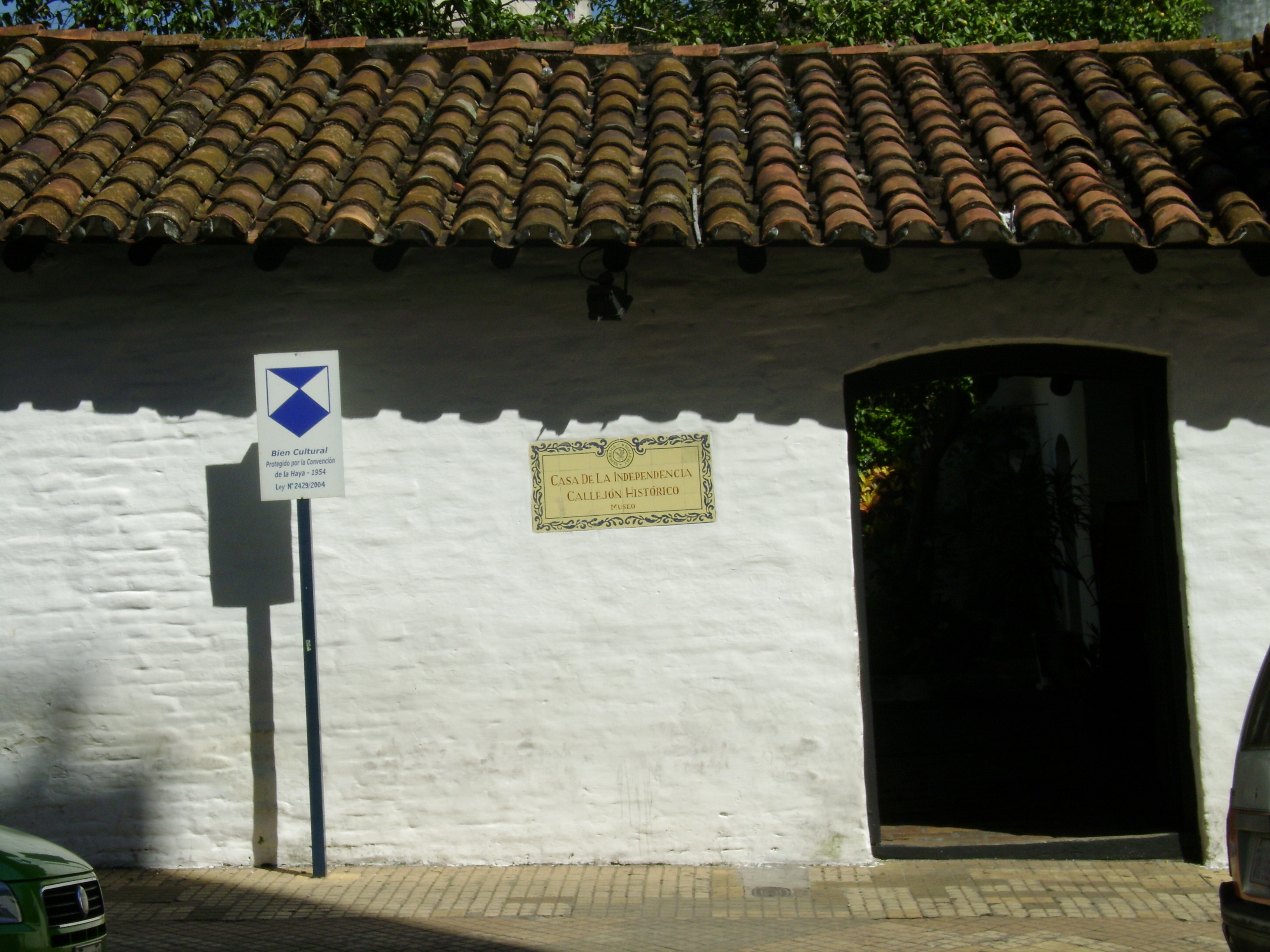
Casa de la Independencia Museum
On the evening of May 14, 1811, a group of men slipped out of an adobe house on the corner of what would later be named Presidente Franco and 14 de Mayo. They walked through a narrow alley, turned toward the Governor's residence a few blocks away, and demanded a power-sharing agreement that would end Spanish colonial rule in Paraguay. The house they left behind -- built in 1772 with walls of adobe, a thatched roof, and a framework of bamboo and palm wood -- still stands. It is now a museum, and the alley is still there, and the street in front of it bears the date of the night they walked through it.
The House Where Conspiracy Found Its Address
The house was built by Spanish settler Antonio Martinez Saenz and his Paraguayan wife Petrona Caballero de Bazan. Their two sons, Pedro Pablo and Sebastian Antonio, inherited it and lived there with their wives, Carmen Speratti and Nicolasa Marin. Two young women -- Facunda Speratti and Virginia Marin, sisters of the wives -- also lived in the house. This domestic arrangement turned out to matter enormously, because the house became a gathering point for the men who would remake the country. Captain Pedro Juan Caballero lodged there when visiting Asuncion from the provinces. Across the street lived Juana Martinez de Lara, aunt of the patriot Vicente Ignacio Iturbe. Fulgencio Yegros and lieutenant Mariano Recalde came frequently, ostensibly courting Facunda and Virginia. The combination of romantic visits, family connections, and a convenient location made the Martinez house the perfect place to hide a revolution in plain sight.
The Night of May 14
Led by Pedro Juan Caballero, the conspirators used the alley beside the house to reach the street and march to the Governor's residence. The plan was not to overthrow by violence but to compel a power-sharing agreement -- a calculated step rather than a bloody coup. Across the street, Juana Maria de Lara hurried to the Cathedral of Asuncion to request Padre Molas to ring the bronze bells. When they sounded on the morning of May 15, the people of Asuncion gathered to celebrate the birth of the Republic of Paraguay. The street in front of the alley was later named 14 de Mayo by decree during the government of Carlos Antonio Lopez in April 1849 -- the first time Asuncion's streets received official names. The house that sheltered the conspiracy became, quite literally, the address where Paraguay's independence was written into the city's geography.
What the Rooms Hold
The museum, inaugurated on May 14, 1965, preserves the house as a series of rooms frozen in time. The office displays documents signed by the independence patriots and a bureau that belonged to Fernando de la Mora, alongside a painting by Jaime Bestard depicting the confrontation with Governor Velazco. In the dining room, a sword that once belonged to Fulgencio Yegros rests in a window display beside a portrait of Jose Gaspar Rodriguez de Francia. The living room holds French furniture from 1830 beneath a crystal chandelier, with full-length portraits of Caballero and Yegros flanked by Jesuit and Franciscan religious carvings. A bed belonging to Fernando de la Mora occupies the bedroom, along with an embroidered shirt he once wore. In the yard, a mural by Jose Laterza Parodi accompanies the text of the July 20, 1811 note addressed to the Primera Junta in Buenos Aires, asserting Paraguayan independence.
The Alley That Changed a Country
The Historical Alley remains the most significant space in the museum. Visitors enter through the Capitulary Saloon, a replica of the meeting hall from Asuncion's original Cabildo -- the first in the Rio de la Plata, established on September 16, 1541. The saloon displays a coat of arms of Spain from 1800 and a portrait of Emperor Charles V. But the alley itself is the destination: a narrow passage where footsteps echo against old walls, the same path the patriots walked to begin their revolution. In one corner of the yard lies the tumulus containing the mortal remains of Juan Bautista Rivarola Matto, brought from the Barrero Grande cemetery. A sundial from the Jesuit mission of Santa Rosa stands at the foot of the first national coat of arms. In 2003, a visitor named Nicolas Dario Latourrete Bo found the museum in poor condition and spearheaded its restoration, eventually being declared Life Protector of the museum in 2005 -- an honor without precedent in Paraguayan history.
From the Air
Located at 25.28S, 57.64W in the historic center of Asuncion, Paraguay, at the corner of Presidente Franco and 14 de Mayo streets. The museum is not visible from the air as an individual structure, but the historic downtown grid of Asuncion is identifiable from 2,000-3,000 feet AGL. The Palacio de Lopez and the Cathedral of Asuncion are nearby visual landmarks. Silvio Pettirossi International Airport (SGAS) is approximately 15 km northeast.