Casa de Tucuman
In 1869, photographer Angel Paganelli arrived at a house in San Miguel de Tucuman that was falling apart. The humid subtropical climate had been dissolving its adobe walls for decades, and the family who owned it could not afford repairs. He set up his camera and took two photographs: one of the crumbling front entrance, another of the interior patio where Carmen de Zabalia's blind daughters sat in the fading light. These images -- the only visual record of the original structure -- would become the blueprint for resurrecting the most important house in Argentine history.
A House Built for a Family, Borrowed for a Nation
The house at what is now Calle Congreso 151 was built in 1760 by Francisca Bazan and Miguel Laguna, a prosperous colonial family. It followed the standard layout of Spanish colonial architecture: rooms arranged around interior patios, thick adobe walls to buffer the heat, and a location near the main plaza befitting the family's social standing. By 1812, the Laguna-Bazan family had moved out, and the house served as barracks for the Army of the North during the Battle of Tucuman. In 1815, the government began renting the property for use as a customs house and regimental depot. When the Congress of Tucuman convened in March 1816, it was this rented house -- not a purpose-built hall of state -- where thirty-three deputies debated and, on July 9, declared the independence of the United Provinces of South America. Family legend long held that the Laguna-Bazan family had donated the house patriotically; historian Ramon Leoni Pinto proved in 1974 that it was rented, and that the furniture used by the Congress was built by enslaved people for the occasion.
Slow Decay and a Single Photograph
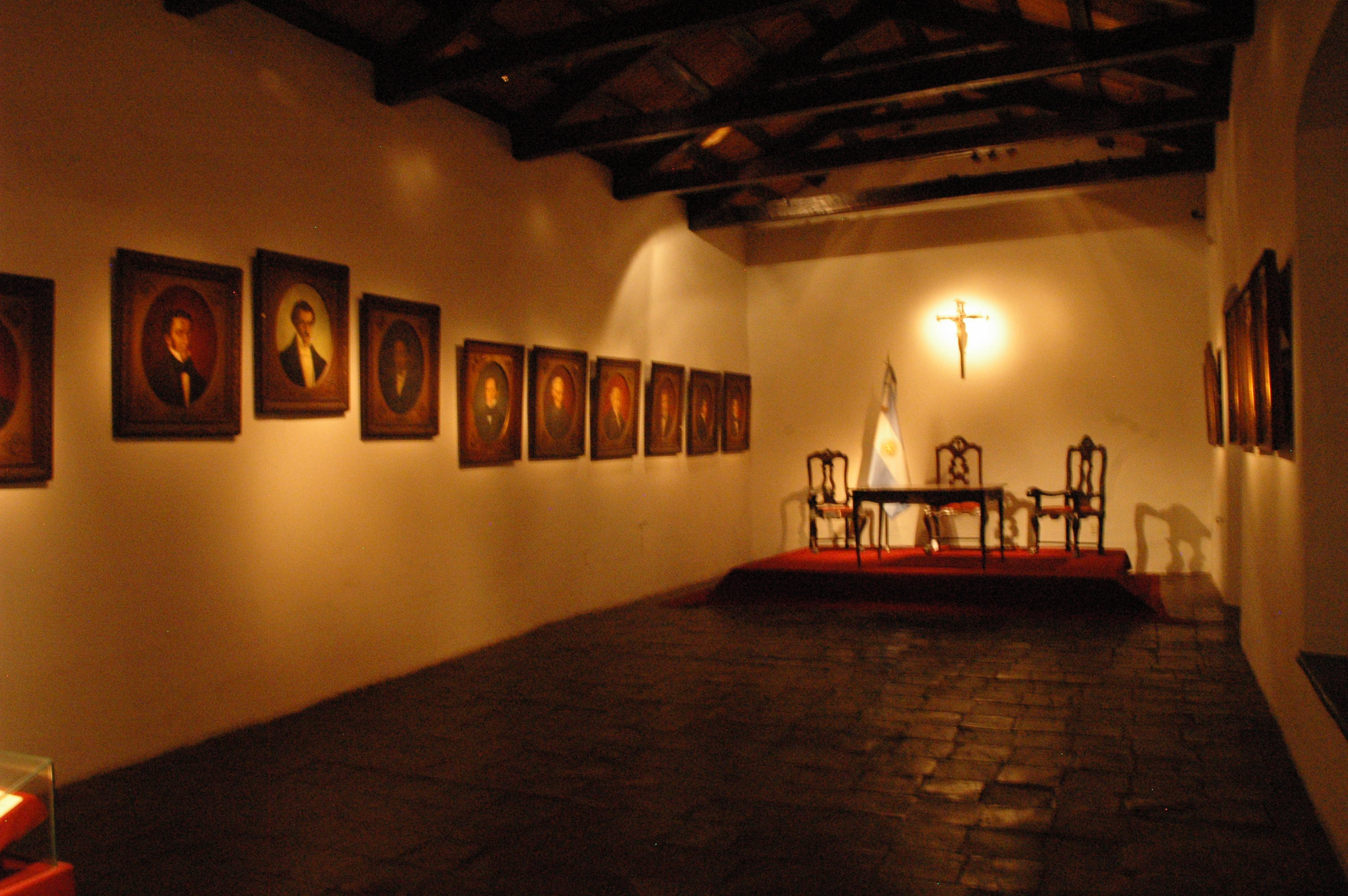
After the Congress relocated to Buenos Aires in February 1817, the house returned to private life. Carmen de Zabalia, granddaughter of the original builders, inherited it in 1839 and attempted restorations she could not afford. Tucuman's climate -- hot, humid summers and tropical rains -- was merciless to adobe construction. By the time Paganelli pointed his camera at the facade in 1869, the building was visibly deteriorating. That same year, during the presidency of Domingo Faustino Sarmiento, the Argentine National Congress authorized nationalizing the house. The process was slow, not completed until 1874 under President Nicolas Avellaneda, himself a Tucuman native. National engineers preserved only the "hall of the oath" -- the room where independence was declared -- and demolished the rest to make way for a postal building. President Julio Argentino Roca, also from Tucuman, later enclosed the hall in a protective structure, its entrance flanked by two bas-reliefs sculpted by Lola Mora depicting the declaration of independence and the May Revolution.
Resurrection from a Photograph
In 1941, the Casa de Tucuman was declared a National Historic Monument. Tucuman's congressional representative, Ramon Paz Posse, introduced a bill to reconstruct the house in its original form. The challenge was considerable: nearly the entire building had been demolished decades earlier. Architects worked from Paganelli's two photographs, the administrative archives from the 1870s renovation, and the original foundations, which remained underground. Construction began in 1942, and the restored building opened on September 24, 1943 -- the anniversary of the Battle of Tucuman. The reconstruction substituted bricks for the original adobe, and the roof reeds were tied with leather in the colonial fashion. The doors were left unpainted because no documentary evidence existed of their original color. The result is not quite the house that stood in 1816, but it is as close as scholarship and honesty could bring it.
Living Monument
The reconstructed Casa de Tucuman has accumulated its own history since reopening. On July 9, 1947, President Juan Domingo Peron stood in the hall of the oath and declared Argentina's economic independence, marking the complete payment of the nation's external debt. In 1971, the guerrilla organization Montoneros stormed the building, overpowering its single guard and painting political slogans across the walls of the declaration room -- an act that provoked the province to dispatch 2,500 police to secure the site. Since 1992, San Miguel de Tucuman has been designated the ceremonial capital of Argentina each July 9, and the president travels there to celebrate Independence Day at the house where it began. Each evening, a son et lumiere show illuminates the colonial facade, telling the story of the declaration to audiences who stand between Lola Mora's sculpted panels. The national anthem plays, the flag is raised, and for a few minutes, a house that was rented for a congress, nearly lost to humidity, and rebuilt from a single photograph becomes, once again, the birthplace of a nation.
From the Air
Located at 26.83°S, 65.20°W in central San Miguel de Tucuman, at Calle Congreso 151. The museum is part of the city's colonial core, visible from low altitude as part of the dense urban grid. The nearest airport is Teniente Benjamín Matienzo International Airport (SANT), 9 km east. From cruising altitude, the city appears as a concentrated urban area on the flat plain east of the Aconquija range, with the green expanse of 9 de Julio Park visible as a notable open space.