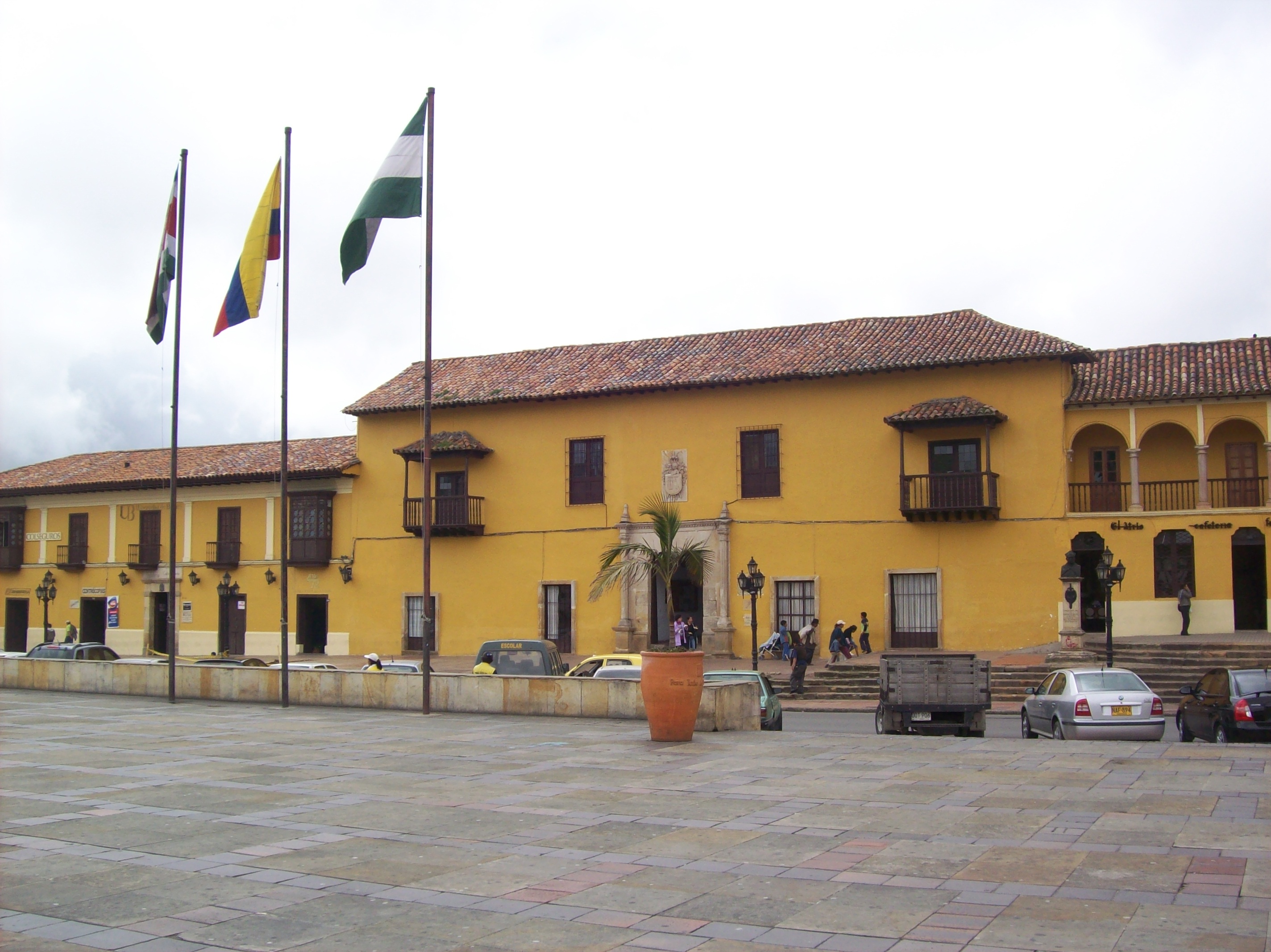
Casa del Fundador Gonzalo Suarez Rendon
A sign on the facade states it plainly: "Captain Gonzalo Suarez Rendon, founder of the city of Tunja, built this house in 1539." Nearly five centuries later, the house still stands at the eastern edge of Tunja's Plaza de Bolivar, its stone arches and painted ceilings intact, its Andalusian architecture recognizable to anyone who has walked the streets of Malaga or Granada. It is the only surviving residence of a city founder anywhere in Latin America -- a distinction that makes it both a museum piece and a monument to the colonial enterprise that reshaped a continent.
The Salt People and the Conquerors
Before Gonzalo Suarez Rendon arrived, the high plateau of the Altiplano Cundiboyacense belonged to the Muisca. They spoke a version of Chibcha called Muysccubun, mined halite in quantities large enough to earn them the name "The Salt People," and organized their society under caciques and priests. The zaque, based in Hunza -- the Muisca name for what would become Tunja -- governed the northern territories from a bohio surrounded by smaller settlements scattered through the Andean valleys. In April 1536, Gonzalo Jimenez de Quesada led 800 conquistadors from the Caribbean city of Santa Marta into the heart of the Andes. The journey took a year and killed eighty percent of his men. By August 1537, the survivors had reached Hunza, where hoa Eucaneme was defeated in his own bohio. Two years of further conquest followed, including the foundation of Bogota on August 6, 1538.
A Captain Founds a City
When Jimenez de Quesada sailed for Spain in early 1539, he left the colony in his brother Hernan Perez de Quesada's hands. One of Hernan's captains was Gonzalo Suarez Rendon, who was sent from Bogota to Hunza with orders to establish a permanent Spanish settlement. On August 6, 1539 -- exactly one year after Bogota's founding -- Suarez Rendon formally established Tunja as the second-most important Spanish city on the Altiplano. He became its first encomendero, overseeing the system of forced indigenous labor that would define colonial economics for centuries. Construction of his house began almost immediately, in 1540, and continued until roughly 1570. Three thousand Muisca built it -- their labor compelled under the encomienda system that Suarez Rendon himself administered.
Andalusia in the Andes
The house is built around a central garden patio in an L-shaped plan, with views across the Tunja Valley. Stone arches define the ground floor; the upper story is constructed in wood, with balconies that look out over the plaza. The architectural style is unmistakably Andalusian -- a transplanted aesthetic that the founder carried from his homeland in southern Spain to a city at 2,820 meters in the Colombian Andes. Inside, the central hall features a painted ceiling, and cloistered staircases connect the floors. The building houses mannerist mural paintings of exotic fauna, the founder's preserved bedroom, mounted cavalry figures with lances, and coats of arms from Leon, Castilla, the city of Malaga, and Kings Carlos I and Philip II of Spain. Since 1905, the Boyaca Academy of History has occupied part of the building, and since 1965 it has served as a public museum.
What the Walls Remember
Declared a monument in 1959 and formally designated as a museum in 1965, the Casa del Fundador sits at an intersection of histories that the building itself embodies. The painted murals celebrate European fauna and heraldry; the walls were raised by Muisca hands. The coats of arms honor Spanish kings; the city they presided over was built on the site of a defeated zaque's capital. The museum now displays paintings of thirteen Boyaca presidents and a depiction of the Battle of Boyaca, the 1819 engagement that ended Spanish rule in the region. Walking through the house, the visitor passes from conquest to independence within a few rooms -- from the bedroom where a conquistador slept to the hall where a republic's history is commemorated. The house endures because it was built to last, with stone and marble and the labor of three thousand people who had no choice in the matter.
From the Air
Located at 5.88N, 73.60W in Tunja, the capital of Boyaca Department, at approximately 2,820 meters elevation. The house sits on the eastern edge of Plaza de Bolivar in Tunja's historic center, identifiable from the air by the city's colonial grid pattern and the large central square. Villa de Leyva lies approximately 37 km to the southwest, and the Altiplano Cundiboyacense extends in all directions. Nearest airport: Tunja Airport (SKTJ) on the city outskirts. Bogota El Dorado (SKBO) is approximately 130 km southwest. Best viewed at 3,000-5,000 ft AGL to see Tunja's urban layout and the surrounding Andean plateau.