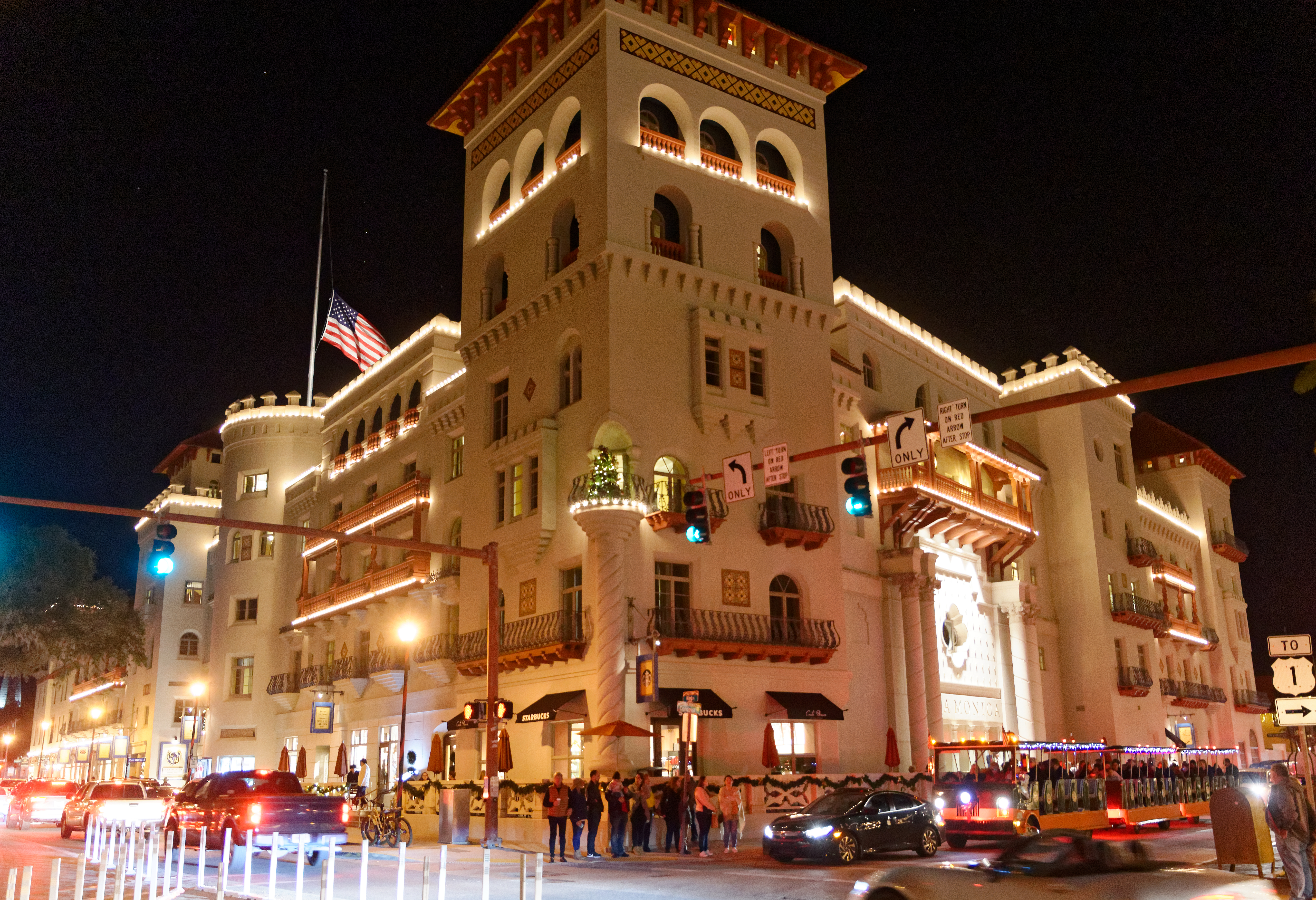
Casa Monica Hotel
Four names, four lives. When Franklin W. Smith opened the Casa Monica Hotel in 1888, he built it from poured concrete in a style nobody in Florida had seen before: Moorish Revival arches and Spanish Baroque towers rising above the streets of America's oldest city. Within months, Smith was broke and sold everything -- hotel, fixtures, furnishings, linen -- for $325,000 to Henry Flagler, the Standard Oil co-founder who was busy turning St. Augustine into a winter playground for the wealthy. Flagler renamed it the Cordova Hotel. It was just the beginning of the building's transformations.
The Flagler Empire
Henry Flagler already owned the Ponce de Leon Hotel (now Flagler College) and the Hotel Alcazar (now the Lightner Museum) when he bought Smith's creation. Together with his business partner John D. Rockefeller at Standard Oil, Flagler had the resources to reshape entire cities. From 1888 to 1902, the Cordova hosted parties, balls, fairs, and charity events for the Gilded Age elite. The famous travel agency "Ask Mr. Foster" had its headquarters in the building, a business started by local Ward G. Foster that would grow into a national enterprise. In 1902, Flagler built a bridge over Cordova Street connecting the hotel's second floor to the Hotel Alcazar next door. The Cordova became the Alcazar Annex. Then the Great Depression arrived, and in 1932 the combined hotel closed its doors.
A Courthouse with Dark Corners
In 1962, St. Johns County purchased the vacant building for $250,000 and converted it into a courthouse. Two years later, in 1964, during the St. Augustine civil rights movement led by Dr. Martin Luther King Jr. and Dr. Robert Hayling, the lobby of the building was used to house police dogs deployed against civil rights demonstrators. The irony of a luxury hotel's grand lobby serving as a kennel for instruments of oppression was lost on no one. Artist Hugo Ohlms painted murals for the courthouse, distinctive works that also appeared in the nearby Catholic Cathedral. The building served as a courthouse until the 1990s, housing courtrooms, government offices, and county archives.
The Architecture of Reinvention
Franklin Smith was a pioneer of Moorish Revival architecture in America. His own winter home, Villa Zorayda, just one block west of the hotel, was the first Moorish Revival building in St. Augustine. Smith was also an early experimenter with poured concrete construction, and the original exterior finish showed the horizontal pour marks that matched other grand structures of the Flagler era. In the 1960s, that original surface was covered with stucco, hiding the construction history beneath a smooth modern skin. When Richard Kessler purchased the building from the county for $1.2 million in 1997, he and architect Howard Davis chose to honor the Moorish Revival style. Tina Guarano Davis painted the Moorish-style woodwork in the restored lobby.
Hidden Beneath the Signs
The Casa Monica reopened as a hotel in December 1999 under its original name -- a name that carries its own layers of meaning. Saint Monica was the North African mother of St. Augustine of Hippo, the bishop for whom the city itself was named. On the Cordova Street side of the building, the Casa Monica sign covers an earlier sign for the St. Johns County Courthouse. State historic preservation officials required that the courthouse sign be preserved rather than removed, so it sits hidden beneath the new one, a secret written on the building's face. The massive flagpole crowning the rooftop is actually a lightning rod. The hotel operates today as part of the Kessler Collection, still one of the oldest hotels in the United States and a member of the Historic Hotels of America.
From the Air
The Casa Monica Hotel is located in the heart of downtown St. Augustine at approximately 29.892N, 81.314W. From the air, its distinctive Moorish Revival towers and terracotta roofline stand out among the historic district buildings near the Plaza de la Constitucion. The hotel sits adjacent to the former Hotel Alcazar (now Lightner Museum) and near Flagler College (the former Ponce de Leon Hotel). The Matanzas River and Bridge of Lions are visible to the east. Nearest airports: St. Augustine Airport (KSGJ) approximately 4nm northwest, Northeast Florida Regional Airport to the north. The historic district's grid pattern and the bayfront are clearly visible at moderate altitudes.