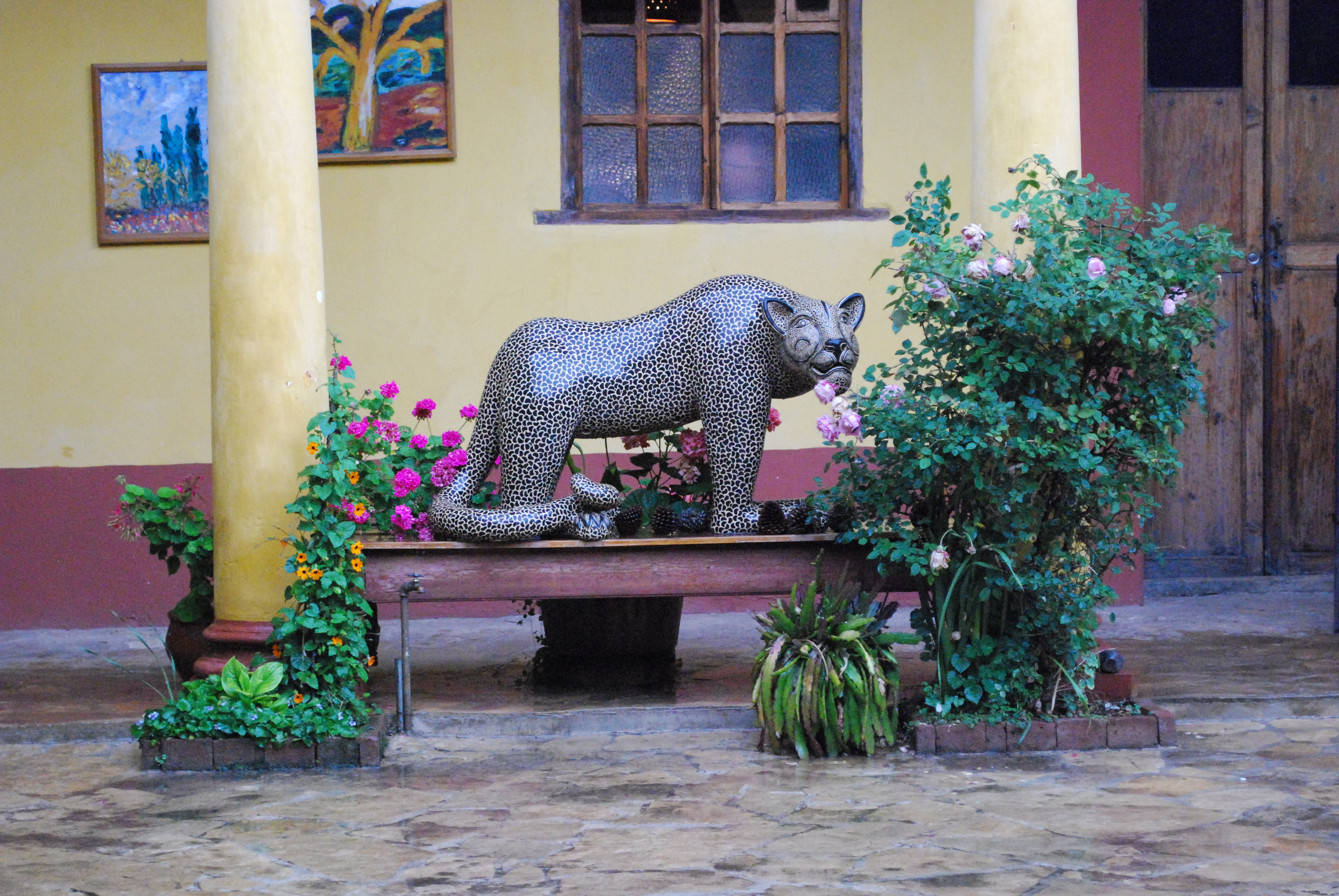
Casa Na Bolom: House of the Jaguar
Frans Blom's friends in the jungle called him Pancho Bolom - Pancho the Jaguar. It was a compliment that carried weight among people who considered the jaguar sacred. When the Danish archaeologist and his wife, Swiss-German journalist and photographer Gertrude Duby, bought a crumbling neoclassical building on the outskirts of San Cristobal de las Casas in 1950, they named it Casa Na Bolom - House of the Jaguar - a bilingual pun in Spanish and Mayan that doubled as a play on their own surname. The building, originally constructed in 1891 as a seminary, became something no one could have predicted: part museum, part hotel, part research library, part rainforest advocacy center, and always, above all else, a home where the Lacandon Maya were welcome.
Two Outsiders in the Lacandon Jungle
They found each other in the forest. Frans Blom, born in Copenhagen in 1893, was one of the first archaeologists to excavate Palenque, the great Mayan city roughly 150 kilometers east of San Cristobal de las Casas. Gertrude Duby, born in Switzerland in 1901, had come to Chiapas to start over, working for the Mexican government as a documentary photographer among the Lacandon people - the only Maya group never conquered or converted by the Spanish. The Lacandon lived deep in La Selva Lacandona, the vast rainforest of eastern Chiapas, and their isolation had preserved cultural practices stretching back centuries. For both Frans and Trudi, the jungle became the axis around which everything else turned. They married, and the rainforest became both their shared workplace and their shared cause.
Dinner in Three Languages
Frans Blom dreamed of Na Bolom as a cultural and academic center from the beginning. He opened his personal library - an exceptional collection of books on Mayan culture - to the public. Mayan artifacts filled display cases alongside Trudi's documentary photographs. To fund their jungle expeditions, they began taking in guests for meals and lodging. What started as practical fundraising evolved into something richer. The long dining table at Na Bolom became legendary: tourists sat beside local residents, who sat beside archaeologists conducting fieldwork in the region, and Frans took pride in the fact that any given meal featured conversation in at least three languages. Henry Kissinger stayed. Diego Rivera stayed. But rooms were always kept free for Lacandon Maya who traveled to San Cristobal for medical treatment - a policy that made Na Bolom unlike any hotel in Mexico.
Trudi's Trees and Trudi's Burden
Frans died in 1963, and Trudi carried Na Bolom alone for three more decades. She became an environmental activist in the 1970s, alarmed by the accelerating destruction of the Lacandon jungle she had spent her professional life documenting. In 1975 she established El Vivero, a tree nursery within Na Bolom's walled gardens, which still supplies free seedlings for reforestation projects across Chiapas. But the emotional and financial cost of maintaining Na Bolom weighed on her. She spent too much time fundraising, writing articles, and managing a revolving cast of young international volunteers. The work was relentless and the resources never sufficient. In the late 1980s, concerned citizens of Chiapas who valued her legacy helped Trudi establish the Asociacion Cultural Na Bolom, a nonprofit whose board of directors manages the property today. Trudi died in 1993, having kept the house and its mission alive for thirty years on willpower and conviction.
A Stone Jaguar Still Guards the Door
Walk up to the front entrance of Casa Na Bolom and you will find the guardian Frans installed there: an ancient stone jaguar carved from a Mayan frieze, its features worn smooth by centuries but its presence unmistakable. Behind that door, the house operates much as the Bloms intended. It is still a museum, still a hotel, still a restaurant where conversation flows in many languages at the long table. Mayan artisans sell tapestries in the shaded courtyard. The Bloms' adopted daughter, Dona Betty, oversees the kitchen. Their adopted Lacandon son, Kayum, visits with his family. A collection of 14,000 photographic negatives by American photographer Marcey Jacobson, documenting daily life in the region from the 1960s through the 1980s, joined the museum's holdings. The Asociacion Cultural Na Bolom sponsors art shows, concerts, and projects dedicated to the Lacandon Maya and their diminishing forest. The jaguar at the door keeps watch over all of it.
From the Air
Located at 16.74N, 92.63W in San Cristobal de las Casas, Chiapas, Mexico, at approximately 2,200 meters elevation. The building is in a residential neighborhood on the northern edge of the city's colonial center. From altitude, San Cristobal's distinctive red-tile roofscape and grid of colonial streets are visible in a highland valley surrounded by pine-forested mountains. Nearest major airport: Angel Albino Corzo International Airport (MMTG/TGZ) in Tuxtla Gutierrez, approximately 65 km to the west-northwest. Best viewed at 3,000-5,000 feet AGL. The city's churches and central plaza serve as orientation landmarks. The surrounding highland Maya villages of Chamula and Zinacantan are visible in the nearby hills.