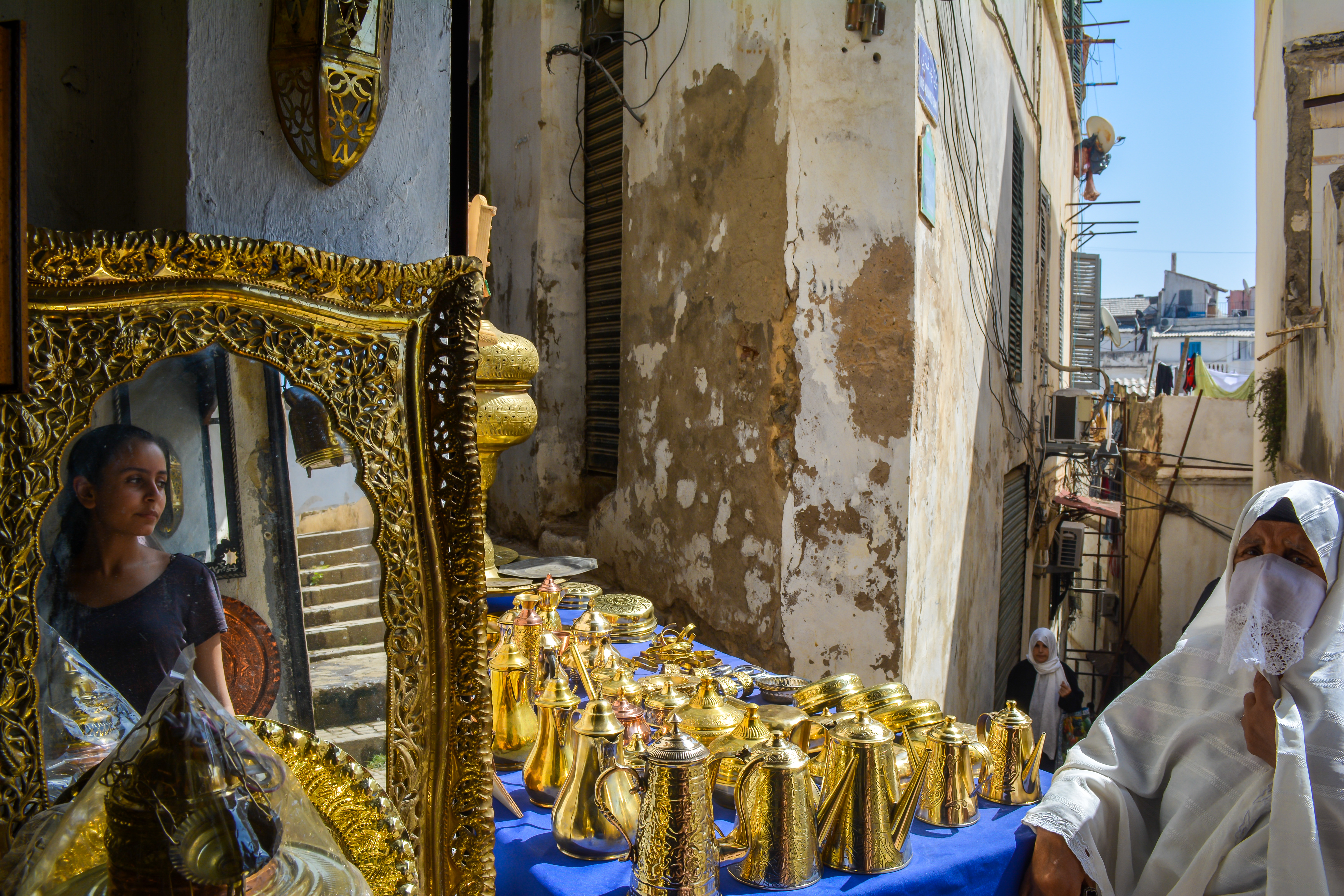
Casbah of Algiers
Le Corbusier called its urban planning perfect. Jean Gabin's most celebrated film used it as a character. Gillo Pontecorvo made it the setting for one of cinema's greatest war films. And for the people who have lived in the Casbah of Algiers across three millennia -- Phoenicians, Berbers, Romans, Ottomans, French colonizers, and Algerian revolutionaries -- it has been something more elemental than a backdrop: a citadel that shaped the destiny of everyone who entered its walls.
Island of Owls
The site's oldest name is Ikosim, a Phoenician word meaning either "Island of Owls" or "Island of Thorns" -- scholars still debate which. Carthaginian traders established a post here in the sixth century BCE, drawn by the small islands near the shore that provided natural mooring and by the 250-meter coastal promontory that offered shelter from storms. The limestone islands supplied building material; the surrounding clay yielded bricks; fresh water was accessible nearby. When the Berber ruler Bologhin Ibn Ziri founded the present-day city in 960 CE, he built upon layers of Punic, Roman, and Byzantine habitation. The Casbah as it stands today -- a triangular wedge of whitewashed houses climbing a steep hillside, opening toward the Mediterranean -- took its form under the Zirid dynasty and was enriched by successive Berber and Ottoman rulers across the following centuries.
The Corsair Capital
The Casbah reached its peak during the Regency of Algiers, the Ottoman-backed state that ruled from the sixteenth to the nineteenth century. Corsair captains operated from the Palais des Rais at the waterfront, their wealth funding the mosques, palaces, and madrasas that filled the medina. An ingenious aqueduct system, built between 1518 and 1620, brought water from the surrounding hills using souterazi -- siphon towers that regulated flow and released air pressure, a technique shared with Constantinople and certain cities in Spain. The Palais Mustapha Pacha, completed in 1798, contained half a million antique tiles from Algeria, Tunisia, Spain, and Italy. The Ketchaoua Mosque, whose confirmed founding dates to 1611/1612 CE under the Ottoman Regency, blended Moorish, Turkish, and Byzantine architectural styles. Within the Casbah's walls, craftsmen organized themselves into specialized streets: coppersmiths in one alley, woodworkers in another, garment makers in a third.
Battleground of Independence
When France conquered Algiers in 1830, the colonial administration demolished much of the lower Casbah to build a European-style waterfront and the grand Place des Martyrs. Haussmannian boulevards cut through the medieval fabric. The Ketchaoua Mosque was seized at bayonet-point in December 1831 and consecrated as a Catholic cathedral on Christmas Day 1832. But the upper Casbah survived, its steep alleys and hidden courtyards proving impervious to modernization. In 1957, that same inaccessibility made it the perfect fortress for FLN independence fighters during the Battle of Algiers. Yacef Saadi commanded his network from safe houses in the Casbah, communicating through couriers who disappeared into the crowds. French paratroopers eventually broke the FLN organization through systematic raids, arrests, and torture, but the Casbah's role as the crucible of Algerian resistance is permanently embedded in the national memory.
A Heritage Under Siege
After independence in 1962, the Casbah's original families -- the beldiya -- gradually moved to more spacious European-style apartments in other neighborhoods. Rural migrants took their place, arriving without what urban planners called "urban experience." The traditional zabalines who collected garbage and siyakines who cleaned streets with seawater dwindled in number. Buildings deteriorated. Restoration plans followed one another without success, hamstrung by inadequate funding and shifting political priorities. Between 1962 and 1985, no government administration even established an office within the Casbah. UNESCO designated it a World Heritage Site in 1992, but the listing alone could not halt the decay. Today, the Casbah remains a contested space: a living neighborhood where craftsmen still sell traditional karakou garments and copper chandeliers near the Ketchaoua Mosque, a symbol of resistance that Algerians invoke with fierce pride, and a masterwork of Islamic urbanism slowly losing its battle against time.
From the Air
Located at 36.786N, 3.059E on the hillside above Algiers' waterfront. The Casbah is immediately recognizable from the air as a dense triangular cluster of white buildings climbing the slope, distinct from the Haussmann-style colonial boulevards along the coast below. The citadel crowns the summit. Nearest airport: Houari Boumediene Airport (DAAG), approximately 16 km southeast. The Mediterranean coastline, the harbor, and the contrast between the medieval medina and the modern city are all visible on approach.