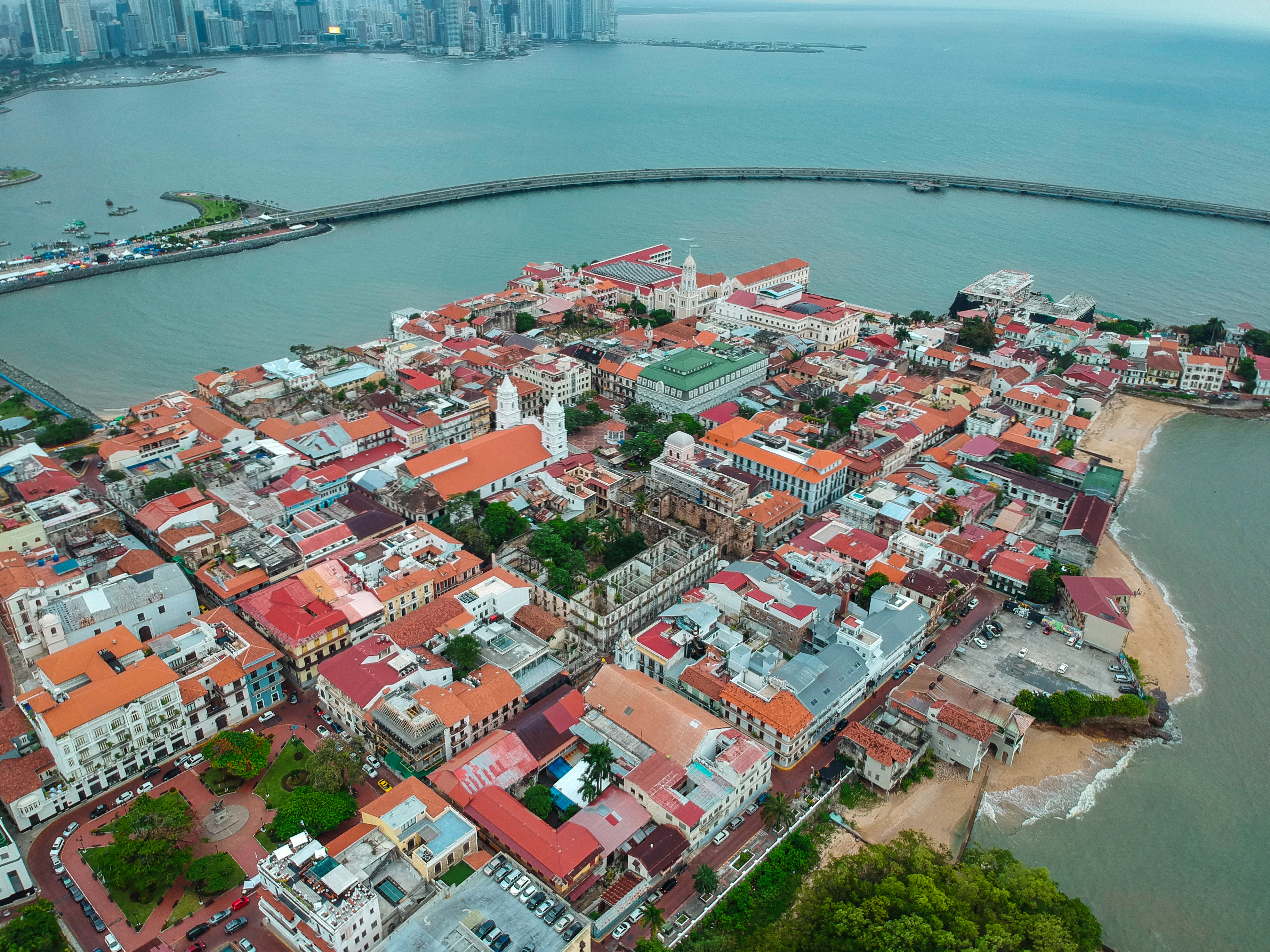
Casco Viejo, Panama
Most cities are built and then destroyed. Panama City was destroyed and then built -- in a different place. When the privateer Henry Morgan burned Panama Viejo to the ground in 1671, the Spanish did not rebuild on the ashes. They moved southwest to a rocky peninsula jutting into the Pacific and started over. By 1673, Casco Viejo -- the "Old Quarter," also called Casco Antiguo or San Felipe -- was complete, its streets laid out on a defensible point of land that no pirate fleet could approach as easily. Three and a half centuries later, the neighborhood Morgan inadvertently created is a UNESCO World Heritage Site, its colonial bones layered with neoclassical facades, Afro-Antillean wooden balconies, and the rooftop bars of a 21st-century tourist economy.
Built from the Wreckage
The founding of Casco Viejo was an act of pragmatic grief. The ruins of Panama Viejo, eight kilometers to the northeast, were still smoldering when Spanish authorities chose the new site. The rocky peninsula offered natural defensive advantages that the old location lacked: water on three sides, a narrow approach by land, and enough elevation to spot approaching threats. The new city rose quickly, with churches, convents, and government buildings establishing the institutions that would define Panamanian civic life for centuries. The Catedral Metropolitana became the city's principal Catholic church. The Palacio de las Garzas became the seat of presidential power -- a function it still serves. Churches dedicated to San Francisco de Asis, San Jose, La Merced, and Santo Domingo filled the streets with bell towers and stone facades, while the Jesuit convent marked the Society of Jesus's presence in the isthmus.
Fire, Decay, and Reinvention
If pirates created Casco Viejo, fire reshaped it. Three major conflagrations swept through the district during the 18th century, partially destroying its original colonial fabric and forcing successive rounds of rebuilding. The current streetscape dates largely from the late 19th and early 20th centuries, when neoclassical and Afro-Antillean architectural styles were inserted among the surviving colonial structures and ruins. This layering is what distinguishes Casco Viejo from other Latin American historic centers. Cities like Cartagena de Indias and Quito preserved relatively pure colonial cores. Casco Viejo is a palimpsest -- each era visible through the one that followed it. A colonial stone archway might adjoin a neoclassical municipal palace from 1900, which in turn sits next to a wooden Afro-Antillean house with louvered shutters and a wrap-around balcony. The effect is less curated than accumulated, a neighborhood that wears its history in strata.
Plazas and Monuments
The quarter's public spaces anchor its identity. Plaza de la Independencia marks where Panama declared independence from Colombia in 1903. Plaza Bolivar honors Simon Bolivar's 1826 Congress of Panama, held in the adjacent convent. Plaza Herrera, ringed by pastel-colored buildings, functions as the neighborhood's living room -- a place where children play and vendors sell food into the evening. Plaza de Francia, at the peninsula's tip, commemorates the French effort to build the Panama Canal and the thousands of workers who died in the attempt. The National Theatre of Panama and the Panama Canal Museum are both housed in repurposed historic buildings, continuing Casco Viejo's tradition of giving old structures new purposes. The Arco Chato, the flat arch of the Santo Domingo convent, stood for centuries as an informal proof that Panama was seismically stable enough for a canal -- an engineering argument made in stone rather than in a report.
The Gentrification Tightrope
Casco Viejo's UNESCO designation in 1997 set in motion forces that are still playing out. International attention brought restoration funding, but it also brought developers. Boutique hotels, upscale restaurants, and nightclubs have colonized buildings that were, until recently, crumbling tenements housing some of Panama City's poorest residents. The gentrification has been rapid and contentious. Long-term residents have been displaced as property values surged, replaced by tourists and expatriates drawn to the district's charm and walkability. The tension is visible in the streetscape itself: a lovingly restored facade might stand next to a building still in ruins, its windows empty, its future uncertain. Casco Viejo is caught between preservation and transformation, between honoring the community that kept the neighborhood alive through decades of neglect and catering to the visitors whose spending makes restoration economically viable. It is a familiar story in historic districts worldwide, but here the stakes feel particularly sharp -- this is the neighborhood that Panama built when everything else was lost.
From the Air
Located at 8.953N, 79.535W on a small peninsula jutting into the Bay of Panama. Casco Viejo is clearly identifiable from the air by its dense grid of colonial-era streets contrasting sharply with the modern high-rise skyline of Panama City immediately to the east. The peninsula shape is distinctive, with the seawall of Plaza de Francia visible at the southern tip. The red-tile roofs of historic buildings stand out against the surrounding water. Nearest airport is Marcos A. Gelabert International (MPMG/PAC) at Albrook, approximately 2 km west. Tocumen International (MPTO) is 18 km east. Best viewed from 1,500-3,000 feet on a coastal approach from the south, where the historic peninsula stands out against the modern city.