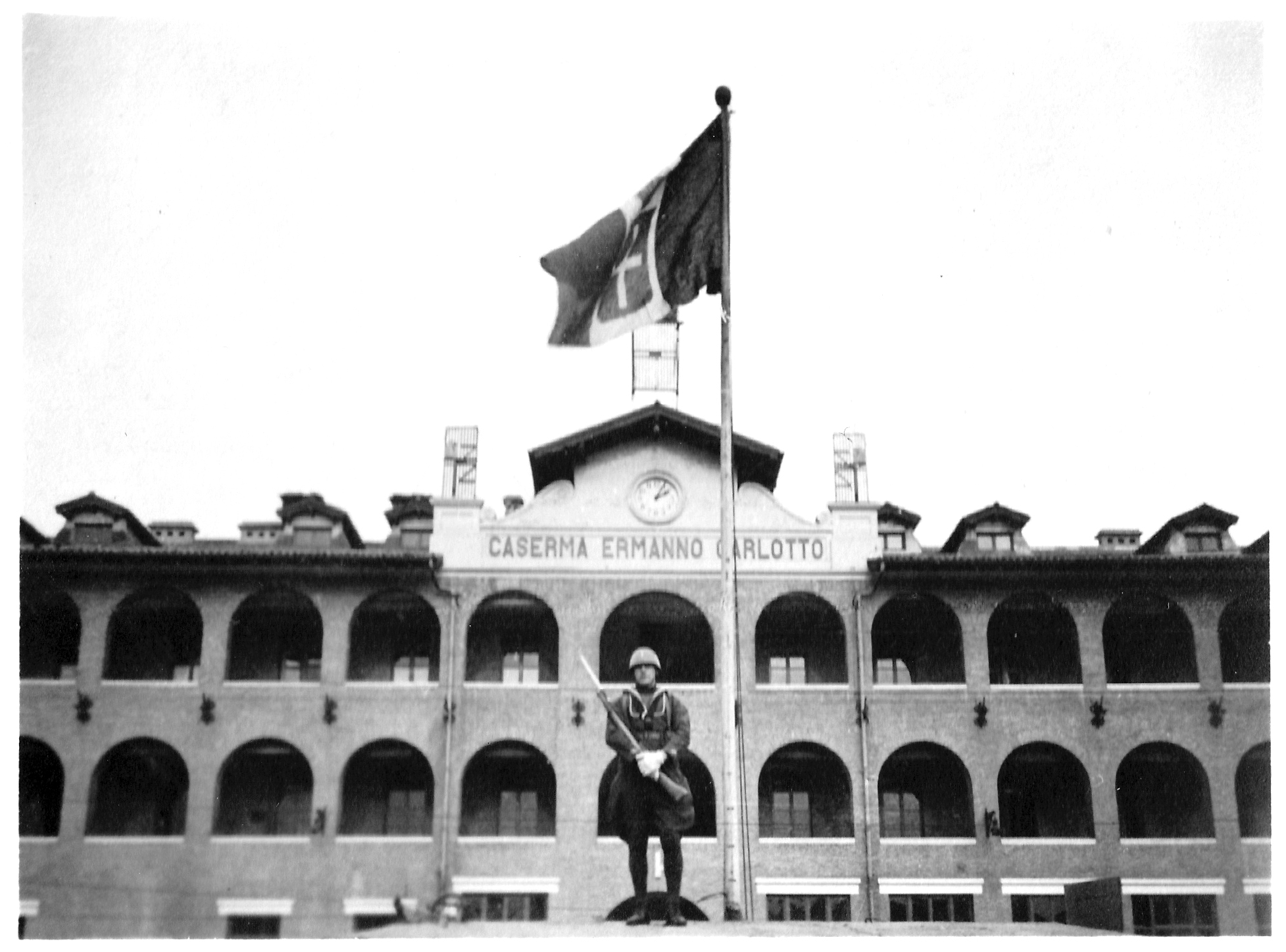
Caserma Ermanno Carlotto
In June 1900, a young Italian naval lieutenant named Ermanno Carlotto led 20 sailors in a last stand during the Boxer Rebellion, dying while defending the city of Tientsin. Italy awarded him the Gold Medal of Military Valor, its highest decoration for courage in battle, and when the Kingdom of Italy built its main military installation in the Italian Concession of Tianjin, they named it for him. The Caserma Ermanno Carlotto would go on to outlive the empire that built it, the concession that housed it, and every government that claimed authority over it. Today, more than a century after Carlotto's death, the barracks still stand -- occupied now by a division of China's People's Armed Police, a quiet continuity that bridges colonial history and modern sovereignty.
From Wooden Shelter to Marine Fortress
The barracks began as a simple wooden structure, a temporary shelter for the Italian Expeditionary Force in China during the aftermath of the Boxer Rebellion. In 1919, the facility was repurposed to house soldiers of the Legione Redenta returning from Siberia -- Italian prisoners of war who had fought their way across Russia during the chaos of the Russian Civil War. Through the 1920s, as Italy modernized its Tianjin concession with new infrastructure and buildings, the barracks were enlarged and upgraded. The expanded facility was inaugurated in April 1926 and eventually housed 600 men from the San Marco Regiment, Italy's elite naval infantry. The Italian representative in China, Vittorio Cerruti, formally opened the completed installation on April 18, 1928.
An Emperor Calls
On April 21, 1933, the barracks received an unlikely visitor: Puyi, the last emperor of China, deposed as a child and living in exile. His visit was unofficial -- Puyi was by then a political figure of ambiguous status, caught between Japanese manipulation and his own diminished aspirations. At the barracks, he met Edda Ciano, daughter of Benito Mussolini and wife of the Italian Foreign Minister. The encounter was a snapshot of the strange diplomatic theater that played out in Tianjin's concessions during the 1930s, where deposed emperors, fascist aristocrats, and colonial military officers crossed paths in spaces that belonged, legally speaking, to none of the nations that actually surrounded them.
The Last Stronghold
On September 9, 1943, the barracks' purpose came full circle. Following Italy's armistice with the Allies, Japanese forces moved to seize Italian concessions across China. In Tianjin, the Caserma Ermanno Carlotto became one of the last resistance strongholds, sheltering both Italian and Chinese civilians alongside soldiers under the command of Ferruccio Stefenelli. The stand was brief -- by September 10, the Empire of Japan had occupied the barracks. In 1944, Mussolini's Italian Social Republic, governing from German-occupied northern Italy, formally handed the concession and its military installations over to the Wang Jingwei regime, the Japanese-backed puppet government in China. The handover was more symbolic than practical; Japan already controlled everything.
Flags Change, Walls Remain
The postwar history of the barracks reads like a lesson in the impermanence of political authority. In 1947, the Italian Republic -- the democratic successor to the kingdom and the fascist state -- transferred the concession to the Republic of China. Two years later, in 1949, the barracks fell under the jurisdiction of the People's Republic of China. Through each transition, the physical structure persisted. The Chinese government eventually designated the barracks as a national priority protected site, recognizing its historical significance across multiple eras. That a building named for an Italian lieutenant killed in 1900 now serves China's People's Armed Police is a quiet irony of empire: the walls outlast the flags, and the people inside keep changing while the structure they inhabit does not.
From the Air
Located at 39.14°N, 117.20°E in the former Italian Concession area of Tianjin, along the Hai River. The barracks complex is within the urban fabric of central Tianjin, near the cluster of former foreign concession buildings. Tianjin Binhai International Airport (ZBTJ) is approximately 15 km east. Recommend viewing at 3,000-5,000 ft to see the relationship between the former Italian Concession and neighboring concession districts along the Hai River.