Castel Sant'Angelo
Every pope who fled for his life ran the same direction: down the Passetto di Borgo, the narrow fortified corridor connecting the Vatican to the massive cylindrical fortress on the Tiber's bank. Castel Sant'Angelo has been saving popes since the 14th century, but saving popes was never its original purpose. Emperor Hadrian built it as his eternal resting place, a towering mausoleum topped with a golden chariot, completed in 139 AD. Nearly two thousand years later, the ashes are gone, the chariot is gone, and a bronze archangel stands where the quadriga once gleamed. The building endures because it kept finding new reasons to exist.
An Emperor's Last Address
Hadrian began construction of his mausoleum between 134 and 139 AD, choosing the right bank of the Tiber and building the Pons Aelius to connect it to the city center. The original structure was a decorated cylinder topped with a garden and golden quadriga. After Hadrian's death at Baiae in 138, his ashes were placed inside alongside those of his wife Sabina and his adopted son Lucius Aelius. Succeeding emperors followed the tradition, the last being Caracalla in 217 AD. The urns were kept deep within the building, in what is now called the Treasury Room. But the tomb's grandeur made it a target. When Alaric's Visigoths sacked Rome in 410, they scattered the imperial ashes. When the Goths besieged the city in 537, the defenders hurled the mausoleum's own decorative statues down upon the attackers. Hadrian's monument to permanence was already being dismantled to serve the living.
The Angel on the Ramparts
The castle owes its name to a vision. In 590, with plague devastating Rome, Pope Gregory I led a procession through the city's streets. As the marchers crossed the Aelian Bridge, Gregory reportedly saw the Archangel Michael atop the mausoleum, sheathing a bloodied sword. The gesture signaled that God's wrath had ended, and the plague soon subsided. The vision gave the fortress both its name and its crowning image. Raffaello da Montelupo carved a marble angel for the summit in 1536, which the Flemish sculptor Peter Anton von Verschaffelt replaced with the current bronze version in 1753. Montelupo's original still stands in an interior courtyard, sword raised, watching over a building that has outlived its sculptor by centuries.
Refuge, Dungeon, and Stage
Pope Nicholas III connected the castle to St. Peter's Basilica via the Passetto di Borgo in the 13th century, creating the escape route that would save Pope Clement VII during the catastrophic Sack of Rome in 1527. While Charles V's mercenaries ravaged the city below, the pope sheltered inside these walls. The Papal State also used Sant'Angelo as a prison, and its inmates read like a roster of Renaissance notoriety. Giordano Bruno, the philosopher who proposed infinite worlds, spent six years in its cells before his execution. Benvenuto Cellini, the goldsmith charged with embezzlement, murder, and sodomy, described strolling the ramparts during his imprisonment and shooting at enemy soldiers. The charlatan Cagliostro languished here as well. Executions took place in a small inner courtyard. This grim history gave Giacomo Puccini the setting for the final act of his 1900 opera Tosca, in which the heroine leaps to her death from the castle's battlements rather than submit to the villainous Baron Scarpia.
When the Heavens Opened
Not everything at Castel Sant'Angelo was blood and imprisonment. The Dutch traveler Cornelis de Bruijn visited in 1676 and left a vivid account of the annual fireworks display on St. Peter's Day. He described the spectacle as appearing to ignite from above the castle simultaneously, spreading through the air in a way that made it feel "as though the heavens themselves are opening up." De Bruijn spent more than a year in Rome and watched the display from multiple vantage points, ultimately concluding that standing directly beneath the fireworks at the castle was the most delightful position. He also documented a peculiar custom: whenever a pope died, prisoners with heavy sentences were transferred to Sant'Angelo, and then all other prisoners in Rome were released. The castle that served as a last resort for popes also became a last resort for the condemned.
The Fortress That Became a Museum
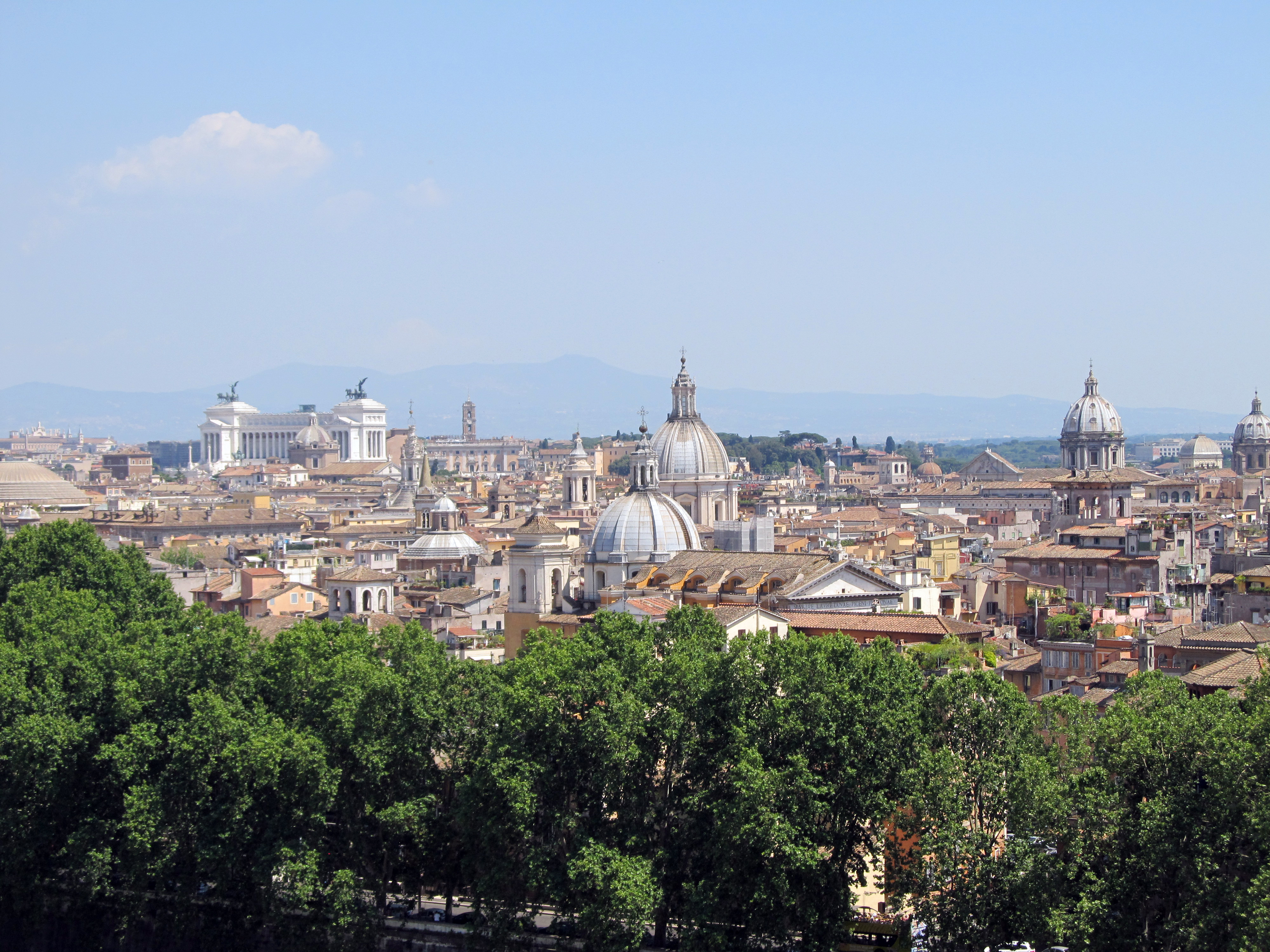
Today Castel Sant'Angelo is a museum, its layers of history stacked like geological strata. Visitors descend into Hadrian's burial chamber, climb through the papal apartments that Paul III built to ensure comfortable sieges, and emerge onto the terrace where Verschaffelt's bronze angel surveys modern Rome. The Ponte Sant'Angelo, Hadrian's original bridge, still provides the scenic approach from the city center, now adorned with Baroque statues of angels holding instruments of the Passion. From the castle's upper terrace, the dome of St. Peter's Basilica looms to the west, a reminder that the fortified corridor connecting the two buildings still runs beneath the rooftops. A building that began as one man's bid for eternity has outlasted every purpose its occupants imagined for it.
From the Air
Castel Sant'Angelo (41.903N, 12.466E) sits on the right bank of the Tiber in central Rome, directly visible as a large cylindrical structure northwest of the historic center. The Ponte Sant'Angelo bridge leads to it from the east. St. Peter's Basilica and Vatican City are 600 meters to the west. Rome Fiumicino Airport (LIRF) is 28km southwest; Ciampino (LIRA) is 16km southeast. Mediterranean climate with clear visibility most of the year.