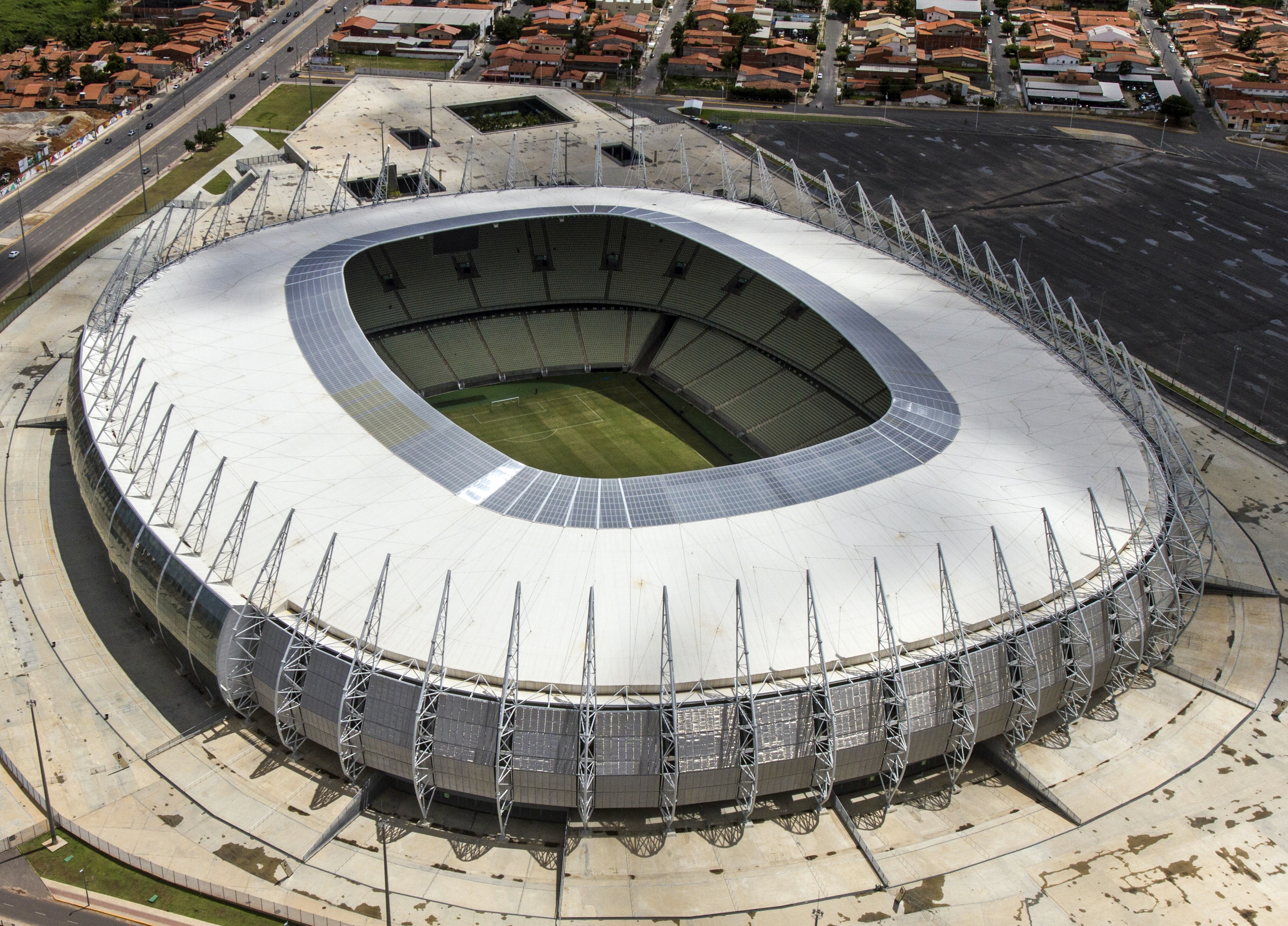
Castelão
On 9 July 1980, the Estádio Castelão in Fortaleza held 120,000 people - the largest crowd in its history - gathered to hear Pope John Paul II open the 10th National Eucharistic Congress. The stadium, officially named Estádio Governador Plácido Castelo but known to everyone simply as the Castelão, or the Big Castle, had been open for fewer than seven years. It was not built for a pope. It was built for football. But the Castelão has always served double duty - sacred and secular, religious and sporting, massive and local - and it has survived two major renovations and one complete reconstruction to emerge as the stadium Fortaleza still calls its own.
Four Years to Build, Fifty to Keep
Construction began in 1969 and the stadium was inaugurated on 11 November 1973, in the Boa Vista district of Fortaleza - giving rise to the alternative nickname Gigante da Boa Vista, the Giant of Boa Vista. Its original capacity, generous by the standards of the time, reflected the ambition of northeastern Brazil to field stadiums that could host major national fixtures. Over the decades it was renovated repeatedly: in 1980 under governor Virgílio Távora, during the Eucharistic Congress; then in a three-stage rehabilitation that began on 16 May 2001 to repair the bleachers, strengthen the physical structure, and rebuild the electrical, hydraulic, and sanitary installations. The re-inaugural match on 23 March 2002 saw Brazil beat Yugoslavia 1-0.
The World Cup Overhaul
On 31 March 2011, the Castelão closed its doors for the most ambitious work in its history. Brazil had been awarded the 2014 FIFA World Cup, and Fortaleza was one of 12 host cities. The old stadium was largely gutted. Seats were replaced, roofing extended, facilities modernized, accessibility upgraded, and the pitch itself redone to FIFA specifications. When the work was officially completed in December 2012, the Castelão became the first of the 12 host stadiums to finish - a point of local pride that the state government and the Ceará football community have not stopped mentioning. Six matches of the 2014 World Cup were played here, including quarterfinal and round-of-16 ties. The modern capacity sits at 63,903, though the count reported across different sources varies slightly depending on how standing-room and media areas are counted.
Two Clubs, One Castle
The Castelão is the permanent home of Fortaleza's two great football rivals - Ceará Sporting Club and Fortaleza Esporte Clube, known locally simply as Ceará and Fortaleza. The Clássico-Rei, the King's Derby between the two, is one of the fiercest rivalries in Brazilian football, and when it is held at the Castelão the stadium divides into two tribes that can barely stand to look at each other. Both clubs were founded in the early twentieth century, both have moved in and out of the top-flight Brasileirão over the years, and both treat the Castelão as their sacred ground. When the big derby is on, the stadium fills; the crowd's voice carries across the city.
Beyond Football
The Big Castle has hosted events football could not fill. On 13 August 1995, 50,000 people attended the farewell mass of Fortaleza's archbishop Dom Aloísio Lorscheider. On 9 December 2007, the stadium hosted the MotoCross Freestyle World Championship, with organizers trucking in more than 700 tons of sand and installing metal ramps nearly six meters long and 2.7 meters high. Concert promoters have used the Castelão repeatedly - Roberto Carlos, Caetano Veloso and Maria Bethânia, Iron Maiden, Ivete Sangalo, and the evangelical festivals led by Franklin Graham have all played here. The stadium's size and location make it the natural venue in northeastern Brazil for anything that needs to fit tens of thousands of people under a single roof. The 1980 papal mass, drawing 120,000, remains the attendance record.
The Name and the Geography
The stadium was named for Plácido Aderaldo Castelo, who served as Ceará's governor from 1967 to 1971, during the period when the project was conceived and construction began. The name happens to be a coincidence of fortune: castelo means castle in Portuguese, and the augmentative form Castelão means something like "big castle" - a happy fit for a building that holds tens of thousands and stands, from the air, like a fortress of concrete and steel above the eastern fringe of Fortaleza. On match days the entire neighborhood reshapes itself around it: buses pulling in, street vendors setting up grills, the black-and-white of Ceará and the red-and-blue of Fortaleza scattered across the approaches, and the crowd noise rising steadily until kickoff turns it into a wall of sound.
From the Air
The Castelão is located at 3.81°S, 38.52°W in the Boa Vista district of Fortaleza, approximately 9 km south of Pinto Martins International Airport (SBFZ) - the nearest and primary airport. The stadium's distinctive circular roof and adjacent complex are clearly visible from low-altitude approaches to the city. On event days, the surrounding traffic and floodlight halo make it visible even at night. Cearán weather runs hot and humid year-round with a distinct wet season from February through May.