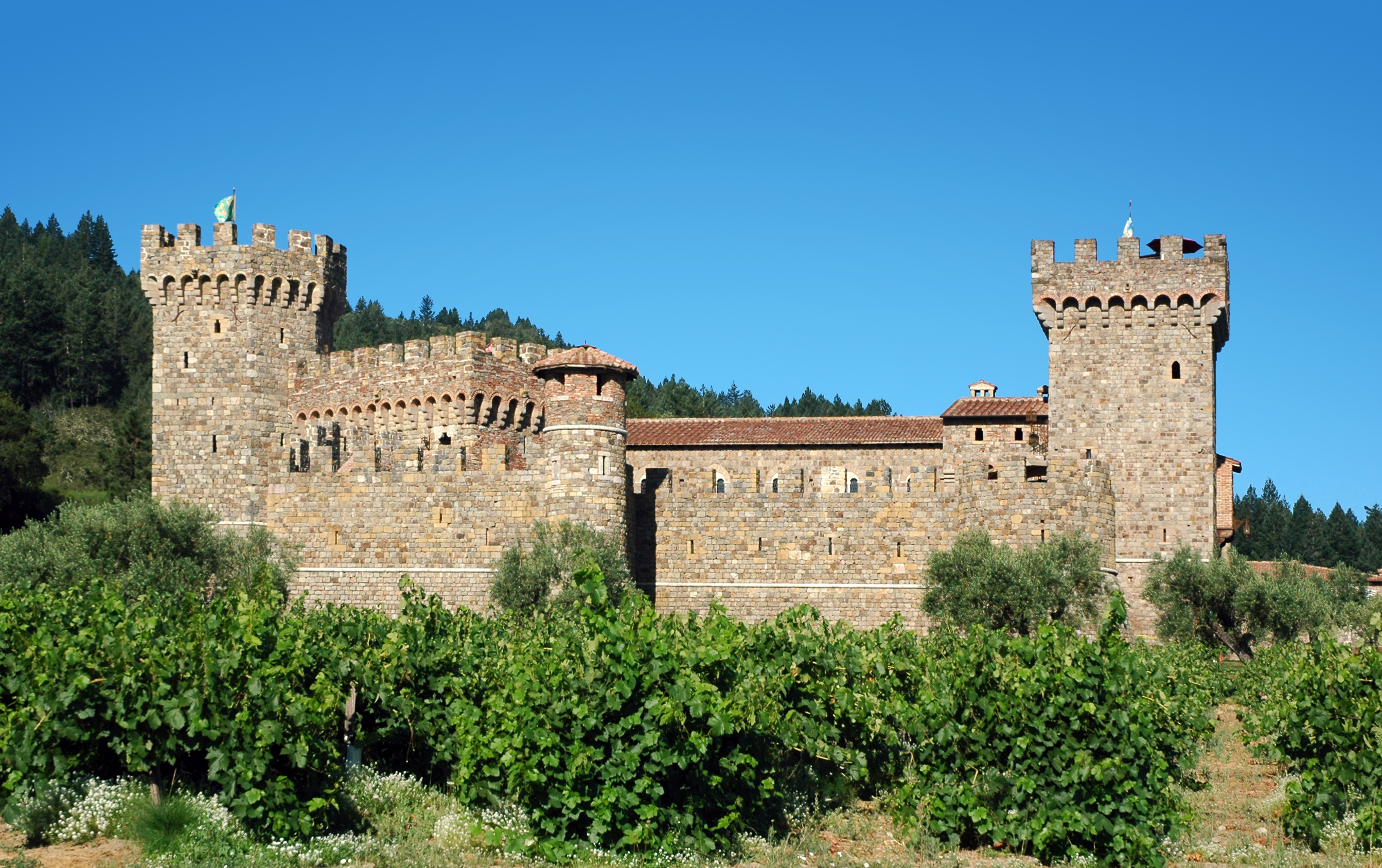
A $40 Million Medieval Fantasy in Wine Country
There is a castle in the Napa Valley with a moat, a drawbridge, defensive towers, and a torture chamber containing an iron maiden said to date from the late Renaissance. It is not a movie set or a theme park. It is a functioning winery, and the man who built it did so because he graduated from business school in 1969, traveled through Europe for two years, and could not stop sketching medieval buildings in his notebook. Dario Sattui's Castello di Amorosa -- the Castle of Love -- opened to the public in April 2007 after 15 years of construction and a $40 million investment that his accountants presumably questioned more than once.
The Vintner's Obsession
Dario Sattui is a fourth-generation California winemaker. His great-grandfather Vittorio Sattui emigrated from Italy and established a winery in San Francisco in 1885 -- a business that Prohibition eventually killed. Dario revived the family name in the 1970s with V. Sattui Winery in St. Helena, building it into a Napa Valley institution. But the castle was always the real project. After earning his MBA from the University of California, Berkeley, Sattui spent two years wandering through European castles, monasteries, palaces, and farmhouses, photographing and sketching medieval architecture with the intensity of someone who already knew he would build one himself. In 1993, he purchased the property -- land that had once been part of Dr. Edward Turner Bale's Rancho Carne Humana estate -- for $3.2 million. Construction began in 1995 and would not end for more than a decade.
850,000 Bricks from the Old World
What Sattui built was not a castle-shaped building. It was a castle built as castles were built. The masonry, ironwork, and woodwork were all fashioned by hand using traditional techniques. Eight thousand tons of locally quarried stone formed the walls. Paving stones, terra cotta roofing tiles, and 850,000 bricks were imported from Europe. The structure spans 107 rooms across eight levels above and below ground, totaling approximately 141,000 square feet after expansions. Its great hall rises 22 feet to a coffered ceiling beneath frescoes painted by two Italian artists who spent a year and a half on the work. A 500-year-old fireplace anchors the room. Extending into the hillside behind the castle is a labyrinth of caves stretching 900 feet, and beneath the castle itself lies a two-acre barrel cellar. The attention to authenticity borders on the compulsive -- which, for a building that exists primarily to age Cabernet Sauvignon, is exactly the point.
The Room Visitors Remember
Every winery offers tasting rooms. Not many offer a torture chamber. Sattui's includes an iron maiden he says he purchased for $13,000 in Pienza, Italy, along with a replica rack and other devices that tend to redirect conversations away from tannin structure and toward the darker chapters of European history. The knights' chamber, the chapel, the courtyard -- these all contribute to the castle's atmosphere. But it is the torture chamber that generates the stories people tell at dinner afterward. Napa County, for its part, has kept a watchful eye on the castle's uses. The grounds cannot be rented for weddings or receptions, though corporate gatherings are permitted. In 2012, the county ordered Sattui to stop holding a weekly Catholic Mass in the chapel due to a lack of use permits -- a reminder that even in a castle, California's zoning code is sovereign.
Fire and Survival
On September 27, 2020, the Glass Fire swept through the northern Napa Valley. Castello di Amorosa's farmhouse suffered major damage, and the entire 2020 vintage of Fantasia -- one of the winery's wines -- was destroyed. But the castle itself, built from thousands of tons of stone and brick in the manner of structures designed to withstand siege warfare, emerged unscathed. The Mercury News reported losses of $5 million in wine, while the $30 million castle stood untouched. It was an unintended validation of Sattui's commitment to medieval construction methods: the same mass and material that would have resisted catapults proved effective against wildfire. The wines at Castello di Amorosa are sold only at the castle or through the winery's wine club -- no retail distribution, no supermarket shelves. Visitors descend into the barrel cellar to taste in rooms lit by wrought-iron fixtures, surrounded by the quiet of caves carved from the hillside. It is, by any measure, an excessive place. That is what makes it work.
From the Air
Located at 38.56N, 122.54W near Calistoga in the upper Napa Valley. The castle's stone towers, courtyard, and medieval profile are distinctive from the air, set among vineyards on the western hillside. Nearest airports: Napa County Airport (KAPC) approximately 16 nm south, and Angwin-Parrett Field (2O3) to the east. The castle sits in the narrowing portion of the valley where the Mayacamas Range closes in from the west. Mount St. Helena is visible to the north. Morning fog common in the valley floor below, with the castle's elevated position often clear.