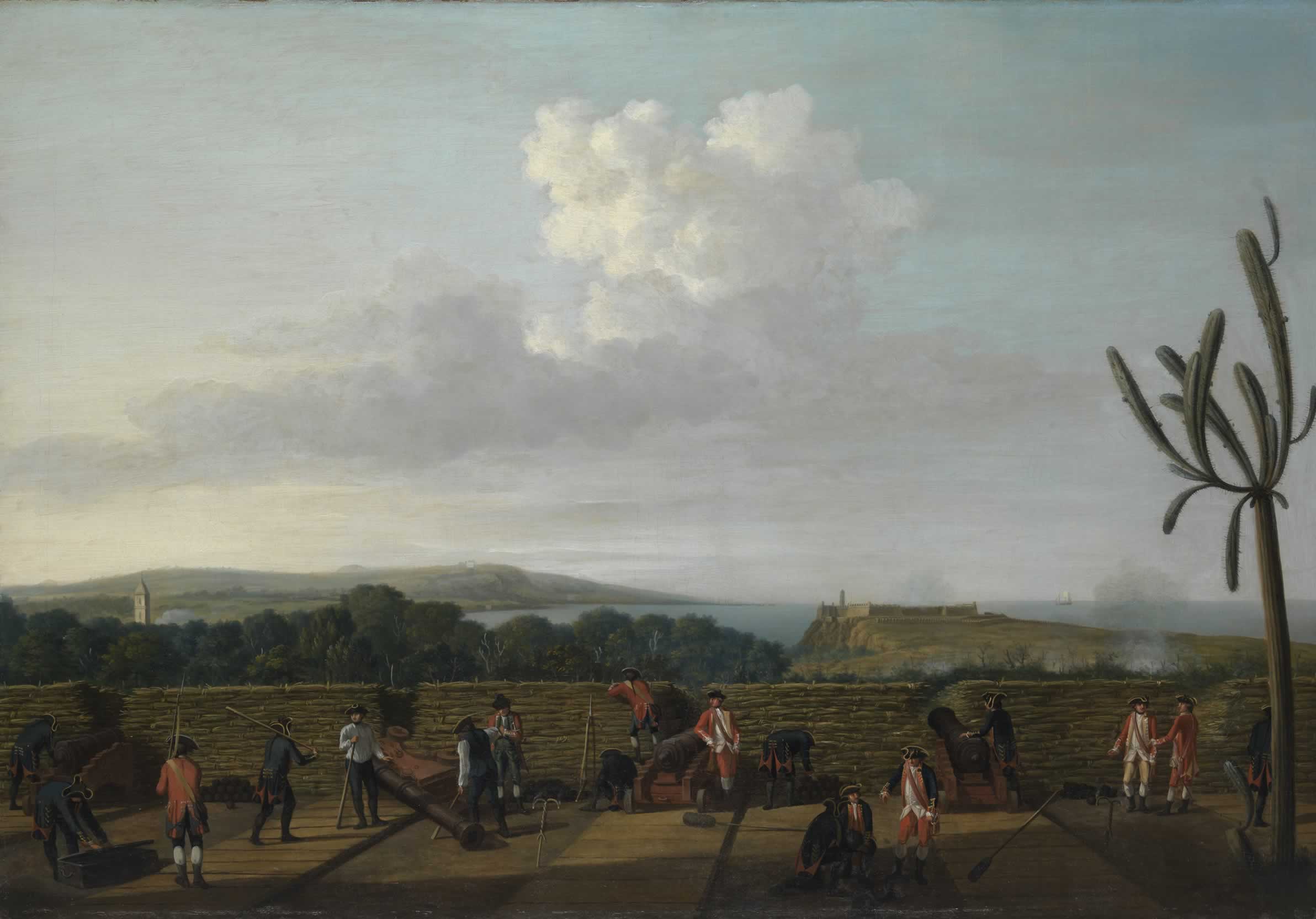
Castillo de los Tres Reyes del Morro
Every night at nine o'clock, a cannon fires from the rocky promontory at the mouth of Havana harbor. The blast echoes across the water toward the lights of Old Havana, a ritual that has continued since colonial times, when the shot signaled the closing of the city gates. The fortress behind that cannon -- the Castillo de los Tres Reyes del Morro, known simply as El Morro -- has stood on this headland since 1589, designed by Italian military engineer Battista Antonelli to guard the narrow channel where treasure-laden Spanish galleons entered the richest port in the Caribbean. In Spanish, morro means a rock visible from the sea that serves as a navigational landmark, and for more than four centuries, this castle on its cliff has been exactly that: the first and last thing sailors see when entering or leaving Havana.
Pirates, Privateers, and a Chain Across the Water
Colonial Cuba was a magnet for trouble. Buccaneers, pirates, and French corsairs all circled Havana, drawn by the wealth flowing through Spain's New World trade routes. Francis Drake sailed close enough to see the harbor in the 16th century but never attacked. In 1628, a Dutch fleet under Piet Heyn was bolder, plundering Spanish ships right in Havana's port. The defenses grew in response. El Morro was paired with the fort at La Punta on the opposite shore, and a heavy chain -- a boom defence -- was strung across the harbor mouth between them, blocking any uninvited vessel. Together with the fortress of La Real Fuerza deeper inside the harbor, these fortifications turned Havana into one of the most heavily defended cities in the Americas. The system held for nearly two centuries.
The Siege That Changed an Empire
The chain finally broke in 1762. Britain, at war with Spain during the Seven Years' War, sent a massive naval force to seize Havana. The fleet approached from an unexpected direction, trapping the Spanish navy inside the harbor. The Spanish commander, Luis Vicente de Velasco, mounted a fierce defense of El Morro. British batteries on the overlooking La Cabaña hill -- a position the Spanish governor had fatally neglected to fortify -- pounded the castle with up to 600 direct hits per day. Velasco lost as many as 30 men daily and had to rotate exhausted defenders in from the city every three days. He refused all offers to surrender, declaring the issue would be settled by force of arms. On July 30, after weeks of mining, the British detonated explosives beneath the right bastion. In the assault that followed, 699 picked men stormed the breach. Velasco, mortally wounded, was carried back to Havana, where he died the next day. His defiant stand earned his family a noble title: his son became the Marqués de Velasco del Morro.
The Price of Victory
When Havana finally surrendered on August 14, 1762, the British captured a staggering prize: over 1.8 million Spanish pesos, nine ships of the line representing a fifth of the Spanish Navy, nearly 100 merchant vessels, and control of the most important harbor in the Spanish West Indies. But the cost was brutal. Disease killed far more soldiers than combat -- by October, 4,708 British troops had died of malaria and yellow fever, compared to 2,764 killed, wounded, or captured in fighting. The occupation lasted barely six months. Under the 1763 Treaty of Paris, Spain recovered Havana in exchange for ceding Florida and Menorca to Britain. The humiliation catalyzed sweeping military reforms across the Spanish Empire, and the fortress at La Cabaña was immediately built on the hill whose neglect had proved so catastrophic.
Walls That Witnessed Centuries
Today El Morro's cannons are rusted to a deep orange-brown, but the thick stone walls remain remarkably intact. The fort rises four stories in places, its central barracks still standing after more than 400 years. Visitors can peer through the old latrines and their chute dropping straight into the sea, examine the drawbridge mechanism, and stand at a small turret where the wall drops 20 meters to rocks battered by Atlantic waves. A plaque from the British ambassador commemorates the 1762 siege. Across the dry moat, the Batería de Velasco -- named for the fortress's most famous defender -- holds more modern guns and offers sweeping views toward the fishing village of Cojímar. The harbor master's office still operates from within the fortress walls. A small underwater archaeology exhibition traces the wrecks that litter the harbor floor.
The Castle in the Canvas
El Morro has been captured in paint and film as often as it was attacked by armies. In 1778, American painter John Singleton Copley placed the fortress in the background of Watson and the Shark, one of the most famous paintings in American art. Bob Hope sailed past it in The Ghost Breakers in 1940. Errol Flynn filmed climactic scenes at the castle for The Big Boodle in 1957, in the final years before the revolution. Under Castro's government, the fortress served a darker purpose: the Cuban poet and novelist Reinaldo Arenas was imprisoned within its walls for criticizing the regime, an experience later depicted in the 2000 film Before Night Falls starring Javier Bardem. The fortress even inspired Cuba's first historical novel -- Antonelli, published in 1839 by José Antonio Echeverría, a story of love and betrayal set among these very stones.
From the Air
Located at 23.15°N, 82.36°W at the entrance to Havana harbor, on the eastern promontory opposite Old Havana. The fortress is unmistakable from the air -- a stone star-shaped fortification on a rocky headland with the Faro Castillo del Morro lighthouse (added 1846) rising above it. Best viewed at 2,000-4,000 feet AGL approaching from the north over the Straits of Florida. José Martí International Airport (MUHA) is approximately 10 nm to the southwest. The harbor entrance channel, La Cabaña fortress, and Old Havana's colonial skyline are all visible in a single pass.