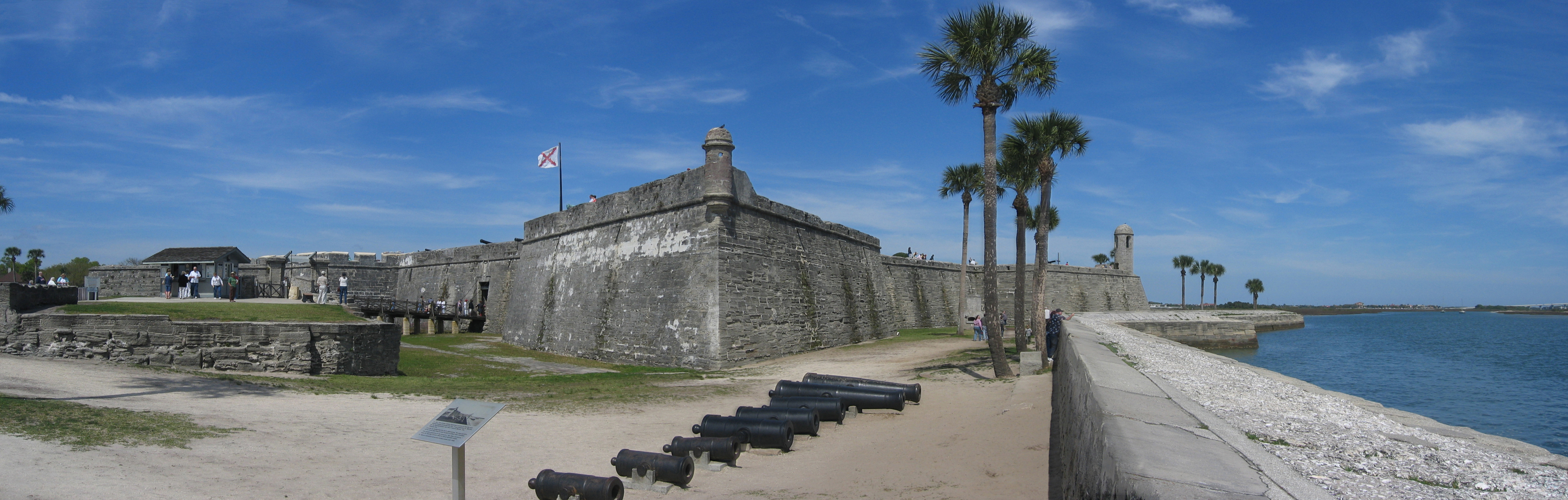
Castillo de San Marcos
Cannonballs do not shatter coquina. They sink into it. This simple fact of geology -- that compressed ancient seashells absorb impact rather than fracture -- is the reason the Castillo de San Marcos still stands on the shore of Matanzas Bay in St. Augustine, Florida. When English forces laid siege in 1702 and again in 1740, their artillery pounded the walls for weeks. The balls buried themselves in the soft shellstone like fists punching into wet sand. The walls held. In over 300 years, the oldest masonry fort in the continental United States has never been taken by force.
Nine Wooden Forts and One That Lasted
St. Augustine was founded in 1565 by the Spanish admiral Pedro Menendez de Aviles on the site of a Native American village called Seloy. Sir Francis Drake attacked with 22 ships in 1586, and over the next 80 years the Spanish built nine successive wooden forts, each destroyed by storms, fire, or enemies. The turning point came in 1668, when the English pirate Robert Searle burned St. Augustine to the ground. Queen Regent Mariana of Spain authorized a masonry fortification. Construction began in 1672, using coquina quarried from Anastasia Island across Matanzas Bay and ferried to the building site. Native Americans from Spanish missions performed most of the labor, with skilled workers brought from Havana. Twenty-three years later, in 1695, the star-shaped fort was complete. Its four bastions -- San Pedro, San Agustin, San Carlos, and San Pablo -- commanded the approaches with overlapping fields of fire.
Sieges That Made the Stone Famous
In November 1702, English colonial Governor James Moore marched south from Carolina with enough men to take the city. Fifteen hundred residents and soldiers crammed inside the Castillo for a two-month siege. The English cannon hammered the walls, but the coquina simply absorbed the blows -- cannonballs sinking into the stone rather than breaking through. The siege broke when Spanish warships arrived from Havana, and the English burned their own ships to keep them from being captured. In 1740, General James Oglethorpe of Georgia tried again, bombarding the fort for 27 days before attempting a blockade. Three hundred soldiers and 1,300 civilians sheltered inside the walls. Oglethorpe's cannon were no more effective than Moore's had been. When supplies ran low and morale collapsed, the British retreated. The coquina had won twice.
Five Flags, No Battles
Though never breached, the Castillo changed hands five times -- every transfer peaceful. Spain held it from 1695 to 1763, when the Treaty of Paris gave Florida to Britain in exchange for Havana and Manila. The British renamed it Fort St. Mark and used it as a prison during the American Revolution, holding founding fathers Thomas Heyward Jr., Arthur Middleton, and Edward Rutledge within its casemates. Spain recovered Florida in 1783 and restored the fort's original name. In 1821, under the Adams-Onis Treaty, Florida passed to the United States, and the fort became Fort Marion. During the Civil War, a lone Union caretaker refused to surrender it to Confederate militiamen unless given a receipt. He got one, and the fort changed hands without a shot. Union forces retook it in 1862, again without firing.
The Prison Years
Under American control, the Castillo became a military prison. In 1837, Seminole chief Osceola was captured under a flag of truce and imprisoned inside its walls before being transferred to Fort Moultrie, where he died. That November, the warrior Coacoochee and nineteen other Seminole prisoners escaped through a narrow embrasure high in their cell wall, sliding down a makeshift rope into the dry moat and vanishing into the night. Beginning in 1875, Native American prisoners from the western Indian Wars were held at the fort. Among them, Plains peoples created hundreds of drawings in the art form now known as Ledger Art, works held today by the Smithsonian Institution. From 1886 to 1887, approximately 491 Apaches were imprisoned here, including members of Geronimo's band. At least 24 Apache died as prisoners.
From Fortress to Freedom Tree
The fort was deactivated in 1933 after 251 years of continuous military use and transferred to the National Park Service. Congress restored its Spanish name in 1942. But the Castillo had one more chapter to play in American history. In 1964, the "Freedom Tree" on the fort green became a gathering place for civil rights demonstrators who were unwelcome on the segregated private property across the street. Protests led by Robert Hayling, Hosea Williams, and Martin Luther King Jr. in St. Augustine helped bring about passage of the Civil Rights Act of 1964. The fort that had imprisoned Seminole and Apache now sheltered a movement for equality beneath its walls.
From the Air
The Castillo de San Marcos is immediately recognizable from the air as a star-shaped masonry fort on the western shore of Matanzas Bay in downtown St. Augustine, at approximately 29.898N, 81.311W. The distinctive diamond-shaped bastions, surrounding moat, and green glacis stand out against the urban grid. The Matanzas River runs along the east side, with the Bridge of Lions visible to the south. The St. Augustine Inlet is to the northeast. Nearest airports: St. Augustine Airport (KSGJ) approximately 4nm northwest, Jacksonville International (KJAX) 35nm north. The fort is best viewed at low to moderate altitude; the star shape becomes clearly defined above 1,500 feet AGL.