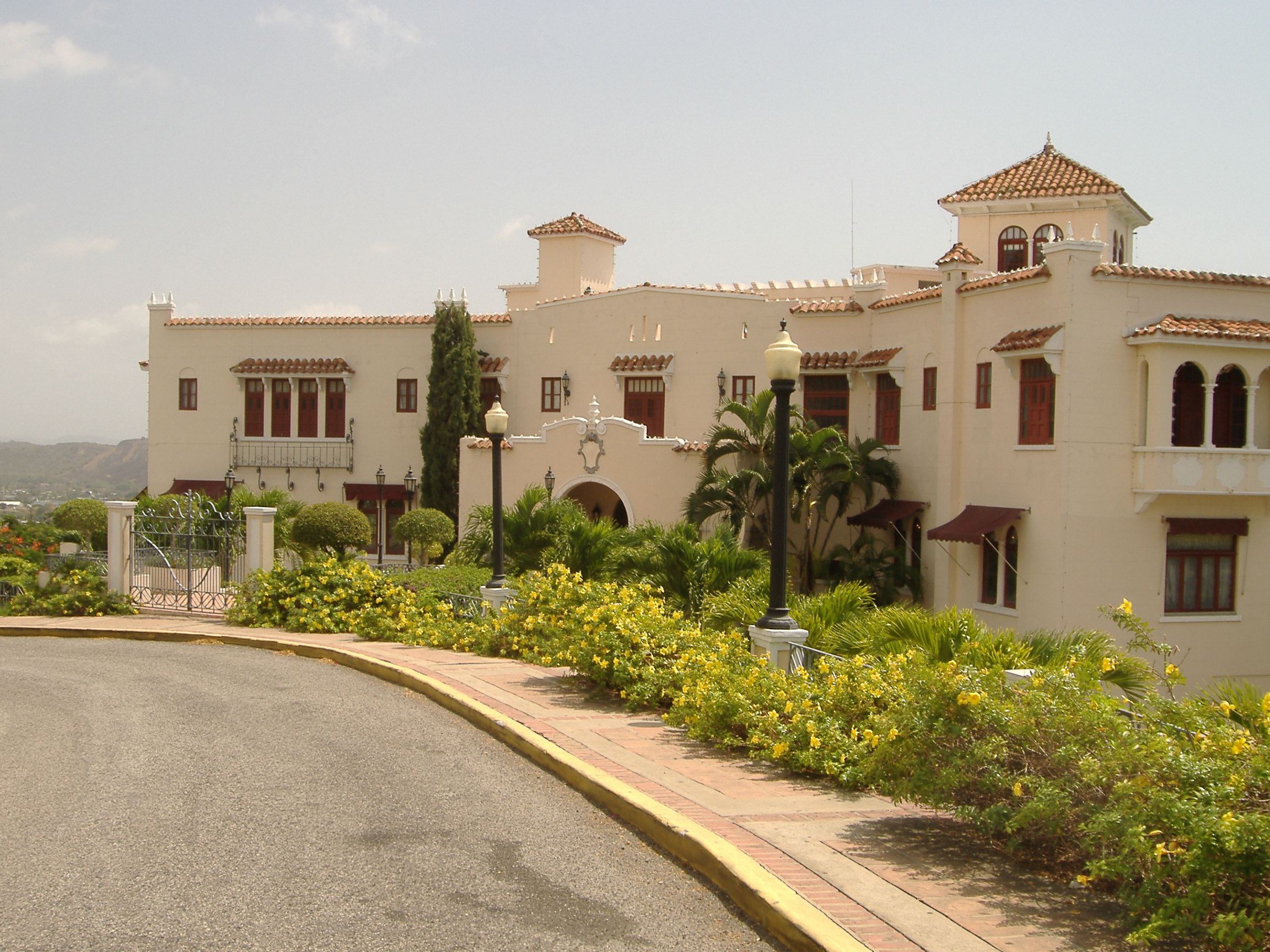
Castillo Serralles
The house that rum built overlooks everything. Perched on a hillside above downtown Ponce, Castillo Serralles commands views of the city, the Caribbean coast, and the sugarcane fields that once made the Serralles family one of Puerto Rico's wealthiest dynasties. Juan Eugenio Serralles commissioned the mansion in the 1930s - the son of Juan Serralles, who founded Destileria Serralles and built the Don Q rum brand into a household name across the island. The castle, as Poncenos call it, is Spanish Colonial Revival architecture at its most ambitious: four floors of terraces, courtyards, fountains, and a rooftop panorama that reminds visitors exactly how much of southern Puerto Rico the sugar economy once controlled. In 1996, the A&E television series America's Castles featured it alongside the great estates of the mainland United States. The comparison was apt. This was not merely a home but a statement of empire - the sugar kind.
Sugar Kings of the South
The Serralles family story is inseparable from the story of sugar in Puerto Rico. Juan Serralles founded the distillery that would become Destileria Serralles, producers of Don Q rum, which grew into one of the island's most recognized brands. The family's wealth came from the same source that enriched and complicated Puerto Rico's entire southern coast: sugarcane cultivation and the rum distilled from it. By the time Juan Eugenio Serralles built the hilltop mansion, the family occupied a position in Ponce's social hierarchy that was less aristocratic than feudal - landowners whose economic influence extended into every aspect of the region's life. The castle was built during the 1930s, a decade when the sugar industry was already beginning its long decline but the old families still possessed the capital and confidence to build monuments to themselves. Today the mansion functions as the Museo Castillo Serralles, where exhibits trace the history of sugar and rum production and their impact on Puerto Rico's economy.
A Bargain at Any Price
When the Serralles heirs decided to sell, the city of Ponce acquired the property for $400,000 - a remarkable figure given that appraisals valued the estate between $17 million and $25 million. The sale included much of the original furniture. The city's initial plan was to create a museum of Puerto Rican music, but the building's identity proved stronger than any imposed concept, and it became instead a museum dedicated to the sugar and rum industries that the Serralles family represented. The 2.5-acre property, meticulously manicured, includes two expansive terraces, an exterior fountain, and a symmetrical garden that reinforces the estate's sense of deliberate order. The purchase preserved not just a building but a physical record of how Puerto Rico's planter class lived during the sugar era - an era whose economic structures shaped communities, landscapes, and social hierarchies across the island for generations.
Four Floors of Ambition
The mansion's layout reveals its dual purpose as both private residence and stage for social performance. The ground floor housed the garage and service quarters - the working infrastructure hidden below the entertaining spaces. The second floor was designed for public life: a library, a central patio open to the sky, a solarium flooded with tropical light, and the formal living and dining rooms where the Serralles family received guests. Access from the street required ascending one of two semi-circular stairways to double French doors that opened into a vestibule with ceramic tile floors and a view straight through to the interior courtyard fountain. The living room, positioned to the left, was the only room with parquet flooring rather than tile - a subtle marker of its primacy. The third floor contained the private sleeping quarters, removed from the social spaces below. Above everything, the fourth-floor terrace offered both covered and open-air areas for relaxation, with panoramic views of Ponce stretching from the mountains to the sea.
The View From the Terrace
Stand on the castle's rooftop terrace and you understand the geography of power in southern Puerto Rico. Below lies Ponce Pueblo, the historic downtown with its cathedral, plazas, and colonial architecture. Beyond that, the coastal plain where sugarcane once grew in fields so vast they seemed to merge with the Caribbean. The mountains rise behind, green and steep, channeling rainfall toward the valleys where cane thrived. The Serralles family chose this hilltop deliberately - not just for the breeze, which relieves the coastal heat, but for the vantage point. From here, a sugar baron could survey his domain. The castle was listed on the National Register of Historic Places in 1980 and the Puerto Rico Register of Historic Sites and Zones in 2001. Today it hosts destination weddings and cultural events alongside its museum function, the terraces that once framed a family's private view of their empire now open to anyone willing to climb the hill.
From the Air
Located at 18.02°N, 66.62°W on a prominent hillside above downtown Ponce, the Castillo Serralles is one of the most visible landmarks from the air in southern Puerto Rico. The Spanish Colonial Revival mansion sits on a 2.5-acre manicured estate above the Ponce Historic Zone. Look for the distinctive white structure elevated above the surrounding neighborhood on the hillside south of the central mountain range. Nearest airport is Mercedita Airport (TJPS/PSE), approximately 6 km south. The hilltop location provides a natural visual reference point when approaching Ponce from any direction. The city's layout - colonial grid downtown, sugarcane plains stretching to the coast, mountains rising to the north - is clearly visible from the castle's elevation. Best viewed on approach from the south or west.