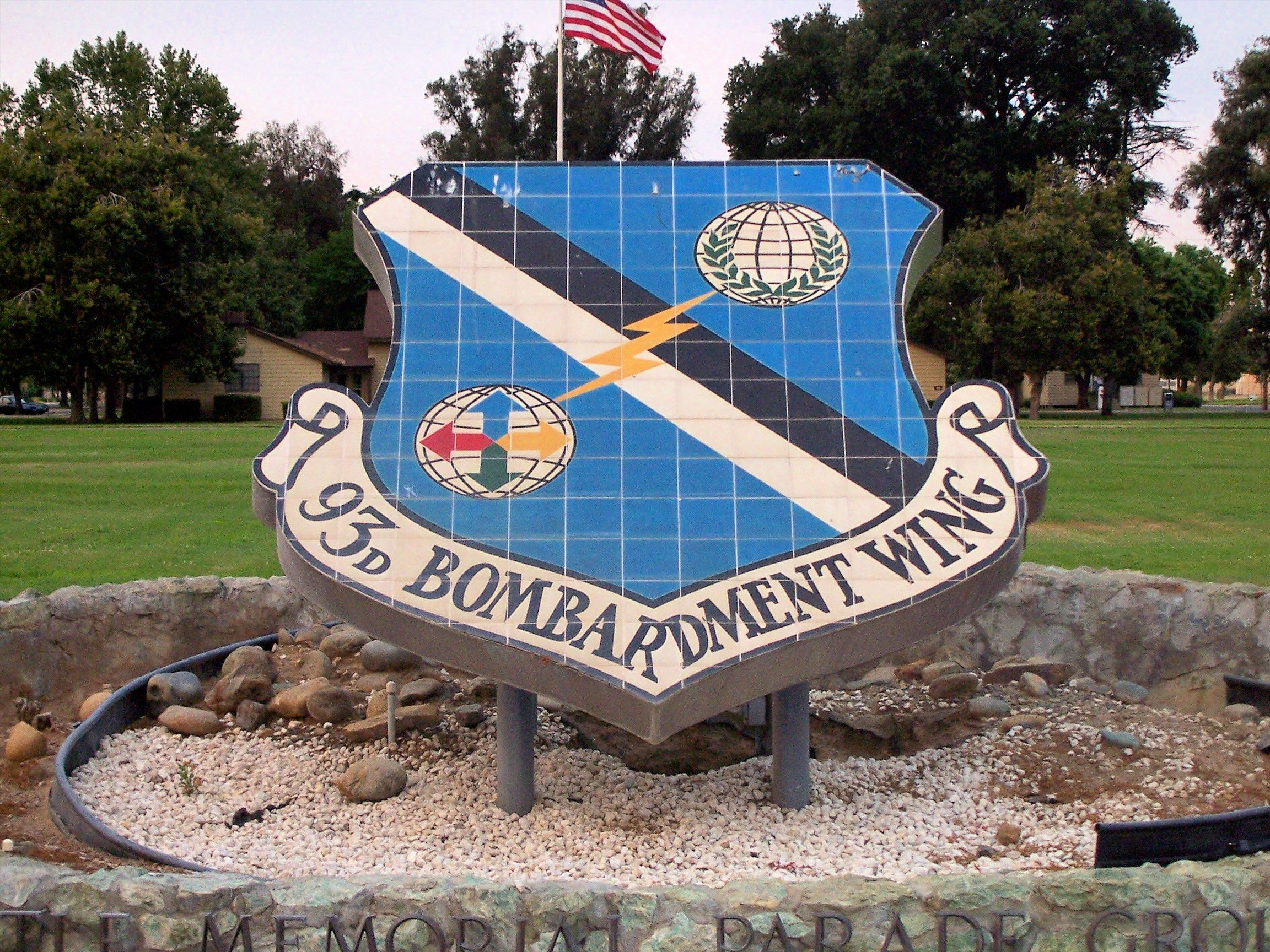
Castle Air Force Base: Christmas Eve, and the Fifty Years After
On Christmas Eve 1944, Brigadier General Frederick Castle was leading nearly 2,000 bombers over Europe when his B-17 Flying Fortress lost two engines to German fighters. The aircraft fell out of formation, burning. Castle ordered his crew to bail out and stayed at the controls to give them time. Five of nine crewmen survived. Castle did not. The airplane exploded in midair, and Castle was posthumously awarded the Medal of Honor. Fourteen months later, when the Army renamed a dusty training field in California's Central Valley, they chose his name. It was the kind of gesture the military makes routinely, but Castle Air Force Base would spend the next half-century earning the weight of it.
Pilots by the Thousands
The airfield opened on September 20, 1941 - three months before Pearl Harbor - as the Army Air Force Basic Flying School at Merced. It was one of dozens of fields feeding the 30,000 Pilot Training Program, a crash effort to produce aviators faster than any nation had ever attempted. Beginning pilots and crewmen cycled through Merced's classrooms and runways. Women Airforce Service Pilots - WASPs - trained here alongside men. Seven auxiliary fields spread across the surrounding farmland handled the overflow. The base churned out pilots through the entire war, though not without cost. Bobby "Weezer" Hutchins, a child actor who had appeared in Our Gang shorts, was killed in a mid-air collision during flight training at Merced on May 17, 1945, just days before the war in Europe ended. By the time the base was renamed Castle Field in January 1946, it had served its wartime purpose. But the peacetime mission that followed would prove larger and longer than anything the war years demanded.
The Backbone of Strategic Air Command
The 93rd Bombardment Group arrived at Merced on June 21, 1946, beginning a relationship with the base that would last nearly fifty years. The 93rd was a storied unit - a former Eighth Air Force B-24 Liberator group reassigned to B-29 Superfortress training - and it became one of Strategic Air Command's original ten bomb groups. In the early days, the 93rd and the 509th Composite Group at Roswell, New Mexico, were essentially all SAC had. The wing flew B-29s, then B-50s, then deployed its entire strength to Kadena Air Base on Okinawa in 1948, the first SAC unit to do so. When the Boeing B-52 Stratofortress entered service, Castle was chosen to receive the very first production aircraft. On June 29, 1955, the 93rd Bombardment Wing accepted the first B-52B off the line, and the base became SAC's primary B-52 aircrew training organization - the place where crews learned to fly the airplane that would define American strategic deterrence for decades.
Around the World in Forty-Five Hours
In January 1957, three B-52s from Castle set out to circle the globe without landing. Operation Power Flite was designed to demonstrate that SAC's new bomber could strike any point on Earth and return. Supported by nearly a hundred KC-97 tankers positioned across a chain stretching from Canada to Morocco to Saudi Arabia to the Philippines to Guam, the bombers - led by Lucky Lady III - completed the circumnavigation and touched down at March Air Force Base in California. It was the first nonstop flight around the world by a jet aircraft. That same year, Castle-based B-52s flew 16,000-nautical-mile missions around North America and to the North Pole. The message was not subtle: SAC could reach anywhere, anytime. Castle's crews would later deploy to Thailand during the Vietnam War, flying combat missions over Vietnam, Cambodia, and Laos. During Desert Storm in 1991, Castle's B-52s struck Iraqi Republican Guard positions and targeted chemical weapons and industrial facilities. The training base had repeatedly proved itself an operational one.
Self-Driving Cars Where Bombers Taxied
The Cold War's end arrived at Castle on September 30, 1995, when the 93rd Bomb Wing inactivated and the gates closed for the last time as a military installation. The base closure under BRAC freed thousands of acres of flat, paved, fenced infrastructure with no immediate use - exactly the kind of space that attracts unconventional tenants. The Castle Air Museum preserved a collection of aircraft at the site. The University of California, Merced established its first research facility on the former base before its main campus was built. A federal penitentiary, United States Penitentiary Atwater, rose on part of the grounds. Then came Google. In 2011, the company leased 60 acres and a hangar to test two projects that sounded like science fiction at the time: a self-driving car program that became Waymo, and Project Loon, an experimental balloon-based internet network. By 2021, Merced County had built a 225-acre automotive testing complex on the site, complete with a 2.2-mile oval test track. In 2022, a rail freight district connected Castle to the BNSF mainline. The runway where B-52s once practiced touch-and-goes now serves a commerce center. Frederick Castle held the controls of a burning airplane so his crew could live. The base that bears his name has reinvented itself so a community could, too.
From the Air
Located at 37.38N, 120.57W northeast of Atwater and northwest of Merced in California's Central Valley. The former military airfield is now Castle Airport (KMER), with a prominent 11,802-foot runway clearly visible from altitude. The Castle Air Museum's outdoor aircraft collection is visible adjacent to the runway. Merced Regional Airport (KMCE) lies approximately 7 miles southeast. Elevation approximately 190 feet. The flat Central Valley terrain provides excellent visibility in most seasons; tule fog can reduce visibility dramatically in winter months. Sacramento (KSMF) is approximately 115 miles north.