Castle Drogo
Edwin Lutyens did not want to build a castle. 'I do wish he didn't want a castle,' the architect wrote privately, 'but just a delicious loveable house with plenty of good large rooms in it.' His client, Julius Drewe, was unmoved. Drewe had made a fortune selling tea, changed the spelling of his surname, invented a medieval ancestor named Drogo de Teigne, and bought 450 acres on the edge of Dartmoor to house the lineage he had conjured from thin air. He wanted a castle, and he was willing to pay for one. What Lutyens built between 1911 and 1930 was the last castle constructed in England -- and, despite the architect's reluctance, one of his finest buildings.
The Grocer's Dream
Julius Drewe was born plain Julius Drew, son of a grocer's family. At eighteen, he was sent to China as a tea buyer by his uncle Francis Peek, a partner in the Liverpool tea merchants Peek and Winch. In 1878, Drewe returned and opened the Willow Pattern Tea Store. Five years later, he co-founded the Home and Colonial Trading Association with John Musker, selling teas Drewe had personally selected in India. By 1903, the company operated 500 stores across Britain. Drewe retired wealthy, added an 'e' to his name, and began researching his family history with the focused attention of a man determined to find what he was looking for. He settled on the Norman knight Drogo de Teigne as his ancestor and chose Drewsteignton in Devon -- a village whose name seemed to confirm the connection -- as the site for his new family seat.
Granite, Grief, and Two Devon Masons
The first foundation stone was laid on 4 April 1911, Drewe's fifty-fifth birthday. Lutyens designed a building of uncompromising granite that would stretch the entire length of a ridge, forming three sides of a courtyard. The budget was fifty thousand pounds for the castle and ten thousand for the garden. Then the world intervened. The First World War slowed construction, and Drewe's enthusiasm collapsed after his eldest son Adrian was killed on 12 July 1917 in the early skirmishes before Passchendaele. 'After my brother's death,' Drewe's daughter recalled, 'the joy of life went out.' The pace of construction reflected this grief: after the first year, historian Christopher Hussey recorded, every stone was laid by just two men -- Devon masons named Cleeve and Dewdney. Castle Drogo was finally completed in 1930, roughly a third the size of Lutyens's original plans, and Julius Drewe died the following year.
A Castle That Does Not Pretend
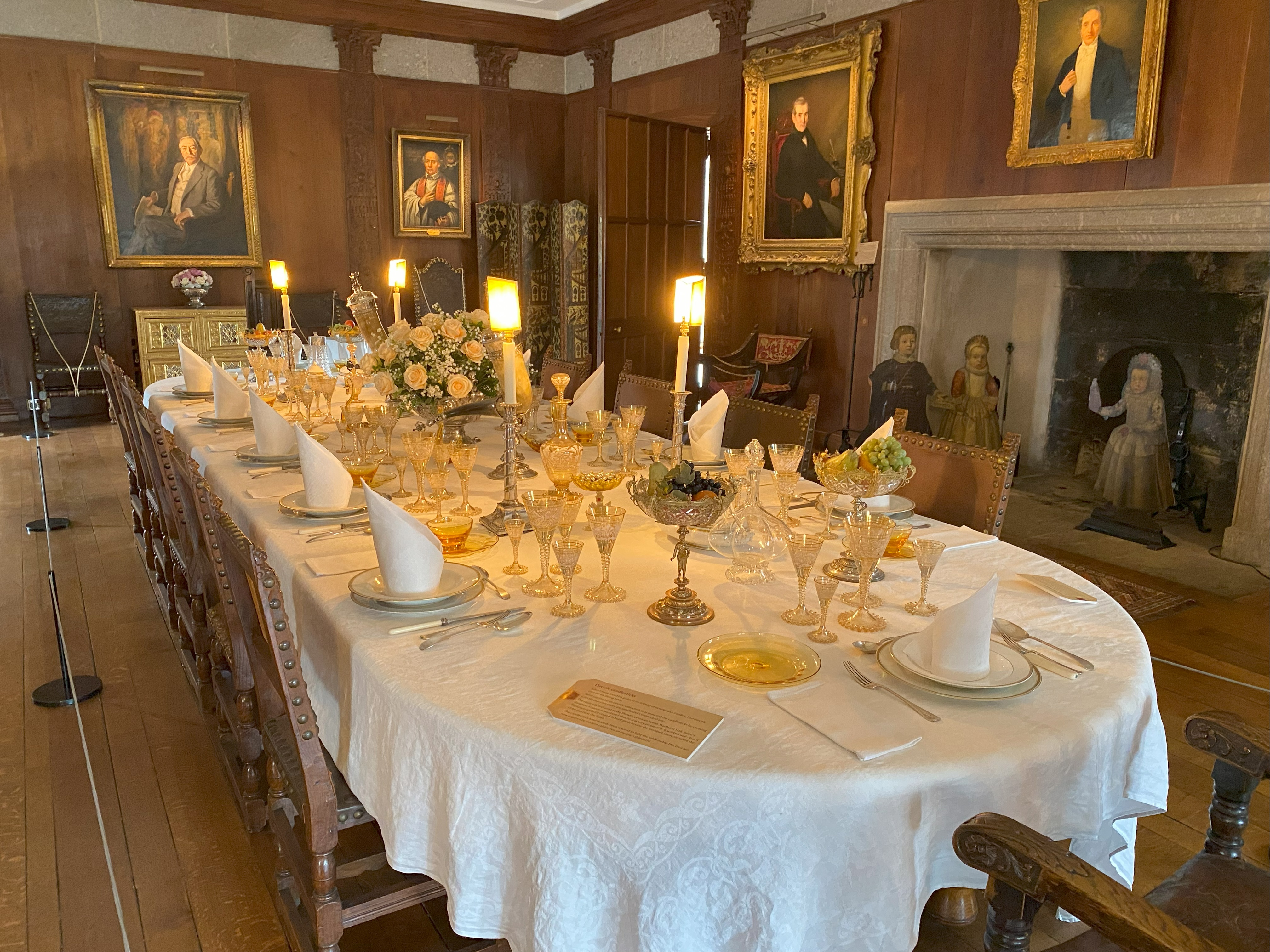
The architectural critic Christopher Hussey captured the paradox of Drogo in a single sentence: 'The ultimate justification of Drogo is that it does not pretend to be a castle. It is a castle, as a castle is built, of granite, on a mountain, in the twentieth century.' Lutyens borrowed from medieval and Tudor castle-building while incorporating thoroughly modern elements. The castle had electricity and lifts from the outset, powered by two turbines on the river below. Its defensive characteristics -- battlements, narrow windows, massive walls that Drewe insisted on doubling in thickness for authenticity -- are purely decorative. Inside, the main block holds four reception rooms, and the gardens were designed by Lutyens with planting by George Dillistone and advice from Gertrude Jekyll, the legendary garden designer. The formal garden, with its rhododendrons, rose garden, and circular grass tennis court, contrasts deliberately with the wild moorland of Dartmoor pressing in from every side.
The Family and the Trust
After Julius's death, his wife Frances and son Basil stayed on at Drogo. During the Second World War, Frances and her daughter Mary ran the castle as a home for babies made homeless by the London Blitz. In 1974, Julius's grandson Anthony and great-grandson Christopher gave Castle Drogo to the National Trust along with 600 acres of surrounding land and several cottages in Drewsteignton. It was the first twentieth-century property the Trust had ever accepted. The writer James Lees-Milne visited in 1976 and noted the irony: 'A new family aspiring to, rather arriving at, landed gentry-hood and now the representative living upstairs in a tiny flat, all within my lifetime.' The castle underwent a nine-year restoration beginning in 2013, addressing chronic water ingress through the granite walls. Today it stands as Lutyens built it -- a monument to one man's ambition, shaped by an architect's genius and the losses of the twentieth century.
From the Air
Located at 50.696N, 3.811W near Drewsteignton on the northeastern edge of Dartmoor, Devon. The castle sits on a ridge above the Teign Gorge. Exeter Airport (EGTE) is approximately 12 nm east. The granite building is best seen from the north or east at 2,000 ft, where its position on the moorland ridge is most dramatic.