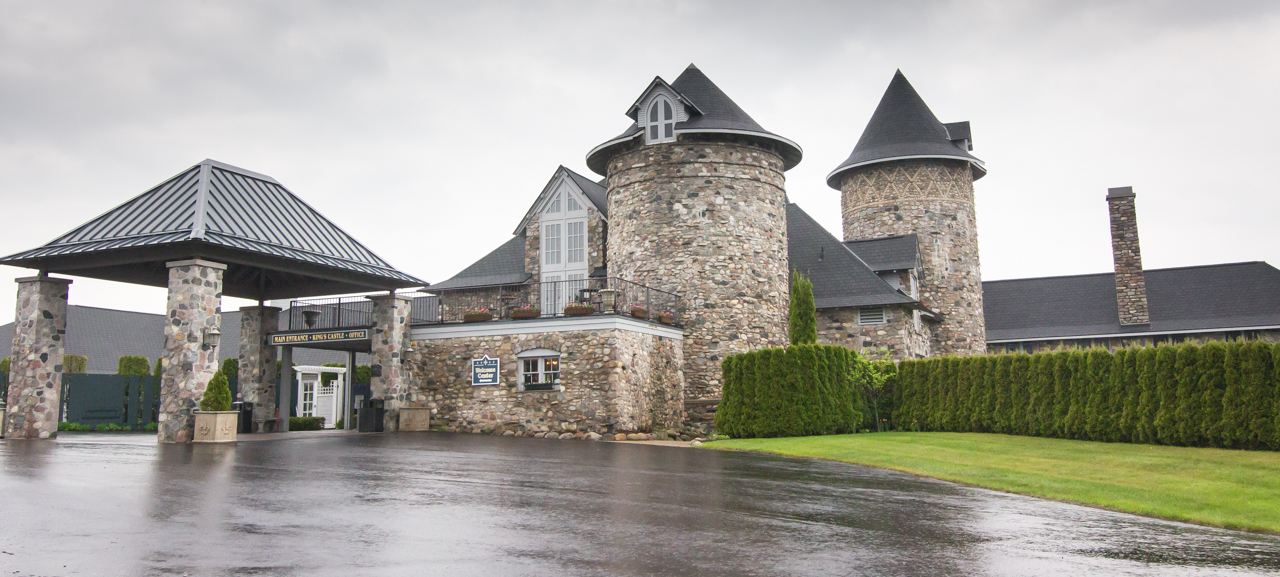
Castle Farms
Metallica once shook these walls. So did AC/DC, Aerosmith, Bon Jovi, and Ozzy Osbourne. For two decades, the fieldstone barns of Castle Farms in Charlevoix, Michigan, reverberated with some of the loudest acts in rock and roll, a fate their original architect could never have imagined when he drew up plans for a model dairy farm in 1918. The buildings, with their high hip roofs and pointed-arch dormers, were designed to evoke the castles of French Normandy. That they ended up hosting heavy metal instead of Holstein cattle is one of northern Michigan's more delightful ironies.
A Sears Executive's Rural Fantasy
Albert Loeb was the Vice President of Sears, Roebuck and Company when he commissioned Castle Farms as a showcase for livestock and the latest farm equipment his company sold. He hired Chicago architect Arthur Heun to design the complex, and the result was extraordinary: a 1,600-acre estate featuring a summer home, caretakers' houses, orchards, fields, and a sprawling livestock barn complex built entirely from locally gathered fieldstone. The architecture borrowed liberally from French Normandy castles, giving the working farm the appearance of a medieval estate transplanted to the shores of Lake Michigan. Loeb bred prize-winning Holstein-Friesian cattle, Duroc-Jersey hogs, and Belgian horses, while the farm shipped butter, syrup, honey, poultry, and eggs through a premium mail-order business. When Loeb died in 1924, his son Ernest carried on for a few years, but financial difficulties forced the farm's closure in 1927.
From Fieldstone to Feedback
The buildings sat largely dormant for decades, rented out as storage space by the Loeb family until 1962, when an executive named John Van Haver purchased the property, restored it, and opened it to the public. Arthur and Erwina Reibel bought Castle Farms in 1969, and by 1976, someone had the inspired idea of using the castle-like complex as a concert venue. For the next twenty years, the fieldstone walls that once sheltered prize cattle absorbed the thunder of amplified rock. Tina Turner performed here. The Beach Boys played here. Def Leppard's guitars echoed off the conical roof of the octagonal icehouse. The setting was surreal: bands playing inside structures designed to store ice and house horses, surrounded by pointed-arch windows and massive stone chimneys. It was a chapter unlike anything Arthur Heun could have drafted.
Seven Structures, One Vision
The original 1917-1918 complex comprises seven buildings, each constructed from fieldstone gathered from the surrounding countryside. The horse barn stretches long and rectangular under a high hip roof, its dormers pierced with pointed-arch windows. Wagon sheds, once open to the air, form an open courtyard alongside a windowless octagonal icehouse and a round office topped with a conical roof. Across the courtyard stands the dairy barn, a U-shaped cattle barn connected to a service wing that once held a dairy, dormitory, bunkhouse, kitchen, and four round-plan silos. Between the two complexes sits the cheese shop, a modest one-story building with a hip roof. A blacksmith's shop, complete with its original forge and massive chimney, anchors the ensemble. The buildings are grouped so that the horse barn complex faces the dairy barn complex across a courtyard, creating a village-like atmosphere that lends the property its castle-like character.
The Restoration and the Renaissance
In 2001, Linda Mueller purchased Castle Farms and began a painstaking restoration to return the buildings to their original condition. By 2005, the work was complete, and the property had found yet another identity. Today Castle Farms operates year-round as a special events facility, primarily hosting weddings and receptions in its courtyard and restored barns. Couples exchange vows beneath the same pointed arches that once framed concert stages and, before that, rows of prize-winning cattle. The Charlevoix Renaissance Festival brings period costumes and jousting to the grounds, and since 2008, a model railroad takes visitors on a scenic journey through Charlevoix's local history. Castle Farms has reinvented itself with each new owner, but the fieldstone walls remain the constant: solid, handsome, and utterly unmistakable against the northern Michigan landscape. From model farm to rock venue to wedding destination, each chapter has left its mark without diminishing the architectural vision that Arthur Heun set in stone more than a century ago.
From the Air
Located at 45.28N, 85.23W near Charlevoix, Michigan. The castle-like fieldstone complex is visible from low altitude, set among the rolling farmland east of Lake Charlevoix. Look for the distinctive cluster of stone buildings with conical and hip roofs. Nearest airport: Charlevoix Municipal Airport (KCVX), approximately 3 nm west. Lake Charlevoix and its connection to Lake Michigan via the Pine River Channel provide strong visual references for navigation.