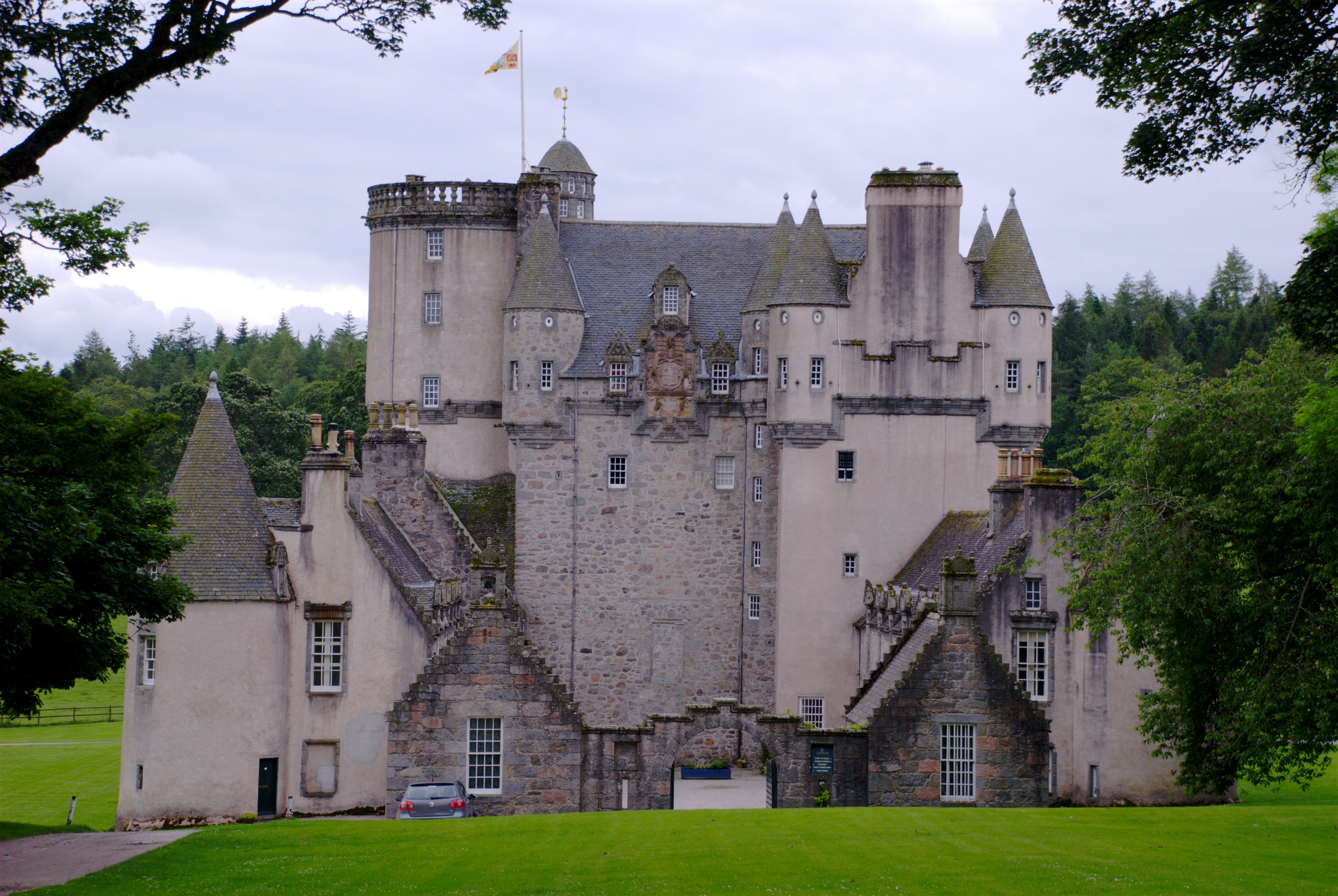
Castle Fraser
Two master masons left their marks on the walls of Castle Fraser - literally. John Bell of Midmar carved his initials into the stonework of the main tower, and Thomas Leiper did the same on the later additions. Between them, working across sixty years from 1575 to 1636, they created the most elaborate Z-plan castle in Scotland: a building where two massive round towers are set at diagonally opposite corners of a central block, creating a plan shaped like the letter Z that allowed defenders to cover every external wall with flanking fire. It was a military design executed with the confidence of architects who knew the age of castle warfare was ending.
The Castles of Mar
Castle Fraser belongs to a group of tower houses and castles in the Mar region of Aberdeenshire that share a distinctive architectural vocabulary: massive round towers, corbelled turrets, conical roofs, and a vertical emphasis that makes them look like buildings straining upward from the ground. The group includes Craigievar, Crathes, Midmar, and several others, all built or rebuilt during the late sixteenth and early seventeenth centuries by the minor nobility of the northeast. They were the work of a small number of master masons who passed techniques and motifs from project to project, creating a regional school of architecture that has no real parallel elsewhere in Scotland. Castle Fraser is the largest and most ambitious of the group, its Z-plan layout giving it a presence that the simpler L-plan towers cannot match.
Sixty Years of Building
Michael Fraser, the 6th Laird, began construction in 1575 on the site of an earlier tower. The project consumed the rest of his life and continued under his successors. John Bell of Midmar, the first master mason, established the basic plan and raised the main block and the great round tower on the southwest corner. When Bell died or moved on, Thomas Leiper took over, adding the second round tower and completing the elaborate roofline with its turrets, dormers, and heraldic panels. The result is a building that reads as a single composition despite its extended construction - the two masons shared enough of a design language that the joints between their work are difficult to detect. The Fraser coat of arms, carved in stone above the entrance, declares ownership. The masons' marks, discreetly placed on the walls, declare authorship.
The Lady Laird
Castle Fraser's most significant transformation came not from a builder but from a moderniser. In the late eighteenth century, Elyza Fraser inherited the estate and set about updating the medieval interiors for Georgian tastes. She was known as the 'lady laird,' a title that acknowledged both her authority and the novelty of a woman managing a large Aberdeenshire estate in an era when female property ownership was unusual. Elyza lowered floors, enlarged windows, replastered walls, and generally dragged the castle from the seventeenth century into the eighteenth. Her alterations were sensitive enough that the medieval structure survived beneath the Georgian overlay, and subsequent restorations have revealed both layers. The great hall, in particular, shows the tension between the original fortress proportions and the domestic comfort that Elyza demanded.
A Castle on Film
Castle Fraser gained an unexpected second life in 2006 when it was used as a location for 'The Queen,' the film starring Helen Mirren as Queen Elizabeth II during the week following the death of Princess Diana. The castle served as the setting for one of the film's most dramatic outdoor scenes — the moment the Queen encounters a stag — while other Scottish castles stood in for Balmoral's interiors. The filming brought international attention to a property that had been known primarily to castle enthusiasts and National Trust members. The irony is not lost on anyone familiar with Aberdeenshire's hierarchy of estates: Castle Fraser, built by minor gentry who could never have aspired to royal company, briefly became the screen version of the monarch's Scottish home.
The Estate Today
The National Trust for Scotland has managed Castle Fraser since 1976, maintaining both the building and its surrounding parkland. The grounds include a walled garden that has been restored to its eighteenth-century layout, with herbaceous borders, vegetable beds, and fruit trees that supply the estate's tearoom. Woodland walks wind through the policies, and the approach drive frames views of the castle that emphasise its dramatic verticality. Inside, the rooms are furnished to represent different periods of the castle's history, from the vaulted ground floor with its medieval proportions to the Georgian drawing room that bears Elyza Fraser's stamp. The Z-plan layout means that the interior is more complex than it appears from outside - corridors angle through the connecting towers, staircases spiral in unexpected directions, and the building reveals itself gradually, room by room, as you climb.
From the Air
Castle Fraser is located at approximately 57.203°N, 2.461°W near Kemnay in Aberdeenshire, about 16 miles west of Aberdeen. The castle's Z-plan layout and round towers are visible from the air, set within a wooded estate. The surrounding landscape is the rolling farmland of the Don valley. Nearest airport is Aberdeen Airport (EGPD), approximately 16 miles east. From 1,500-2,500 feet, the castle's distinctive plan and the contrast between its round towers and rectangular central block are clearly visible.