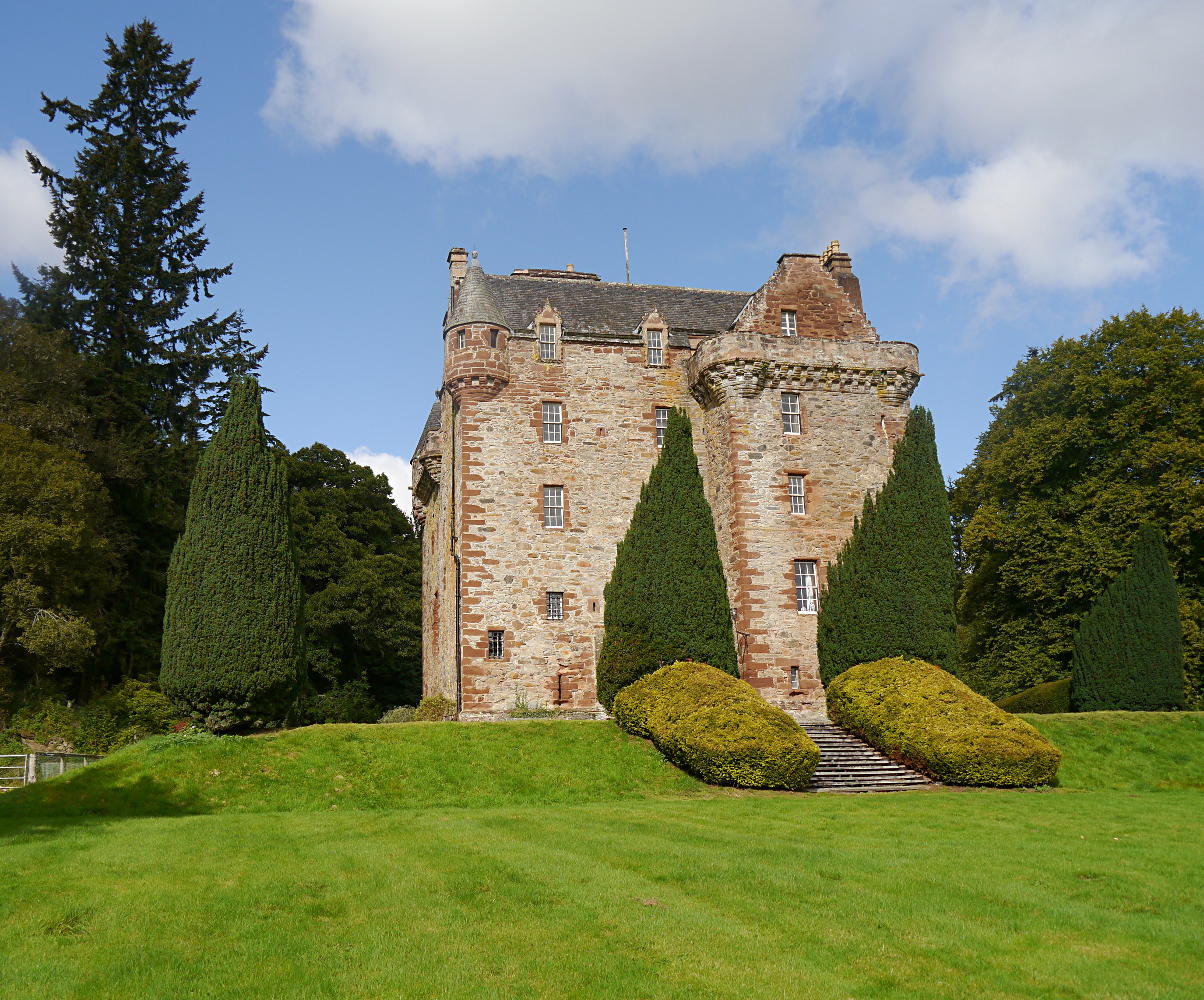
Castle Leod
The Spanish chestnuts in the grounds of Castle Leod are said to have been planted from seeds brought back from the Continent in the sixteenth century. Whether that provenance is accurate or romantic embroidery, the trees are undeniably old -- massive trunks, spreading canopies, and the kind of presence that only centuries of growth can produce. They stand in the grounds of a castle that has belonged to the Mackenzie family since a grant following the Battle of Flodden in 1513, one of the longest continuous associations between a clan and its seat in the Scottish Highlands.
After Flodden
The Battle of Flodden in September 1513 was a catastrophe for Scotland -- King James IV was killed, along with much of the Scottish nobility. Among the survivors who distinguished themselves were members of the Mackenzie clan, and the grant of Leod lands near Strathpeffer recognized their service. The current castle dates primarily from the early seventeenth century, built by Sir Roderick Mackenzie of Coigach. It is a classic Highland tower house: compact, vertical, defensible, with thick walls and small windows at the lower levels opening to larger ones above. The castle sits in wooded grounds near the spa town of Strathpeffer, with views across the surrounding agricultural land to the hills of Easter Ross. Its position is strategic without being dramatic -- a working estate rather than a mountain fortress.
Mackenzie Fortunes
The Mackenzie chiefs who lived at Castle Leod navigated the dangerous waters of Highland politics with varying success. The clan's involvement in the Jacobite risings of 1715, 1719, and 1745 brought periods of forfeiture and exile, during which their estates -- including Castle Leod -- were confiscated by the crown. The castle survived these upheavals partly because it was a residence rather than a military target. Unlike Eilean Donan, which was bombarded and demolished in 1719, Castle Leod was too far inland and too domestically scaled to attract naval attention. The Mackenzie line endured through the complex marriage alliances that characterize Scottish aristocratic history. Anne Hay-Mackenzie was created Countess of Cromartie in 1861, reviving a title that had been forfeited after the '45 rising, and the Cromartie branch of the family has held Castle Leod since.
A Tower House Enduring
Castle Leod received significant modifications in the mid-nineteenth century, when the Hay-Mackenzie family extended the tower house to accommodate more comfortable Victorian living standards. Extensions built in 1851 were rebuilt in 1904 after a fire, but the original seventeenth-century tower remains the core of the building. The castle holds Category A listed status from Historic Environment Scotland, recognizing its architectural and historical significance. The grounds, with their ancient trees and walled gardens, offer a sense of domestic continuity that the more dramatic Mackenzie properties -- Brahan Castle, now demolished, and Eilean Donan, rebuilt from ruins -- cannot match. Castle Leod is the Mackenzie seat that actually survived, not as a ruin or a reconstruction but as a continuously inhabited house. The current chief of Clan Mackenzie, the Earl of Cromartie, lives here, maintaining a connection between family and place that has persisted for over five hundred years.
From the Air
Castle Leod is located at 57.60°N, 4.53°W near the town of Strathpeffer in Easter Ross. The castle and its wooded grounds are visible from the air south of Strathpeffer. The Cromarty Firth lies to the northeast, and the town of Dingwall is approximately 3 nm to the east. Nearest airport: Inverness (EGPE) approximately 12 nm to the southeast.