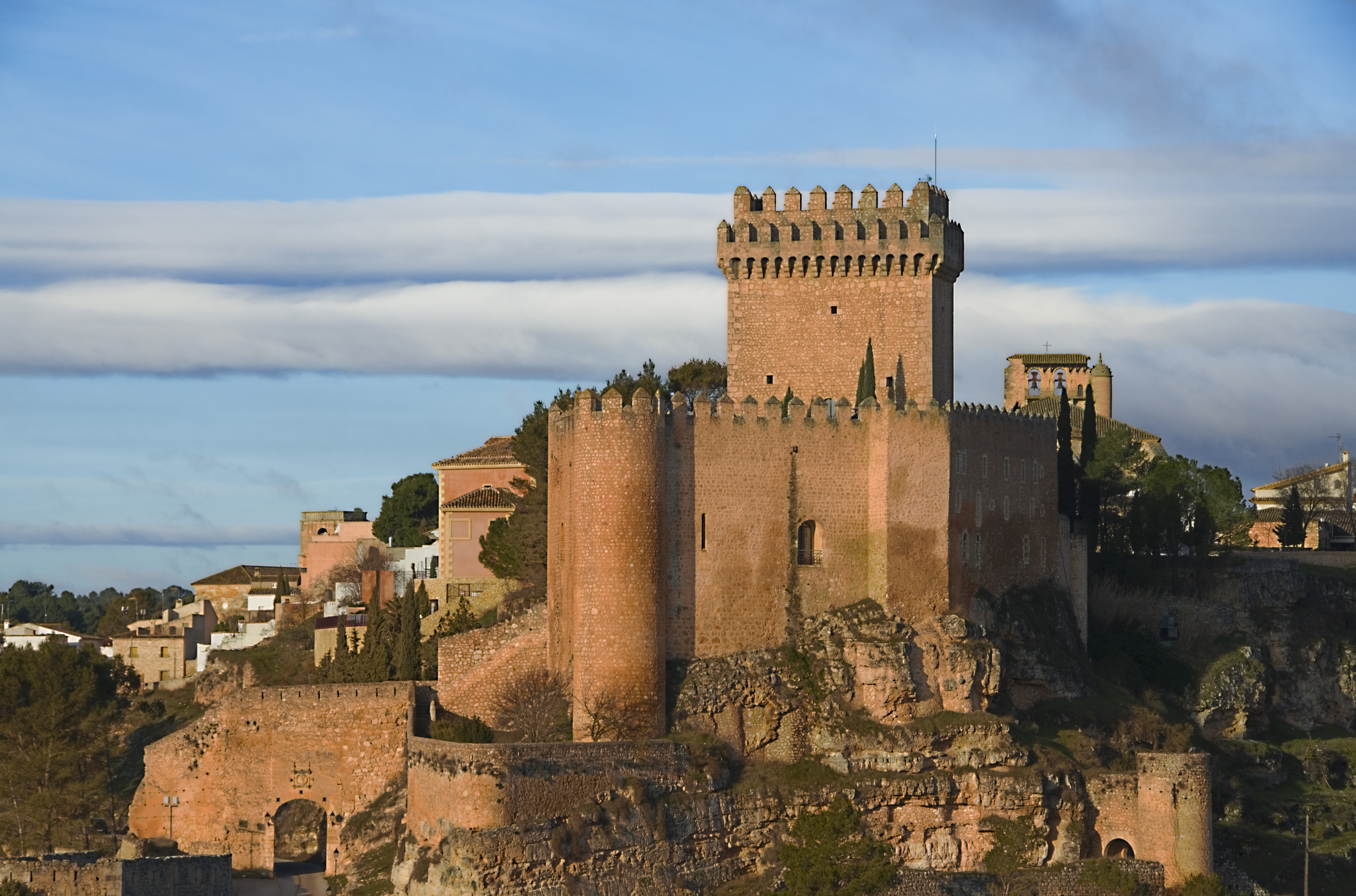
Castle of Alarcon
Nine months. That is how long Fernan Martinez de Ceballos besieged the Castle of Alarcon in 1184 before its Moorish defenders finally surrendered to the forces of Alfonso VIII of Castile. As a reward, Ceballos was granted the extraordinary privilege of taking the town's name as his own, becoming Martinez de Alarcon and founding a lineage that would echo through centuries of Spanish history. The castle itself, perched on a limestone promontory nearly encircled by the gorge of the Jucar River, had already been standing for centuries by then. Today, you can sleep in it.
From Emirate to Kingdom
The castle's origins are Arab, built when the fortress fell under the jurisdiction of the Emirate of Cordoba. As the Caliphate fragmented into competing taifa kingdoms, Alarcon passed to the Taifa of Toledo, serving as a defensive stronghold during the internal conflicts that weakened Muslim Spain. Its position, nearly surrounded by the river gorge with only a narrow land approach, made it a natural fortress long before anyone laid the first stone. After the Christian conquest in 1184, the castle received sustained attention from the kings of Castile, who expanded its defenses, granted it a fuero (charter), and gave it lordship over an astonishing 63 villages, including what would become the city of Albacete. The Military Order of Santiago was tasked with its protection, and in 1212, Alarcon sent troops to fight at the decisive Battle of Las Navas de Tolosa.
A Prize Passed Between Princes
Few castles in Spain changed hands as frequently as Alarcon, though most of those transfers happened through royal decree rather than combat. Ferdinand IV gave it to Juan Manuel, Prince of Villena, in 1305, and the literary prince wrote some of his famous works within its walls. The lordship passed through his descendants before Peter of Castile reclaimed it for the crown. Henry II gave it away again; Henry III took it back. In 1446, it fell to Juan Pacheco, Marquis of Villena, whose family sided with Joanna la Beltraneja against Queen Isabella during the succession crisis. Through it all, the castle served as both residence and bargaining chip, its strategic value ensuring that no monarch could afford to ignore it and none could bear to let a rival hold it.
Blood in the Mortar
Local legend offers a darker explanation for the reddish and black spots visible in the castle's mortar. The story tells of a lord whose beautiful sister attracted a suitor from neighboring lands, a young man notorious for his cruelty. When the lord rejected the proposal, the suitor plotted murder and kidnapping. An assassin arrived at the castle posing as a visitor requesting a private audience. The lord, suspicious, prepared accordingly. At the moment the stranger lunged, servants seized and killed him. According to the tale, construction workers then mixed the assassin's body into the mortar being prepared for ongoing repairs. The stains in the walls, the legend insists, are his blood. Whether or not the story holds any truth, the castle's walls do display unusual discolorations that have fueled the tale for centuries.
From Ruin to Parador
After the medieval period, the castle followed a familiar Spanish trajectory: abandonment, decay, and a long slide toward collapse. By 1712, master builders warned that urgent repairs were needed to prevent the walls from falling entirely. In 1863, the Duke of Frias sold the castle and its surviving towers for 20,000 reales. A century later, in 1963, the Spanish government expropriated the property and transformed it into a parador, one of the state-run luxury hotels housed in historic buildings. It opened to guests on March 25, 1966. The conversion preserved the castle's imposing silhouette while giving the ancient rooms a second life. Guests today sleep within walls that have sheltered Arab defenders, Castilian kings, literary princes, and at least one legendary assassin whose bones may or may not rest in the masonry.
From the Air
Located at 39.55N, 2.08W on a dramatic limestone promontory nearly encircled by the gorge of the Jucar River in Cuenca province, central Spain. The castle and the medieval town of Alarcon are strikingly visible from the air due to the river gorge forming a near-complete loop around the site. Nearest airports include Albacete (LEAB) approximately 80 km south. Recommended viewing altitude: 2,000-4,000 feet AGL to appreciate the river-gorge geography.