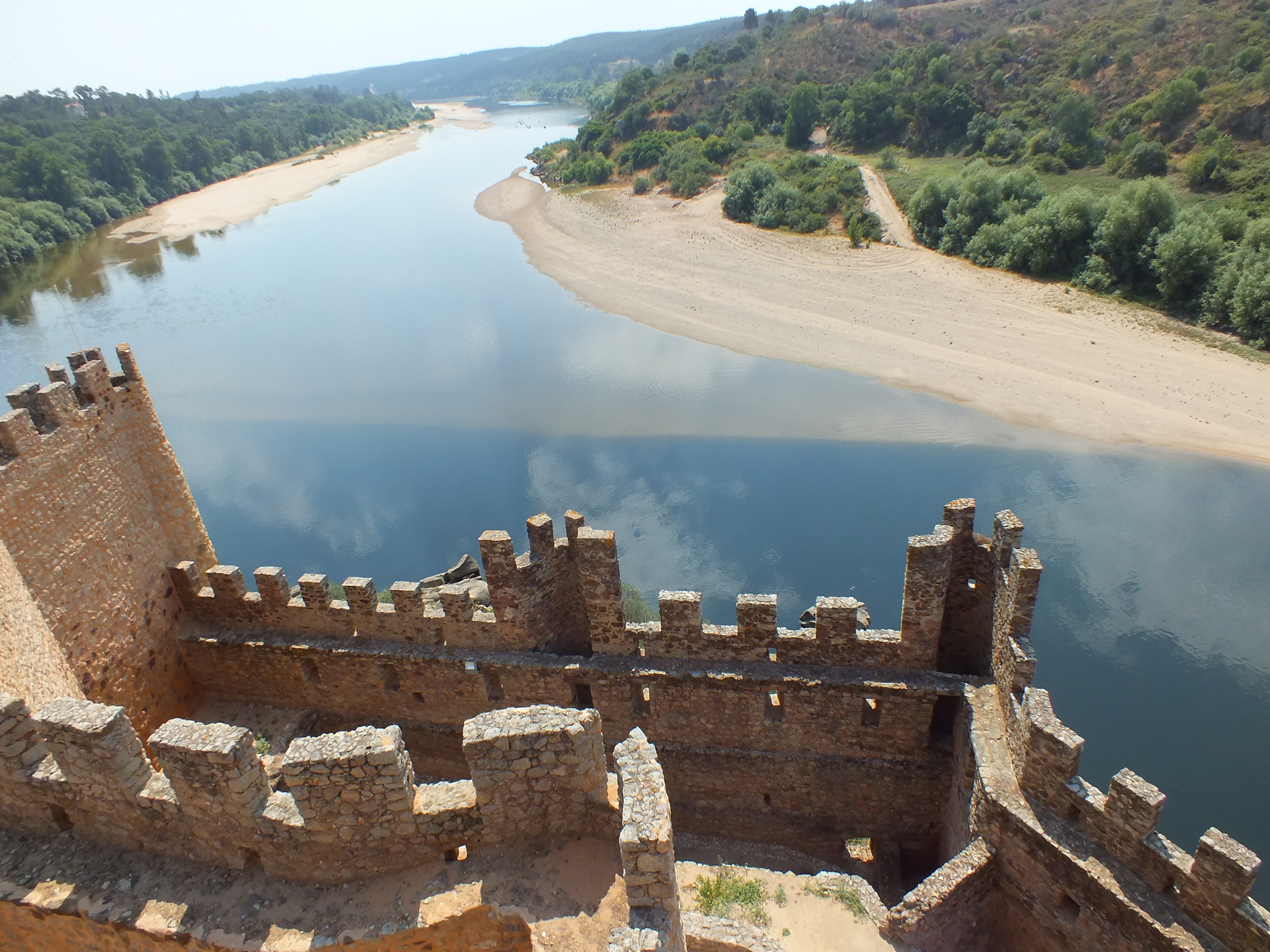
Castle of Almourol
Some castles command hilltops. Some guard mountain passes. The Castle of Almourol rises from a granite outcrop in the middle of the Tagus River, surrounded on all sides by water, reachable only by boat. The effect is deliberate and theatrical -- a fortress that seems to float on the current, its crenellated walls and square keep reflected in the river below. Built by the Knights Templar in 1171, Almourol was designed not just for defense but for awe, a stone declaration of Christian power planted in the center of Portugal's greatest waterway during the long centuries of the Reconquista.
Fortress on the Current
The islet of Almourol rises roughly 18 meters above the surface of the Tagus, a granite knuckle that has been a strategic landmark for millennia. Long before the Templars arrived, a Lusitanian castro occupied the site -- a hilltop fortification of the pre-Roman Iron Age people who inhabited central Portugal. Roman legions took the position during the 1st century BCE, recognizing what the Lusitanians already knew: whoever held this rock controlled river traffic in both directions. After Rome, the Alans, Visigoths, and Arabs each adapted the defenses to their own purposes. But the castle that stands today belongs to the Templars, who rebuilt it from the ground up as part of a defensive line stretching across the Tagus valley.
Gualdim Pais and the Templar Line
An inscription above the main gate dates the castle's reconstruction to 1171, placing it squarely in the work of Gualdim Pais, the legendary Portuguese Templar Master. Pais had fought in the Second Crusade before returning to Portugal, where King Afonso Henriques granted the Templars vast territories along the Tagus to hold against Muslim counterattacks from the south. Almourol became one link in a chain of Templar fortresses -- along with Tomar, Pombal, and others -- that formed a defensive cordon across central Portugal. The watchtowers that punctuate Almourol's walls were a Templar innovation, imported from crusader architecture in the Holy Land and applied here on the Iberian frontier. Two inscription stones survive inside the castle: one records the rebuilding under Gualdim Pais, and another bears a carved cross above an open window in the keep, marking the site's Christian purpose.
Legends in the Walls
A castle on a river island, accessible only by water, naturally generates stories. Portuguese folklore draped Almourol in romantic legends -- tales of a Moorish princess imprisoned in the keep, of enchanted knights who guarded treasure beneath the granite, of spirits that walked the battlements on moonlit nights. The 19th-century writer Francisco de Morais set scenes of his chivalric romance Palmeirim de Inglaterra in a castle widely believed to be modeled on Almourol. The Romantic movement embraced the ruin as a symbol of Portugal's heroic past, and painters and poets made pilgrimages to the island throughout the 1800s. The castle's isolation preserved it from the worst of time's damage, but also from the kind of continuous habitation that might have kept it in practical use. By the modern era, Almourol had become pure monument -- a place that existed more in imagination than in military strategy.
The Island Today
Visitors reach Almourol by small boat from the riverbank near Vila Nova da Barquinha, a crossing that takes only minutes but feels like a passage between centuries. The castle's layout is compact -- the island measures only about 310 meters long -- but its walls, towers, and central keep are remarkably intact for a structure approaching its ninth century. Inside, the masonry doorways that bisect the interior reveal how the Templars organized defensive space, creating compartments that could be held independently even if outer walls were breached. From the top of the keep, the Tagus stretches in both directions through the flat agricultural plain of the Ribatejo, and the defensive logic of the site becomes immediately clear: nothing moved on this river without the garrison's knowledge. In a country rich with castles, Almourol remains singular -- a fortress that turned geography itself into a weapon.
From the Air
Located at 39.46N, 8.38W on a small islet in the Tagus River, approximately 4 km from Vila Nova da Barquinha in central Portugal. The castle is unmistakable from the air -- a compact stone fortress on a granite outcrop surrounded by river water. Nearest airports include Tancos military airfield (LPTN) just a few kilometers north, and Lisbon Humberto Delgado (LPPT) roughly 130 km to the south. Best viewed at 1,500-2,500 feet to appreciate the island setting within the Tagus River valley.