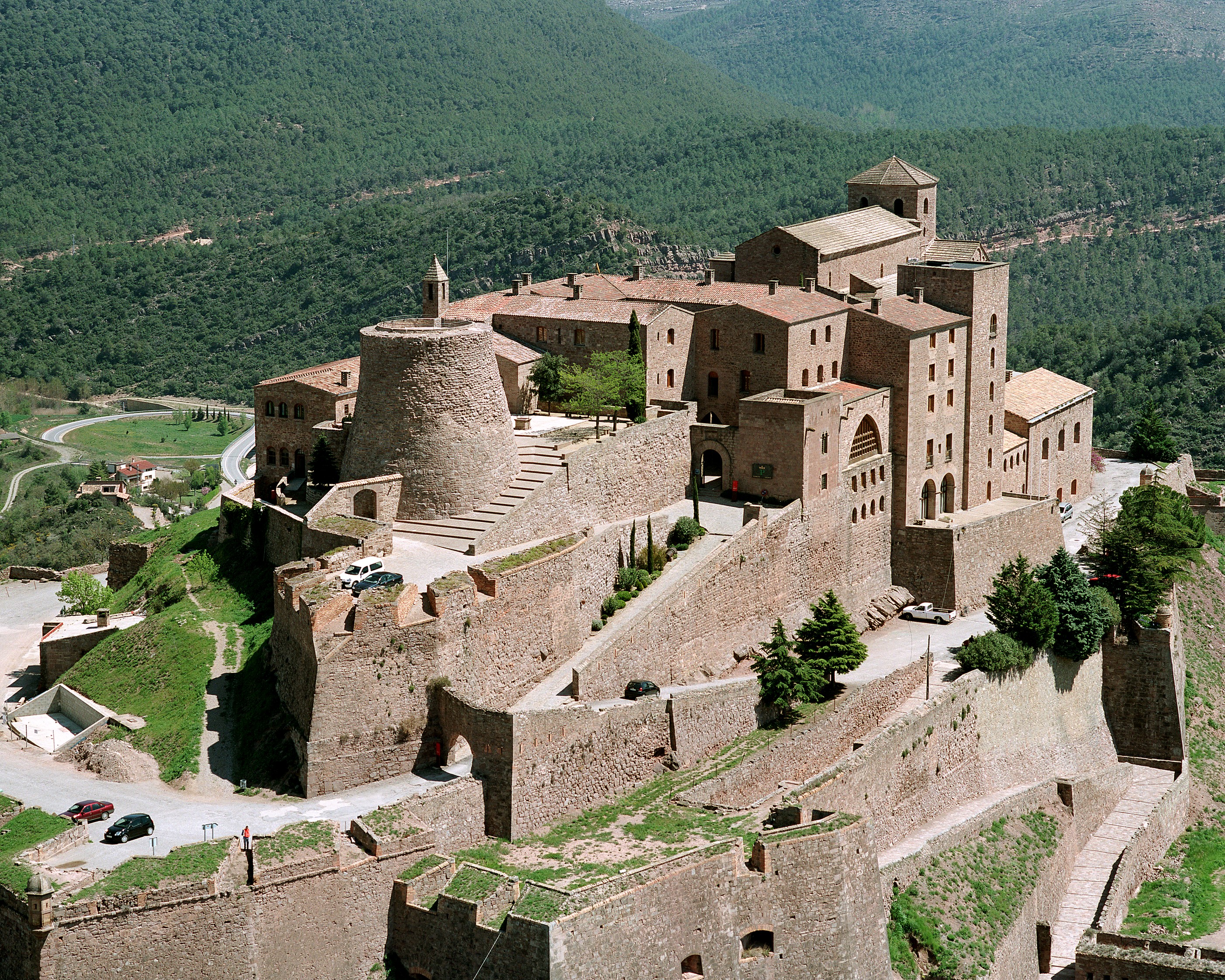
Castle of Cardona
They called the dukes of Cardona the kings without crowns. From this fortress on a hill above the Cardener river valley, the family wielded influence that rivaled the royal house of Aragon itself, holding vast territories across Catalonia, Aragon, and Valencia, with dynastic connections stretching to Castile, Portugal, Sicily, and Naples. The castle they ruled from was already centuries old by the time they rose to prominence -- first constructed in 886 by Wilfred the Hairy, the count credited with founding the Catalan nation. Today the fortress is a Parador, one of Spain's state-owned luxury hotels, and guests sleep in rooms where medieval lords once plotted the politics of an empire.
The Hairy Count's Fortress
Wilfred the Hairy -- Guifre el Pilos in Catalan -- built the first fortification here in 886, choosing a hilltop that commanded views of the Cardener river valley and the town of Cardona below. The site was strategic: Cardona controlled one of the great salt deposits of Europe, a resource so valuable that the town's wealth and the castle's defenses grew together over centuries. Wilfred himself is a figure wrapped in as much legend as history, credited with establishing the independence of the Catalan counties from Frankish control, but the fortress he founded is real enough. Its stones have stood on this hill for over eleven hundred years.
Kings Without Crowns
By the fourteenth century, the castle had become the seat of the dukes of Cardona, the most powerful noble family connected to the Crown of Aragon, surpassed in rank only by the royal house itself. Their territories extended across three kingdoms, and their marriages linked them to the major dynasties of the Iberian Peninsula and the western Mediterranean. The title was not merely honorary. The dukes controlled vast stretches of Catalonia, maintained independent military capacity, and exercised a degree of autonomy that made other nobles -- and sometimes the king -- uneasy. The castle on the hill was both their residence and their statement: power rooted in stone, salt, and a lineage that could trace itself back to the earliest days of Christian rule in Catalonia.
The Last to Fall
The castle's most dramatic chapter came in 1714, during the War of the Spanish Succession. When Philip V's Bourbon forces moved to assert control over Catalonia, Cardona's garrison resisted. Even after a siege destroyed much of the castle's outer walls, the defenders held. The garrison of Cardona was among the very last in Catalonia to surrender to the Bourbon troops -- a final act of defiance in a war that would reshape the political structure of Spain. The fortress that Wilfred the Hairy had built eight centuries earlier served its original purpose to the end, absorbing punishment and refusing to yield until resistance was no longer possible.
Romanesque, Gothic, and the Maiden's Tower
The castle's architecture spans styles and centuries. Romanesque and Gothic elements coexist in the principal rooms, including the Sala Dorada -- the golden room -- and the Sala dels Entresols. The structure's most celebrated feature is the eleventh-century Torre de la Minyona, the maiden's tower, which rises 15 meters high with a diameter of 10 meters, a massive cylindrical keep that has anchored the fortification for nearly a thousand years. Adjacent to the fort stands the Church of Sant Vicenc de Cardona, built in the Lombard Romanesque style, whose portico was once covered with murals. Fragments of these painted vaults were removed in 1960 and are now displayed at the Museu Nacional d'Art de Catalunya in Barcelona, where they are recognized as masterworks of Romanesque painting.
Sleeping in History
Since its conversion into a Parador hotel, the Castle of Cardona has offered visitors an unusual proposition: spend the night inside an eleven-hundred-year-old fortress where dukes held court, soldiers withstood siege, and the salt wealth of medieval Catalonia was guarded and administered. The views from the hilltop remain the same ones that made the site strategic in 886 -- the river valley below, the town of Cardona huddled at the castle's feet, and the Catalan landscape stretching toward the Pyrenees. The conversion preserved the medieval structure while making it habitable, a balance between heritage and hospitality that Spain's Parador network has refined across dozens of historic properties. At Cardona, the weight of history is not metaphorical. It is in the stone walls, the narrow passages, and the tower that has watched over this valley for a millennium.
From the Air
Located at 41.91N, 1.69E on a prominent hilltop overlooking the town of Cardona and the Cardener river valley in central Catalonia. The castle complex is clearly visible from altitude, dominating the surrounding terrain. Nearest major airports are Barcelona-El Prat (LEBL) approximately 100 km southeast, and Lleida-Alguaire (LEDA) approximately 80 km west. The salt mountain of Cardona is also visible nearby. Best viewed at 3,000-5,000 feet to appreciate the castle's commanding position above the valley.