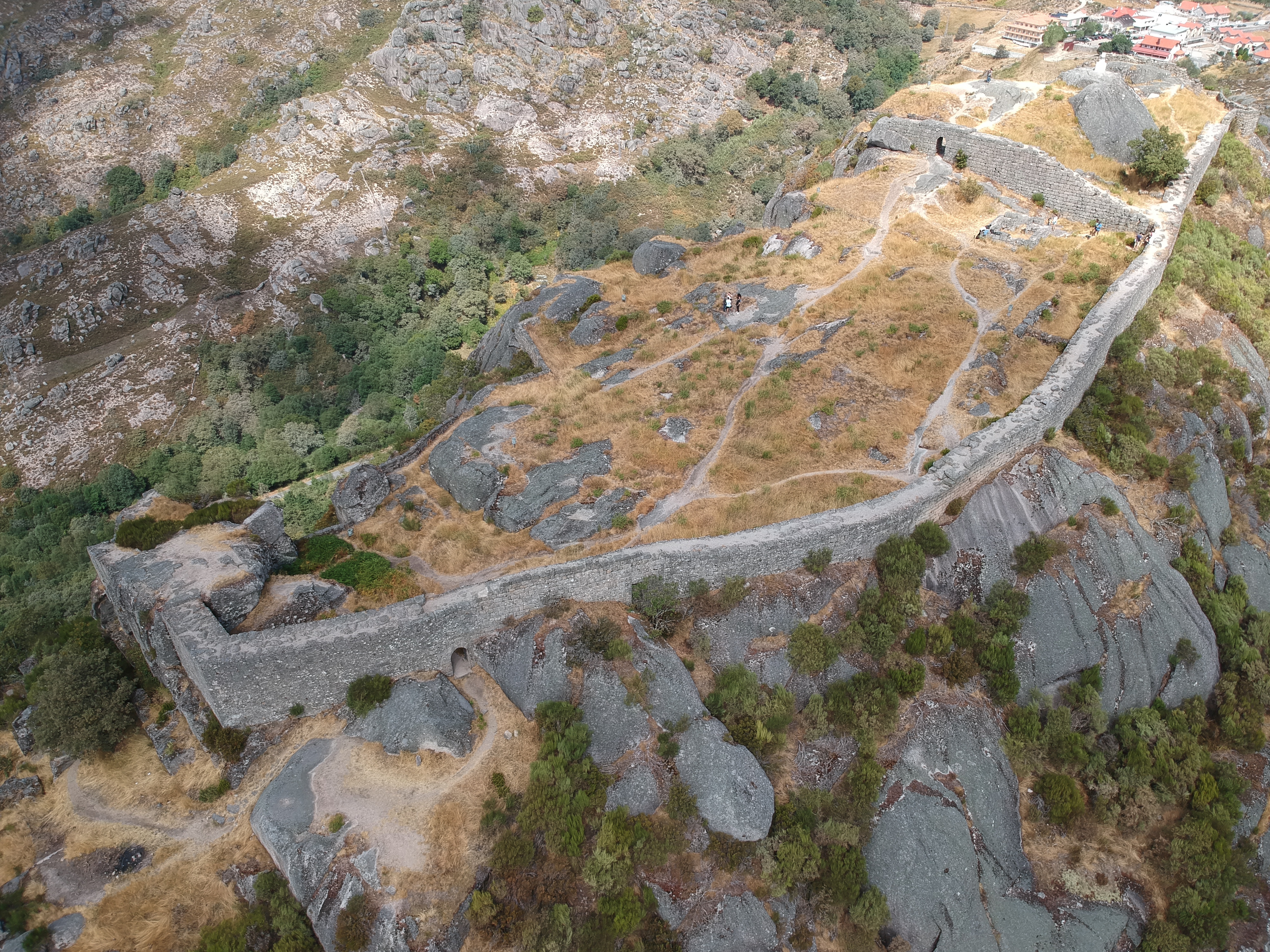
Castle of Castro Laboreiro
Two gates give entry to the Castle of Castro Laboreiro. The principal one, called the Gate of the Sun, opens to the east and the morning light. The other, facing north, is called the Gate of the Frog, though history remembers it by a harsher name: the traitors' gate. At 1,033 meters above the Minho and Lima rivers, this is one of the highest castle ruins in Portugal, an oval ring of walls built over cliffs and crags where the stone sometimes follows the rock in sharp zigzags rather than straight lines. The fortress has been seized, burned, rebuilt, and finally left to the elements, yet its bones remain, stubborn as the granite they were cut from.
From Castro to Castle
The site was already old when the first castle appeared. In the 9th century, Alfonso III of Asturias donated the settlement and its ancient castro to Count Hermenegildo Gutierrez, grandfather of Saint Rudesind, as a reward for defeating a rebel named Witiza. The Galician count adapted the pre-Roman hillfort into a proper castle, but the Moors eventually took it. In 1144, Afonso Henriques, who would become Portugal's first king, reconquered the fortress and began restoring its defenses the following year. His successor Sancho I completed the work in the 12th century, but the effort proved temporary. Leonese forces razed the castle during their invasion of 1212, and it fell to King Denis to begin yet another reconstruction in 1290, this time with a sharper eye toward defense against the neighbors to the east.
The Fortress That Would Not Stay Taken
Castro Laboreiro's position on the border made it a perennial flashpoint. In the 14th century, King John I used it to block Castilian incursions from Galicia. Drawings made by Duarte das Armas around 1506 show the castle with five rectangular towers surrounding a central keep, a cistern to the north, and an unidentified structure to the south. The most dramatic episode came in May 1666, when the Spanish commander Baltazar Pantoja seized the castle after four hours of skirmishing and installed Governor Pedro Esteves Ricarte. The occupation was short-lived. The 3rd Count of Prado, Francisco de Sousa, retook the fortress. The king, recognizing its historical importance, chose to preserve the castle despite the advice of military engineer Michel Lescole, who apparently saw little strategic value in maintaining it.
A Prison, a Garrison, and Silence
Peace arrived in 1715, and the castle was officially decommissioned. But it found one more use. From 1746 to 1779, Manuel de Araujo Machado, the Count of Bobadela and Governor of Castro Laboreiro, served as Governor-at-Arms for the province. During that tenure, he ordered 400 men and women arrested and imprisoned at the castle for refusing to present their children for military service. The fortress that had defended communities for centuries became a tool for punishing them. In 1801, troops occupied the castle one final time, mounting four military pieces in defense, but no battle came. After that, silence settled over the hilltop for good.
Granite and the Long View
The castle was listed as a National Monument in 1944, though meaningful restoration did not begin until 1979, when workers repaved the access roads and cleared the vegetation that had been slowly consuming the walls. The municipal council improved access again in 2005. What remains is the oval trace of the walls, following the natural contour of the rock, the foundations of the towers, the cistern ruins in the eastern courtyard, and the two named gates. The courtyard between the walls once served as a refuge during invasions, a place where villagers gathered their cattle and property behind the footbridge that controlled access. Standing among the ruins today, the view stretches across the river valleys toward Spain, and it is easy to understand why generation after generation chose this exposed, wind-battered hilltop as the place to make a stand.
From the Air
Located at 42.02N, 8.16W in the municipality of Melgaco, extreme northwest Portugal, very near the Spanish border. The castle sits on an isolated hilltop at 1,033 meters elevation, making it a prominent visual landmark amid the mountainous terrain. The Minho River valley lies to the north (forming the border with Spain) and the Lima River valley to the south. Nearest airports include LPVZ (Viana do Castelo) approximately 80 km southwest. Terrain is rugged and mountainous. Best viewed from 4,000-5,000 ft AGL to appreciate the hilltop position.