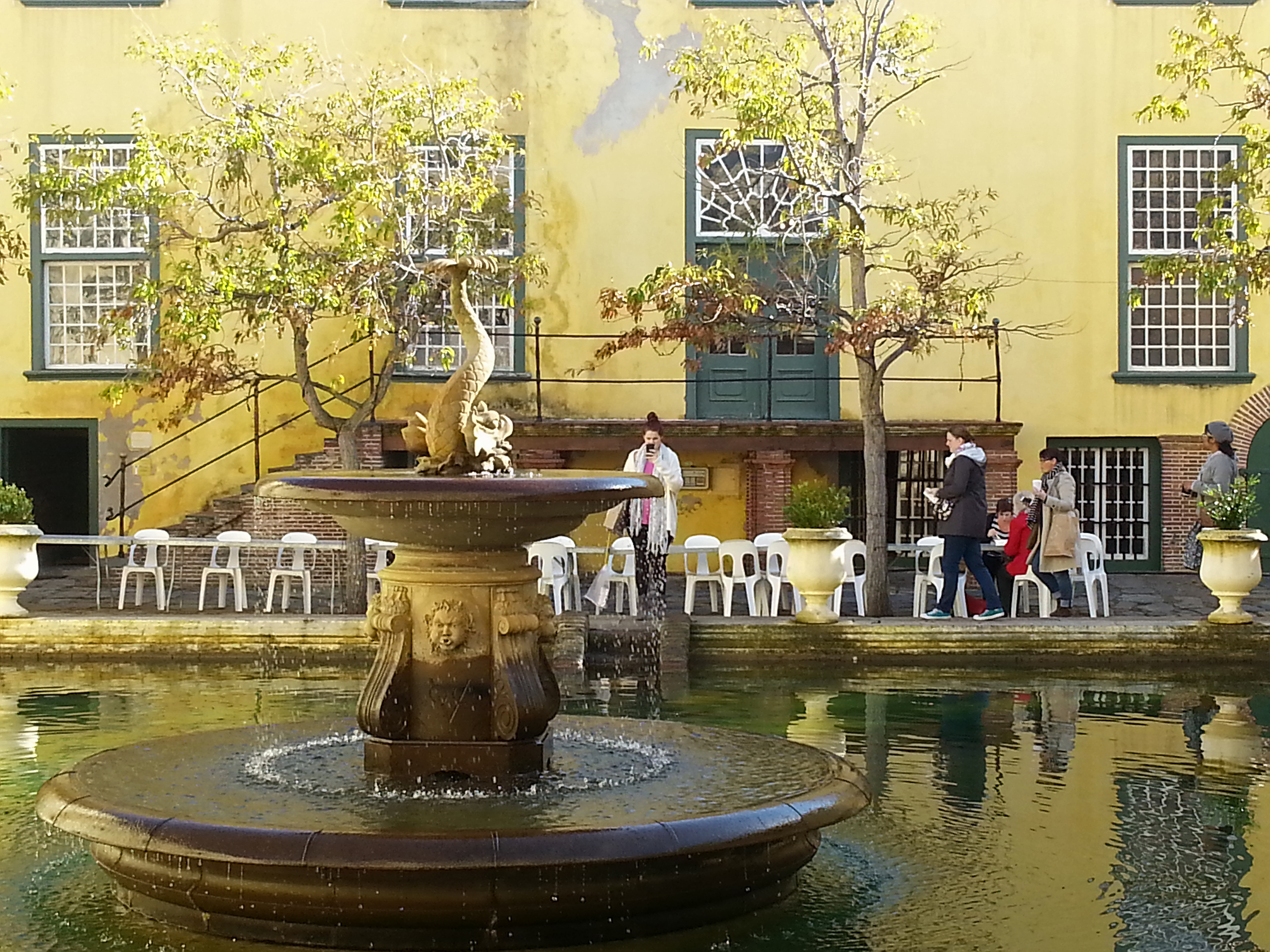
Castle of Good Hope
A French traveller named Francois-Timoleon de Choisy stopped at the Castle of Good Hope in June 1685, on his way to Siam, and wrote that the fortress was "very attractive" - its houses so clean and white "that you know they are Dutch." He marvelled at a garden he wished could be transplanted to Versailles, with walks of orange and lemon trees stretching as far as the eye could see. What de Choisy did not mention, or chose not to, was that the fortress had been built in part by enslaved people - up to 60,000 brought from Madagascar, Mozambique, the Dutch East Indies, and India. The Castle of Good Hope is the oldest colonial building in South Africa, a pentagon of stone that tells two stories at once: one of elegant Dutch engineering and another of the brutal labor system that made it possible.
Walls Against an Empire
The castle exists because of fear. In 1664, tensions between Great Britain and the Netherlands were rising, and Commander Zacharias Wagenaer - successor to Jan van Riebeeck at the Cape - received orders to build a stone fortress. The first stone was laid on 2 January 1666, but the Dutch East India Company was famously reluctant to spend money. Construction dragged on for years, interrupted by budget disputes and labor shortages. The VOC would not enslave the local Khoikhoi and San peoples, fearing revolt from a population whose size they could not gauge, so they imported enslaved workers from across the Indian Ocean world instead. On 26 April 1679, the five bastions were finally named after the titles of William III of Orange-Nassau: Leerdam, Buuren, Katzenellenbogen, Nassau, and Oranje.
A Fort Adrift from the Sea
When the castle was completed, its walls rose directly from the shoreline of Table Bay. Ships anchored within sight of its guns, and the pentagonal fortress commanded the approaches to the tiny Dutch settlement. Today, the castle sits hundreds of meters inland, stranded by two centuries of land reclamation that pushed Cape Town's waterfront steadily northward. The Foreshore district - office blocks, highways, the convention center - now occupies what was once open water. It is a disorienting transformation. The castle was designed as a maritime fortress, its cannons trained on the sea, and now it faces a traffic circle. Yet the yellow-painted walls still carry their original purpose in their bones: the color was chosen to reduce heat and glare, the courtyard's dividing wall was built to protect civilians during attack, and the De Kat Balcony, designed by Louis Michel Thibault and sculpted by Anton Anreith between 1786 and 1790, served as the platform from which announcements were made to soldiers, enslaved people, and burghers alike.
The Spy Who Dug with a Spoon
During the Second Boer War (1899-1902), part of the castle served as a prison. Among its inmates was Fritz Joubert Duquesne, a Boer soldier who would go on to become one of the most remarkable spies of the twentieth century - later known as the man who claimed to have killed Lord Kitchener and as the leader of the Duquesne Spy Ring, the largest espionage case in American history at the time of its exposure in 1941. But at the Castle of Good Hope, Duquesne was just a prisoner with an iron spoon. Night after night he scraped cement from between the stones of his cell wall, slowly excavating a tunnel through walls built to withstand cannon fire. He nearly made it out, but a large stone slipped and pinned him in the passage. Guards found him the next morning, unconscious but alive.
Six Flags Over the Cape
The castle courtyard displays six flags that have flown over the Cape in chronological order: the Dutch Prince's Flag, the flag of Great Britain, the Batavian flag, the flag of the United Kingdom, the old South African flag, and the current South African flag. Each represents a transfer of power, a shift in who controlled this strategic point between the Atlantic and Indian Oceans. The castle was declared a historical monument in 1936 - the first site in South Africa to receive that protection - and extensive restorations in the 1980s made it the best-preserved Dutch East India Company fort in existence. Today it houses the Castle Military Museum, the Cape Heritage Museum, and the William Fehr Collection of paintings and antique furniture. Every weekday at 10am, the Castle Guard performs the Key Ceremony, a ritual based on drills from three centuries ago, formally opening the gates to visitors who come to walk through the oldest doorway in South Africa.
From the Air
The Castle of Good Hope (33.926S, 18.428E) is a distinctive pentagonal fortress in central Cape Town, located east of the city center near the train station. Originally built on the Table Bay shoreline, it now sits inland due to extensive land reclamation. The five-pointed star shape is clearly visible from altitude. Cape Town International (FACT/CPT) is approximately 15km to the east. Table Mountain (1,085m) rises to the southwest. The N1 and N2 highways pass nearby. The castle is surrounded by modern development including the Grand Parade and City Hall.