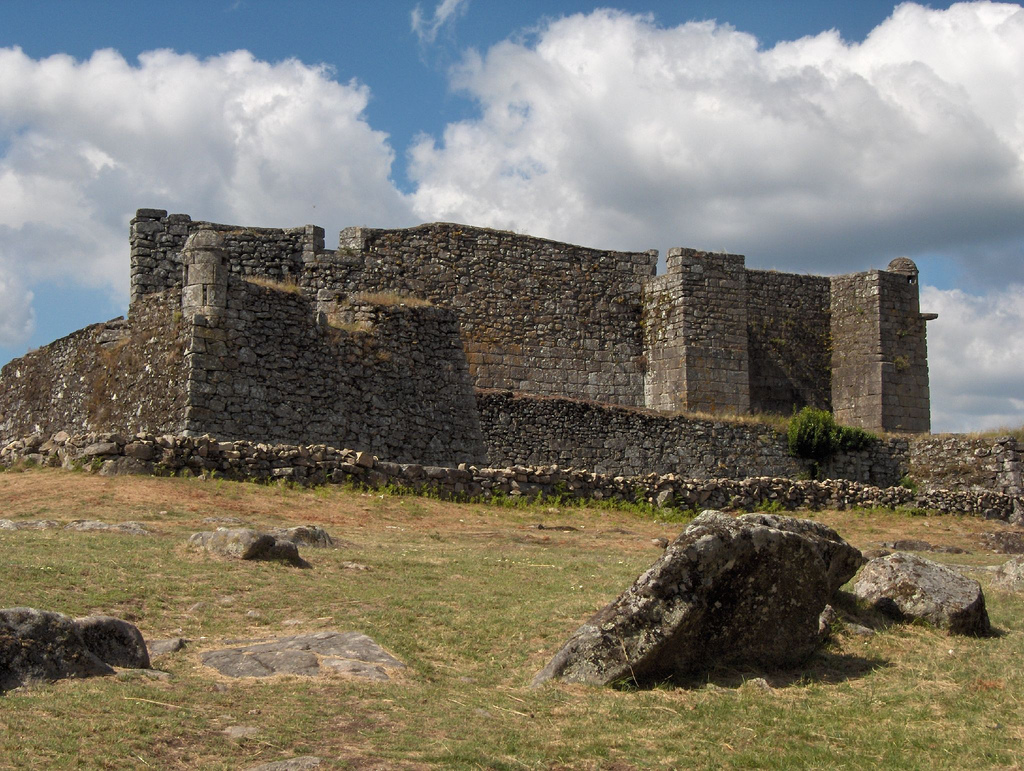
Castle of Lindoso
Below the walls of the Castle of Lindoso, sixty-seven granite granaries stand in tight formation like a village within a village. Called espigueiros, these narrow stone structures perch on stubby legs to keep grain safe from rodents, each one topped with a cross to ward off evil spirits. They date mostly from the 18th and 19th centuries, but the castle looming above them is far older. Built in the 13th century during the reign of Afonso III, the fortress was designed to do one thing: watch the Spanish border. It has been doing so, in one form or another, for nearly eight hundred years.
A Sentinel on the Lima
Lindoso sits in the remote northwest corner of Portugal, inside the boundaries of the Peneda-Geres National Park, the country's only national park. The castle occupies a hilltop overlooking the village, the valley of the Lima River, and the mountains of Spanish Galicia beyond. Afonso III ordered it built as part of a broader effort to strengthen Portugal's defensive borders, and its position was well chosen. From the battlements, the view extends deep into both countries, making surprise approach nearly impossible. For centuries, this was frontier territory in the fullest sense, a place where the line between Portugal and Spain was drawn not on paper but in stone.
Wars, Sieges, and a Door Dated 1666
The castle spent its early centuries in relative obscurity. That changed during the Portuguese Restoration War, which began in 1640 when Portugal broke free from sixty years of Spanish rule. Suddenly, Lindoso's border position made it strategically vital. In September 1641, the castle served as a staging base for Portuguese incursions into Galicia. As the war dragged on, the fortress received extensive modernization, completed around 1666, a date still inscribed on the lintel of one of its doors. The improvements came just in time: Spanish troops briefly captured the castle, only to lose it again three years later. A main ravelin defending the principal entrance was completed by 1720, and the castle saw its last military action during the Napoleonic Wars, when it was placed on defensive footing but never attacked.
The Granary Army
The espigueiros clustered below the castle walls are Lindoso's most distinctive feature. Numbering sixty-seven, they constitute the largest and best-preserved collection of communal granaries in the Peneda-Geres region. Each one is a narrow rectangular box of granite, raised on stone legs to allow air circulation and prevent moisture and vermin from reaching the maize stored inside. Slots in the side walls let wind pass through for drying. The crosses at their peaks are not merely decorative; they reflect a rural Catholic tradition of blessing the harvest and the structures that protected it. Seen together from a distance, the granaries resemble a miniature city, their peaked forms echoing the castle towers above them.
Stone, Weather, and Memory
After the wars ended, peacetime was not kind to the castle. Without a military purpose, maintenance ceased. Rain, wind, and neglect wore at the masonry for over a century. The Castle of Lindoso was declared a National Monument on June 23, 1910, but meaningful restoration did not begin until 1979. Today the keep still stands, divided into two floors, and the stone walls retain their battlements. The structure is built entirely of stone masonry, with the north and south ends of the tower once accessible by drawbridge. Visitors who climb to the top find a panorama that explains everything about why the castle was placed here: the green valley of the Lima, the granite peaks of Peneda-Geres, and to the east, the mountains of Spain.
From the Air
Located at 41.87N, 8.20W in the Peneda-Geres National Park, extreme northwest Portugal near the Spanish border. The castle sits on a prominent hilltop above the village of Lindoso and is visible from moderate altitude. The cluster of espigueiros granaries at its base creates a distinctive visual pattern. Nearest airports are LPVZ (Viana do Castelo) and LPBR (Braga), both approximately 70-80 km to the west. Terrain is mountainous; the Lima River valley provides a navigable corridor. Best viewed from 3,000-4,000 ft AGL.