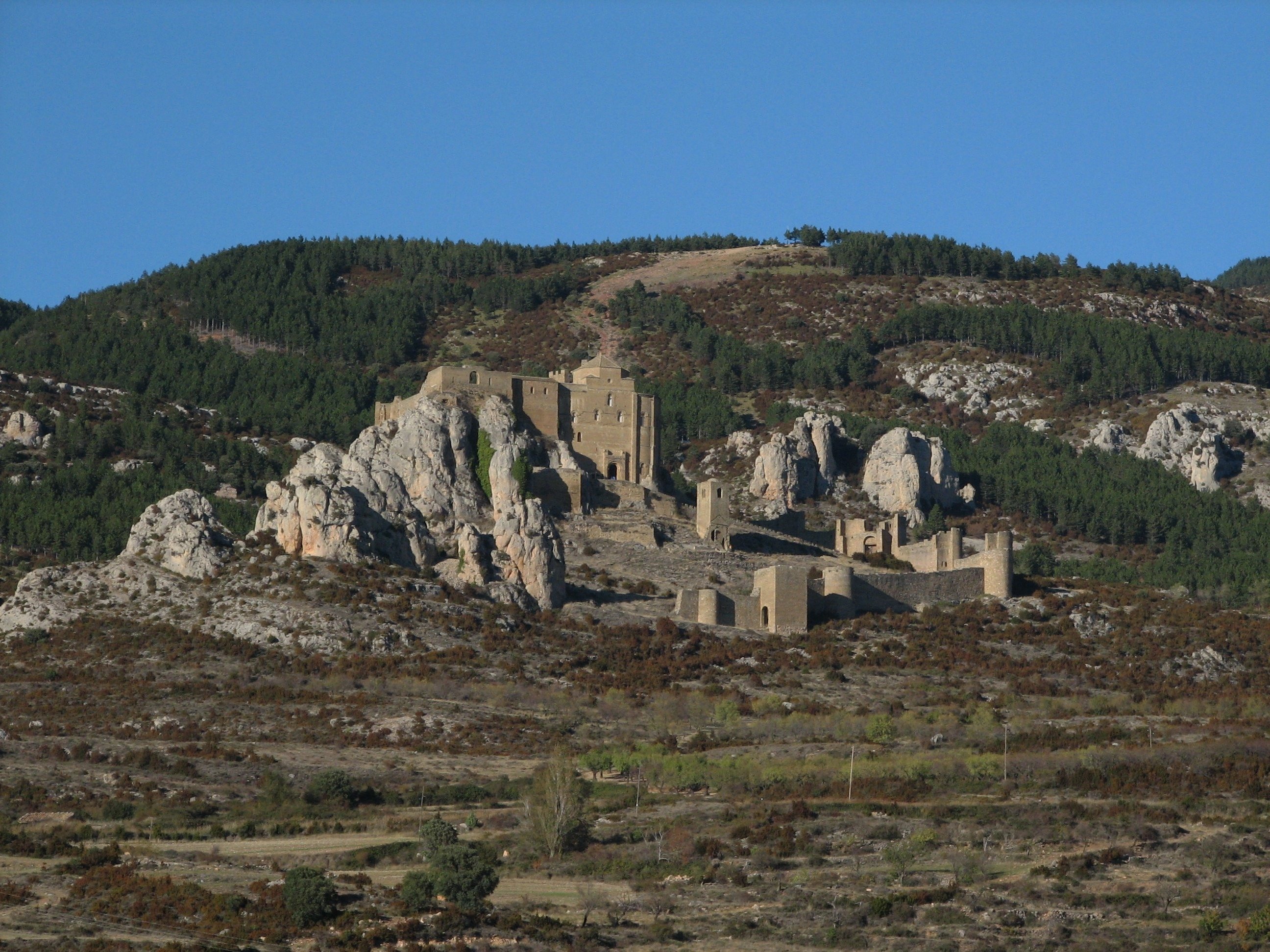
Castle of Loarre
Ridley Scott chose it to stand in for Jerusalem. When the director needed a Crusader fortress for his 2005 epic Kingdom of Heaven, he found what he was looking for not in the Holy Land but in the foothills of the Spanish Pyrenees, where the Castle of Loarre rises from a limestone outcrop above the plains of Huesca Province in Aragon. The castle's appeal to filmmakers is the same quality that made it formidable to medieval armies: it appears to grow directly from the rock, its walls and towers following the contours of the outcrop as if the mountain itself decided to fortify. One of the oldest castles in Spain, Loarre was built across two centuries of construction on the frontier where Christian and Muslim civilizations collided, rebuilt, and collided again.
Frontier Fortress
Construction began around 1020, when Sancho el Mayor reconquered the surrounding lands from Muslim control. The castle's first phase was purely military - towers, walls, and a chapel positioned to command the approaches from the south, where the Islamic frontier shifted with each generation's wars. The rocky outcrop dictated the layout from the start. Unlike the symmetrical castles of northern Europe, Loarre could never be a unified structure. It grew as a collection of buildings bounded by curtain walls, each element adapted to the irregular terrain beneath it. The keep, the Torre del Homenaje, was deliberately built in an isolated position in front of the main fortifications, connected only by a wooden bridge that could be destroyed if the outer defenses fell. It contained a basement and five floors - a last refuge of vertical defense.
The King Who Launched a Conquest
After 1070, Loarre's importance grew sharply. In 1073, King Sancho Ramirez installed a community of Augustinian canons within the castle walls, transforming it from a purely military outpost into a fortified monastery. It was from Loarre that Sancho Ramirez prepared his greatest ambition: the conquest of Huesca, the major Muslim-held city on the plains below. He would not live to see it completed - the city fell to his successor, Peter I of Aragon and Navarre, in 1094. By 1097, Peter had donated all of Loarre's goods to a new royal monastery at Montearagon, suggesting that the castle's strategic importance was already fading as the frontier moved south. But the building program continued, with architectural work extending well into the 12th century.
Stone That Remembers Two Worlds
The Torre de la Reina, or Tower of the Queen, survives as the most architecturally distinctive element of the complex. Its three floors are lit by three sets of twin-arched windows featuring columns with exaggerated entasis - the deliberate swelling of a column's profile - and trapezoidal capitals that scholars have linked to both Lombard and Mozarabic traditions. This blend is revealing. Lombard influence arrived from northern Italy through Catalonia, carried by builders working in the First Romanesque style. Mozarabic forms came from Christians who had lived under Muslim rule and absorbed Islamic decorative principles. In the stonework of a single tower, the two great cultural currents of medieval Iberia left their mark side by side.
Centuries of Rebuilding
The outermost walls and their eight towers date from the 13th or 14th century, a later ring of defense enclosing the older core. By then, the frontier had moved hundreds of kilometres south and the castle served administrative rather than military purposes. Neglect followed irrelevance. Walls crumbled, towers collapsed, and the Romanesque chapel lost its original timber roof, replaced by a vault at the end of the 11th century but subsequently deteriorating through centuries of exposure. A major restoration in 1913 began the slow process of recovery, and further campaigns in the 1970s rebuilt walls and towers that had fallen into ruin. Today the castle stands largely whole again, its Romanesque church and defensive architecture among the best preserved in Spain. Visitors climb the same rocky approach that Sancho Ramirez's soldiers once ascended, passing through curtain walls that frame views across the Aragonese plains - the same plains where Muslim and Christian armies once maneuvered for advantage beneath these walls.
From the Air
The Castle of Loarre sits on a limestone outcrop at 42.33N, 0.61W in the foothills of the Pyrenees, roughly 30 kilometers northwest of Huesca. The fortress is dramatically visible from the air, its walls following the contours of the rock against the green foothills. Best viewed at 2,000-4,000 feet AGL from the south or west for the full profile of the outcrop and castle. The nearest airport is Huesca-Pirineos (LEHC), approximately 15 nautical miles southeast. Zaragoza Airport (LEZG) is about 50 nautical miles south. Mountain winds and thermals are common in the foothills, especially in afternoon hours.