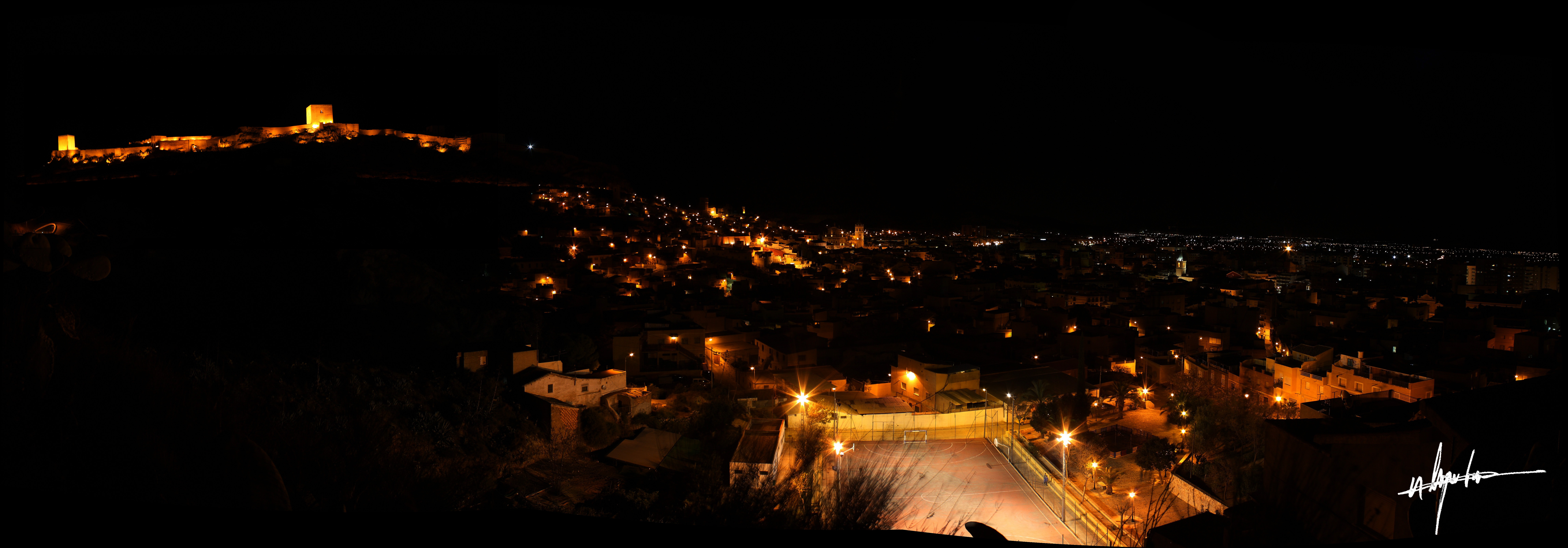
Castle of Lorca
Beneath the parador -- the luxury hotel that now occupies part of the Castle of Lorca -- construction workers uncovered something unexpected: the remains of a 14th-century Jewish quarter, complete with twelve homes and the only medieval synagogue ever found in the Region of Murcia. The discovery was fitting. This fortress, 640 meters long and 120 meters wide, one of the largest castles in Spain, has been accumulating layers of habitation since the Neolithic period. Each excavation reveals another civilization that called this hilltop home.
Before the Castle
Archaeological excavations conducted between 1999 and 2011 pushed the story of this hilltop back thousands of years before any castle existed. Beneath the medieval fortifications, researchers found an Argaric Bronze Age settlement that extended from the hilltop down to the site of the modern town, with homes, funerary sites, and a defensive wall. When the first castle or fortress was built here remains uncertain. The earliest written reference comes from Muslim sources in the 9th century, which identify the city of Lurqa as an important town in the territory of Theudimer, a Visigothic lord who governed seven cities in southeastern Spain under the Treaty of Orihuela. The fortress grew under Muslim rule into an impregnable stronghold, its interior divided by the Espaldon Wall into a western enclosure for livestock and grain storage and an eastern neighborhood called the barrio de Alcala.
The Frontier Fortress
In 1244, the Castilian Infante Don Alfonso -- the future Alfonso X -- conquered Lorca, and the castle became a critical defensive position against the Kingdom of Granada. For 250 years, this was frontier territory: the Christian kingdom of Murcia on one side, the Muslim state of Granada on the other, and Lorca Castle the watchtower between them. Alfonso X ordered the construction of the towers that still define the castle's silhouette -- the Alfonsina and the Espolón -- and rebuilt the walls so thoroughly that hardly a trace of the Muslim fortress survived above foundation level. The Castilian monarchs repopulated the town and maintained its defenses, understanding that Lorca's geographic position made it indispensable as long as Granada held out.
A Hidden Synagogue
The Jewish Quarter discovered during hotel construction extended over 5,700 square meters within the alcazaba, the Moorish inner fortification. The physical separation from the rest of the city served a dual purpose: protecting the Jewish community from harm while keeping Christians and Jews apart, with Christians inhabiting the lower town. The remains include twelve homes arranged on four terraces with irregular streets adapted to the landscape, and a synagogue dating from the 14th century. The synagogue's interior preserves the place where the Torah was kept, examples of Gothic-style yeseria plasterwork, and the plinth where the bimah stood. An angular foundation stone was partially sunk into the floor -- a way to gain interior height without exceeding the height of surrounding buildings, in compliance with laws of the period. The women's section, the matroneum, was located above the vestibule, accessed by a separate corridor.
Decline, Destruction, and Revival
When the frontier disappeared with the fall of Granada in 1492, Lorca Castle lost its strategic purpose. The expulsion of the Jews by Ferdinand and Isabella depopulated the Jewish Quarter. The castle was abandoned, deteriorating into near-complete ruin by the 18th century. It saw brief military service again during the Napoleonic War of Spanish Independence, when walls were repaired, structures modified, and a battery of cannons installed -- changes that erased much of its medieval appearance. On June 4, 1931, the castle was declared a National Historic Monument. Then, on May 11, 2011, the earthquake struck. The Espolón Tower and sections of the walls suffered serious damage, adding a new chapter of destruction and repair to a site that has been rebuilt repeatedly over a millennium. Today, the castle hosts medieval reenactments through the Lorca Taller del Tiempo program, and the parador hotel built within its walls offers guests the unusual experience of sleeping inside a fortress whose foundations are older than most European nations.
From the Air
Located at 37.68°N, 1.71°W on a prominent hilltop above the city of Lorca in the Region of Murcia, southeastern Spain. The castle's elongated profile (640m x 120m) is clearly visible from altitude. The Alfonsina and Espolón towers are prominent landmarks. Nearest airport: LEMI (Region of Murcia International Airport), approximately 65 km east. Best viewed at 2,000-5,000 ft AGL, where the castle's full extent and its relationship to the town below are clearly visible.