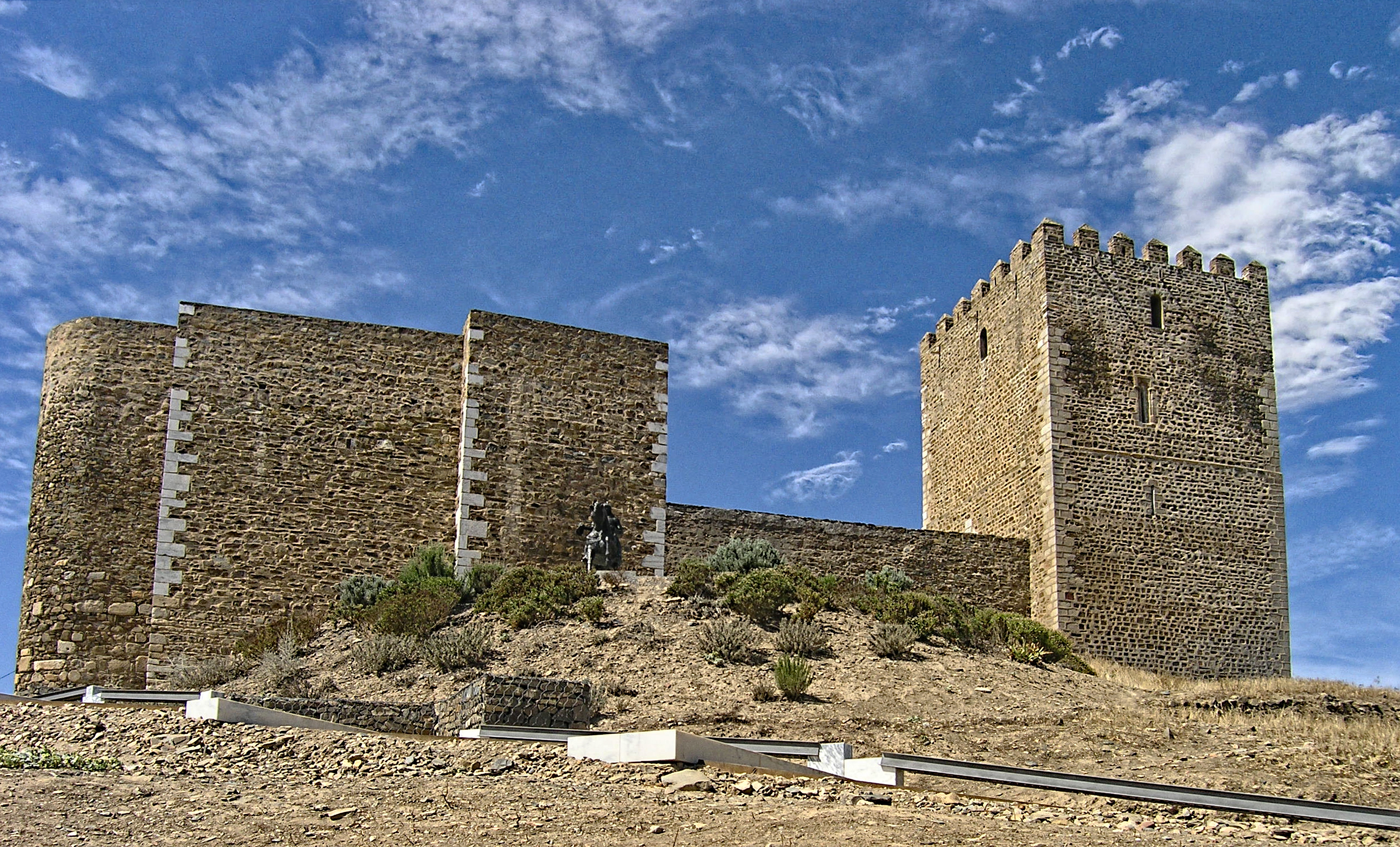
Castle of Mertola
Julius Caesar knew the town as Myrtilis Julia, the name he gave it in 44 BC. The Phoenicians, who founded it six centuries earlier as a replacement for their lost capital of Tyre, called it simply New Tyre. The Moors held it for centuries. The Knights of Santiago made it their headquarters. And through all of these reinventions, the castle atop the hill where the Guadiana River meets the Ribeira de Oeiras has endured, rebuilt and repurposed by each new occupier but never abandoned -- not until the 18th century, when Portugal's attention turned to the sea and left its inland fortresses to crumble.
A Trading Post Older Than Rome
In 318 BC, following Alexander the Great's invasion and sack of Tyre in Lebanon, displaced Phoenicians sailed west and founded Myrtilis on this strategic hilltop. The location was chosen for the same reasons every subsequent civilization would prize it: the confluence of river routes connected the settlement to the southern Iberian Peninsula and its mineral wealth. Carthaginians and Phoenicians frequented the region as a trading center long before Rome turned its attention to Hispania. Under Roman rule, Mertola became a center for mineral extraction and agriculture in the Baixo Alentejo, encircled by walls far grander than those visible today. The Romans were drawn by the same resource that would define Mertola's economy into the modern era -- the copper-rich earth of the surrounding hills.
From Mosque to Church, from Minaret to Bell Tower
The Almohad dynasty repaired and expanded the fortifications during the last third of the 12th century, constructing the walls that still encircle much of the settlement. In 1238, Sancho II of Portugal conquered Mertola during the Reconquista, ending centuries of Islamic rule. But the most eloquent testimony to the transition sits just outside the castle walls: a former Islamic mosque, transformed into the Church of Nossa Senhora da Assuncao, its architectural DNA still legible beneath the Catholic overlay. Between 1240 and 1316, Mertola served as the seat of the Military Order of Santiago, and in 1292 the Order's master Joao Fernandes commissioned the construction of the keep tower -- the 30-meter structure that still dominates the skyline.
A Frontier Fortress Abandoned
The castle's story traces the arc of Portugal itself. Through the 14th and 15th centuries, successive kings reinforced the walls and improved the fortifications. The Treaty of Moncao in 1386 returned Mertola to the Portuguese Crown. King Manuel issued a royal charter in 1512, and the castle appeared in Duarte de Armas's Book of Fortresses in 1509 -- a visual record of the kingdom's defensive network. But as Portugal's maritime empire expanded, inland frontier castles lost their strategic purpose. By 1758, Mertola was semi-ruined and un-garrisoned. The 19th and 20th centuries brought a new extractive economy: the mines of Santo Domingo, where cupric pyrite replaced the Romans' earlier mineral harvests. A 1969 earthquake damaged the old fortress further.
A Village Becomes Its Own Museum
The modern revival of Mertola transformed the entire settlement into a village museum. The keep tower, once a military stronghold, now serves as an observation deck and interpretive center presenting Roman, Visigothic, Christian, and Islamic collections. Among the displays is one of Portugal's finest collections of Islamic art -- pottery, coins, and jewelry that survived the Reconquista by the simple expedient of being buried underground. The Carouche Tower in the southwest, a compact cube just 4.7 meters wide, features a hemispheric cupola over pedestals, its Islamic architectural heritage still visible. In the courtyard, a covered cistern with a vaulted ceiling over three arches continues to hold water, as it has for centuries. From the battlements, visitors look down at the Guadiana -- the same river that drew the Phoenicians here twenty-three centuries ago.
From the Air
Located at 37.638N, 7.664W in Mertola, Beja district, southern Portugal. The castle and walled town are dramatically sited on a hilltop at the confluence of the Guadiana River and Ribeira de Oeiras, clearly visible from altitude. Nearest airport: LPBJ (Beja, ~55 km north). The Guadiana forms the Portuguese-Spanish border to the east.