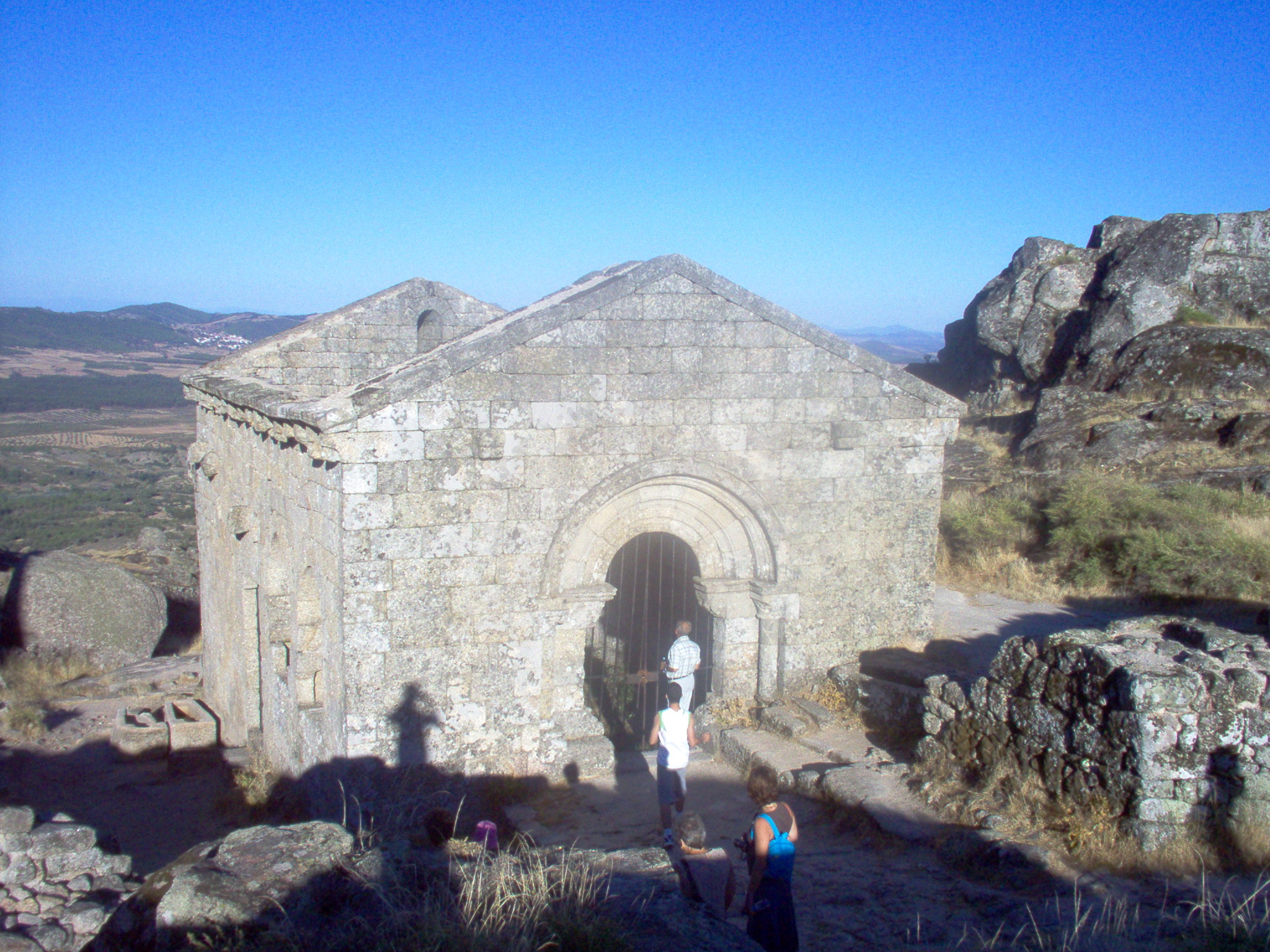
Castle of Monsanto
The boulders came first. Enormous granite outcroppings -- some as large as houses -- have jutted from the hilltop of Mons Sanctus since long before anyone thought to build walls between them. When the first fortifications appeared here, the builders did not try to clear the rock. They built around it, over it, through it, threading walls and towers between the boulders until castle and cliff became inseparable. In the village of Monsanto below, the tradition continued: houses were wedged beneath overhanging granite, using the stone as natural roofing. The result is a place where human architecture surrenders to geology, and a castle that seems less built than grown from the mountain itself.
From Roman Praetor to Templar Master
Legend traces the first fortification on Mons Sanctus to the 2nd century, when Roman Praetor Lucius Aemilius Paullus supposedly colonized a Lusitanian castro on the hilltop. The reality is murkier -- prehistory left traces on this height that predate Rome -- but the strategic value of the site is undeniable. At 763 meters above sea level, the hilltop commands views of the plains extending to the Serra da Gardunha in the west and the Spanish border in the east. Visigoths held it after Rome fell, then Arabs after the Visigoths. The castle entered its defining era in 1165, when King Afonso I of Portugal donated the region to Gualdim Pais, Master of the Knights Templar. On November 30 of that year, a letter of donation granted the Templars a vast territory stretching from Monsanto to Idanha-a-Velha, bounded by the Erges and Tagus rivers. By 1171, Gualdim Pais had built castles at both Monsanto and Idanha-a-Velha.
Loyalties and Powder Kegs
Monsanto's position on the frontier made loyalty a survival question. During the 1383-1385 Portuguese succession crisis, the village initially sided with Queen Beatrice and her Castilian husband -- but later switched allegiance to the eventual victor, King John I. The chronicler Fernao Lopes recorded the shift, noting that Monsanto was among the towns that realigned themselves by 1384. The new dynasty rewarded the village with privileges in 1407, 1436, and 1497, all aimed at one goal: keeping people in this exposed outpost. In the 17th century, the castle was adapted for artillery warfare, with earthworks, batteries, and cannon emplacements replacing the medieval defenses. Spanish and French forces besieged and captured it multiple times. Then, in 1815, the castle's own magazine exploded, partially destroying the fortress from within. Military engineer Maximiano Jose da Serra surveyed the wreckage, and his descriptions documented the scale of the loss -- walls blown outward, towers cracked, an entire section of the fortification rendered uninhabitable.
A Village Woven Into Stone
The castle sits within a broader fortified settlement that includes the parish of Sao Salvador, with its gates of Santo Antonio and Espirito Santo, defensive batteries, and walls that follow the contours of the rocky escarpment. Within the castle walls stand the ruins of the Romanesque Church of Sao Miguel, its main facade featuring a full-arch doorway with four archivolts and capitals decorated with zoomorphic figures. The columns display a standard cubit measure carved into the stone -- a practical medieval tool embedded in a sacred building. Nearby, the Chapel of Santa Maria do Castelo stands beside three trapezoidal tombs and a cluster of anthropomorphic excavations carved directly into exposed rock. The ruins of the Chapel of Sao Joao occupy the eastern flank. Together, these structures reveal a community that lived, worshipped, and buried its dead within the castle's protective embrace, surrounded by boulders that served as both foundation and shelter.
The Most Portuguese Village
In 1938, the Directorate General for Buildings and National Monuments began systematic restoration of Monsanto's walls, staircases, and battlements -- work that continued through the mid-20th century with repairs to towers, gates, and the chapel ceilings. But the village's most famous distinction came from a different kind of recognition. In the mid-20th century, Monsanto was voted the most Portuguese village in Portugal, a title that celebrated its extraordinary fusion of granite landscape and human settlement. The hilltop where Lucius Aemilius Paullus may have marched, where Templars raised their standards, where powder kegs exploded and armies traded sieges across centuries, endures as a monument not to any single era but to the stubborn human impulse to build a home in the most improbable of places. The boulders remain, and the walls curve around them still.
From the Air
Located at 40.04N, 7.11W on a prominent rocky hilltop at 763 meters elevation in the Castelo Branco district of eastern Portugal, near the Spanish border. The castle and village are striking from the air, with enormous granite boulders visible among and beneath the buildings. Nearest airports include Castelo Branco airfield and Lisbon (LPPT) approximately 250 km southwest. Best viewed at 2,500-3,500 feet. The Serra da Estrela mountain range is visible to the north, and the Spanish frontier lies to the east.