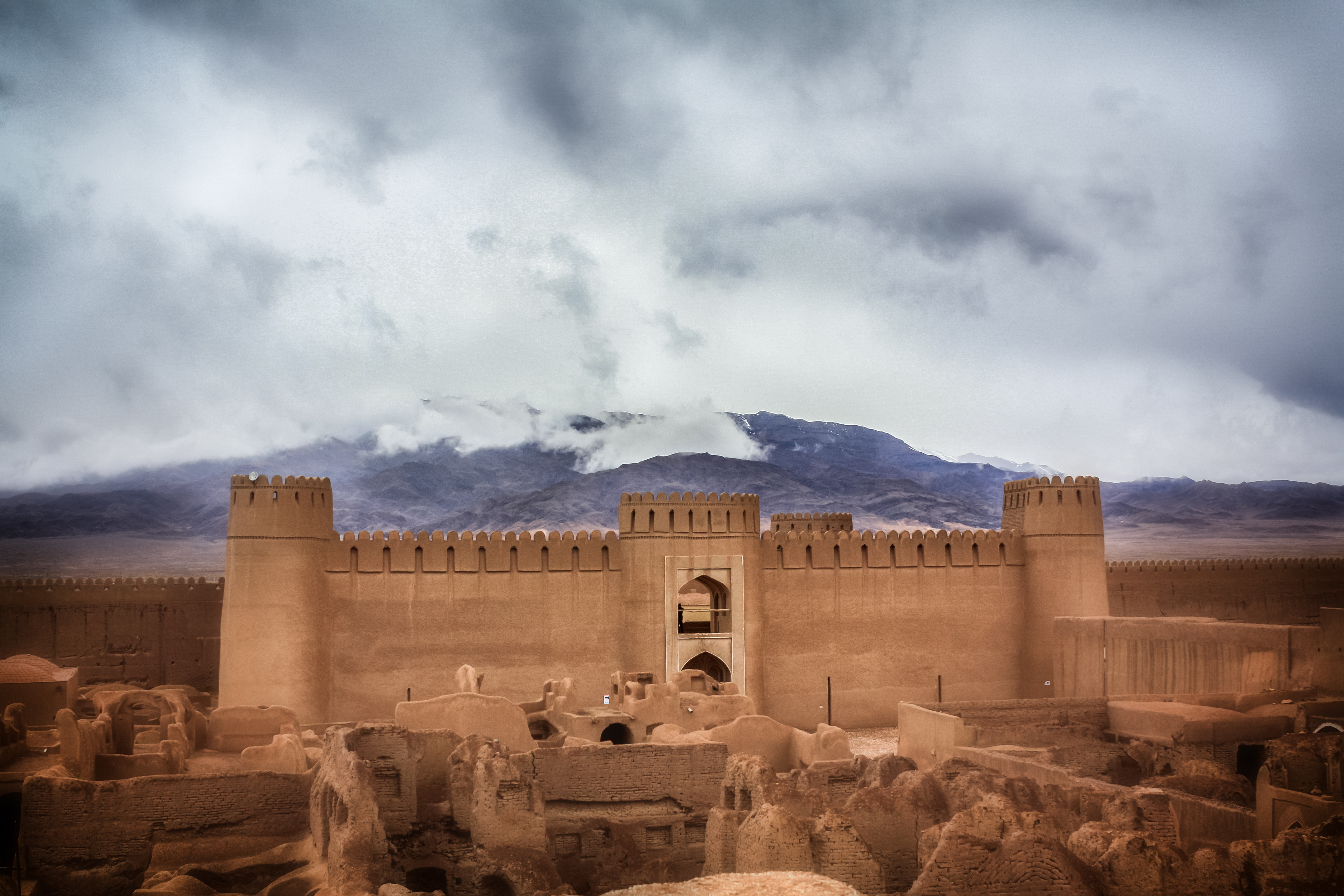
Castle of Oblivion
You were not executed. You were forgotten. That was the punishment the Sasanian kings reserved for their most dangerous political prisoners -- not a public death that might create a martyr, but disappearance into a fortress so secret that speaking its name was forbidden. The Castle of Oblivion, known in Armenian as berd Anush, held captive kings and deposed princes in the lowlands of Khuzestan, somewhere near the Karun River. No one was permitted to mention the prisoners held inside. Their names were erased from conversation. They ceased to exist in every way that mattered, except that they continued to breathe.
A Name That Contradicts Itself
Even the fortress's name carries layers of deception. Armenian sources called it berd Anush, and for centuries scholars interpreted this as the Castle of Oblivion -- a fitting name for a place designed to erase memory. But the linguist Claudia Ciancaglini has argued that the Armenian form is borrowed from an unattested Middle Persian phrase that can be reconstructed as anosh bard. In Middle Persian, anosh means not "forgotten" but "immortal." The original name likely meant the Imperishable Fortress. Armenians, hearing the foreign word, reinterpreted it through their own language, where anyush means "forgotten." So the castle was named twice: once for what it was -- a structure built to last forever -- and once for what it did to the people inside it. Both names turned out to be accurate. The fortress endured for centuries, and its prisoners were indeed lost to memory.
The King Who Took His Own Life
The most famous prisoner of the Castle of Oblivion was Arshak II, an Arsacid prince who ruled Armenia as a Roman client king from 350 until roughly 367 CE. His downfall began with the Sasanian king Shapur II's invasion of Armenia. Arshak had allied with Rome, but after the Roman emperor Julian's disastrous campaign against Persia ended in his death in 363, the resulting treaty left Armenia exposed. Shapur attacked, and Arshak was captured. He was sent to the Castle of Oblivion, where he remained for years. According to Armenian sources, sometime around 369 or 370, an Armenian eunuch named Drastamat -- who had served as a court official under Arshak and his father -- managed to visit the imprisoned king. Arshak spoke of his former glory, of battles and banquets and the throne he would never see again. Then he took Drastamat's knife and killed himself. Drastamat, stricken by what he had witnessed, pulled the blade from the dead king's chest and stabbed himself in turn.
The King Who Escaped
Not everyone who entered the Castle of Oblivion died there. Kavad I, a Sasanian king, was imprisoned after being deposed by his own nobility and clergy in 496 CE. His crime was supporting the radical teachings of the Mazdakite preacher Mazdak, whose egalitarian ideas threatened the wealth and power of the aristocracy. Kavad's brother Jamasp was installed on the throne in his place. But Kavad had allies his captors had not accounted for. His sister smuggled aid to him, and an officer named Siyawush helped organize his escape. Kavad fled east to the court of the Hephthalite king, a powerful Central Asian ruler with his own reasons for wanting a friendly king on the Sasanian throne. The Hephthalite king gave Kavad an army and his daughter in marriage. In 498 or 499, Kavad marched back into Iran. Jamasp, calculating that resistance would mean civil war, stepped aside. Kavad reclaimed the throne and ruled for another thirty years.
Lost to the Landscape
The Castle of Oblivion fulfilled its own prophecy. Its precise location is unknown. Scholars believe it stood near the ancient city of Gundeshapur, along the Karun River in what is now Khuzestan province, but no confirmed ruins have been identified. The Roman historian Ammianus Marcellinus may have referenced the same fortress under the name Agabana when describing the imprisonment of Arshak II, which would place it in the broader region between Shushtar and Dezful. Another prisoner, Khosrov IV of Armenia, was deposed and sent to the castle after 387 CE but was eventually released and returned to power under the Sasanian king Yazdegerd I -- proof that oblivion was sometimes reversible. The fortress may lie beneath modern construction, or it may have been built of materials that returned to the earth centuries ago. A prison designed to make people forget succeeded so completely that even the building itself has been forgotten.
From the Air
The Castle of Oblivion's exact location is unknown, but scholars place it near ancient Gundeshapur along the Karun River in Khuzestan province, Iran, in the vicinity of 32.03°N, 49.85°E. The area between modern Shushtar and Dezful, where the Karun flows through flat alluvial lowlands before reaching the Zagros foothills to the east, is the most likely region. From altitude, the Karun River is the dominant feature -- Iran's only navigable river, winding through the plain. Nearest airport is Ahvaz International Airport (OIAW), approximately 120 km to the southwest. The ancient city of Gundeshapur (modern Shahabad) lies roughly 14 km southeast of Dezful. Best viewed at 10,000-15,000 feet to survey the broad Khuzestan plain where the fortress once stood.