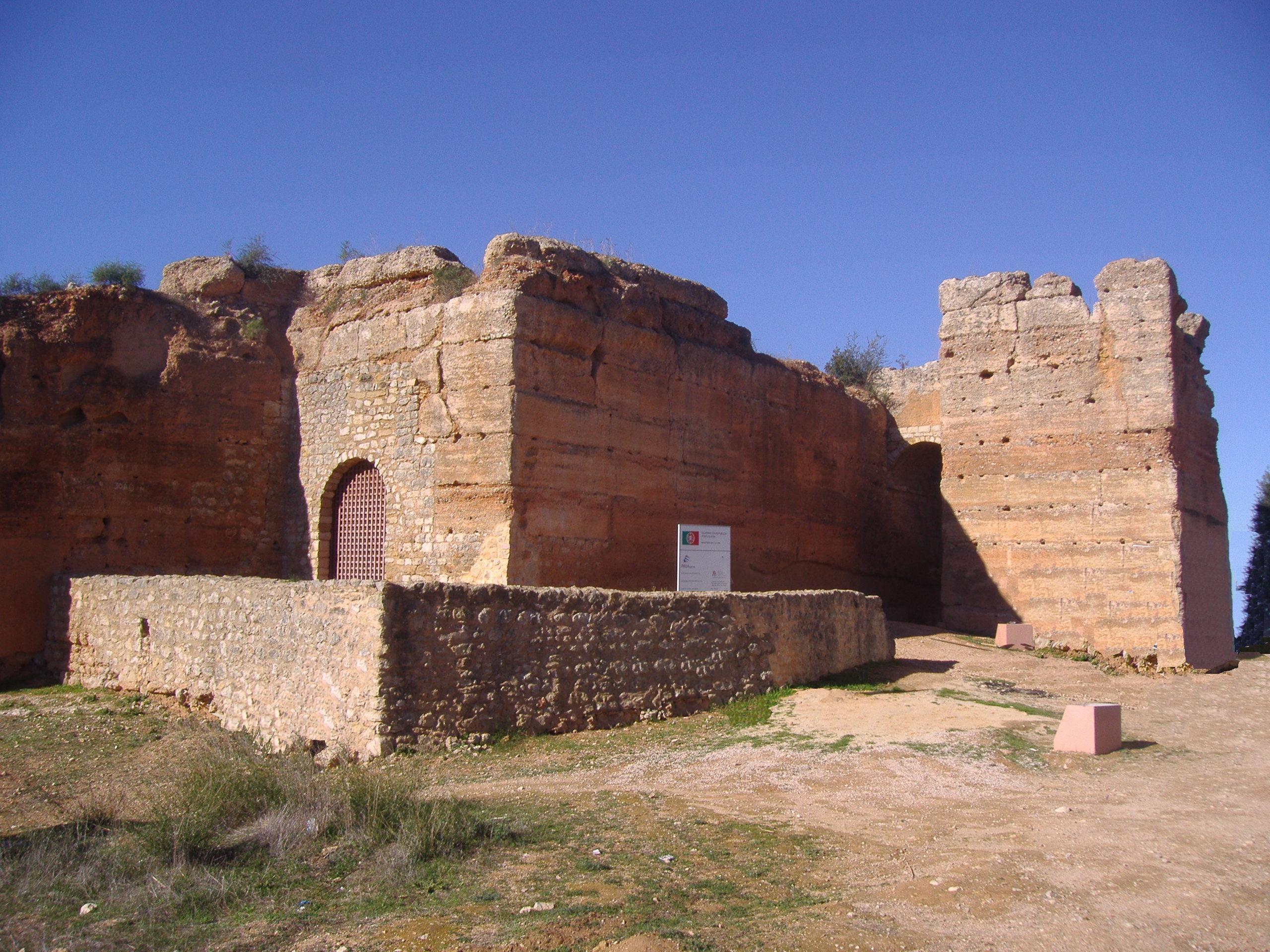
Castle of Paderne
Look at the Portuguese flag and you will see five small blue shields arranged in a cross on a white inset, surrounded by seven castles on a red border. Those castles are not abstract symbols. They represent real fortifications captured during the Reconquista, the centuries-long campaign to reclaim the Iberian Peninsula from Moorish rule. The Castle of Paderne, a crumbling Almohad fortress perched on a rocky bend of the Quarteira River in the Algarve, is believed to be one of them. Eight kilometers from the resort town of Albufeira, yet a world away from its beach umbrellas and cocktail bars, Paderne sits in the quiet interior where the Algarve's tourist economy gives way to cork oaks and red earth.
Romans, Moors, and the Road South
Long before the Almohads raised their walls here, the site had strategic value. Around the middle of the 2nd century, the Romans conquered a Lusitanian hill settlement, a castro, that had existed since the Neolithic period. They transformed it into a military outpost and eventually a politico-administrative center called Paderne or Paderna. The location mattered because it controlled the ancient Via Lusitanorum, the Roman road that crossed the Quarteira River at this point. The rocky peninsular bend on which the settlement sat made it naturally defensible, a quality that every subsequent occupant would exploit. After Rome fell, the site passed through various hands until the Moors captured the Roman villa by 713, beginning five centuries of Islamic rule in the Algarve.
The Almohad Builders
The walls that survive today date from the late 12th century, when the Almohad dynasty undertook an intensive program of military construction across the Algarve. The threat driving this building campaign was real: Christian armies from the north were advancing steadily, and the depopulation of the Muslim countryside caused by their raids left communities vulnerable. The Almohads fortified Paderne alongside Faro, Loule, Silves, and many other locations, creating a network of defensive positions that allowed civilians to shelter in the relative safety of the Algarvean Barrocal, the rocky limestone interior. The Castle of Paderne was built from taipa, rammed earth reinforced with lime, a construction technique that the Almohads employed throughout their territories. The reddish walls, now crumbling but still standing to considerable height, blend into the surrounding landscape as if the fortress grew from the earth itself.
A Ruin on the Flag
The castle fell to Portuguese forces during the Reconquista, joining the constellation of captured fortresses that came to symbolize national identity on the flag. Inside the ruined walls, the Chapel of Nossa Senhora do Castelo was later built, its own ruins now adding a Christian layer to the Moorish and Roman foundations beneath. A medieval bridge, the Ponte de Paderne, restored in 1771, still crosses the Quarteira River below the castle, connecting the hilltop to the surrounding countryside along roughly the same route the Romans laid out nearly two thousand years ago. Today the castle is a National Monument, its taipa walls weathering slowly under Algarve skies. There are no ticket offices, no audio guides, no cafes. Just the fortress, the river, the bridge, and the long view across the Barrocal that the Almohad sentries would have recognized.
From the Air
Located at 37.157N, 8.201W in the Algarve interior of southern Portugal, about 8 km north of Albufeira. The ruined castle sits on a prominent bend of the Quarteira River and is visible from the air as a reddish-walled enclosure on a rocky outcrop. Nearest airport is Faro (LPFR), approximately 35 km east. Best viewed at 1,500-3,000 ft AGL.