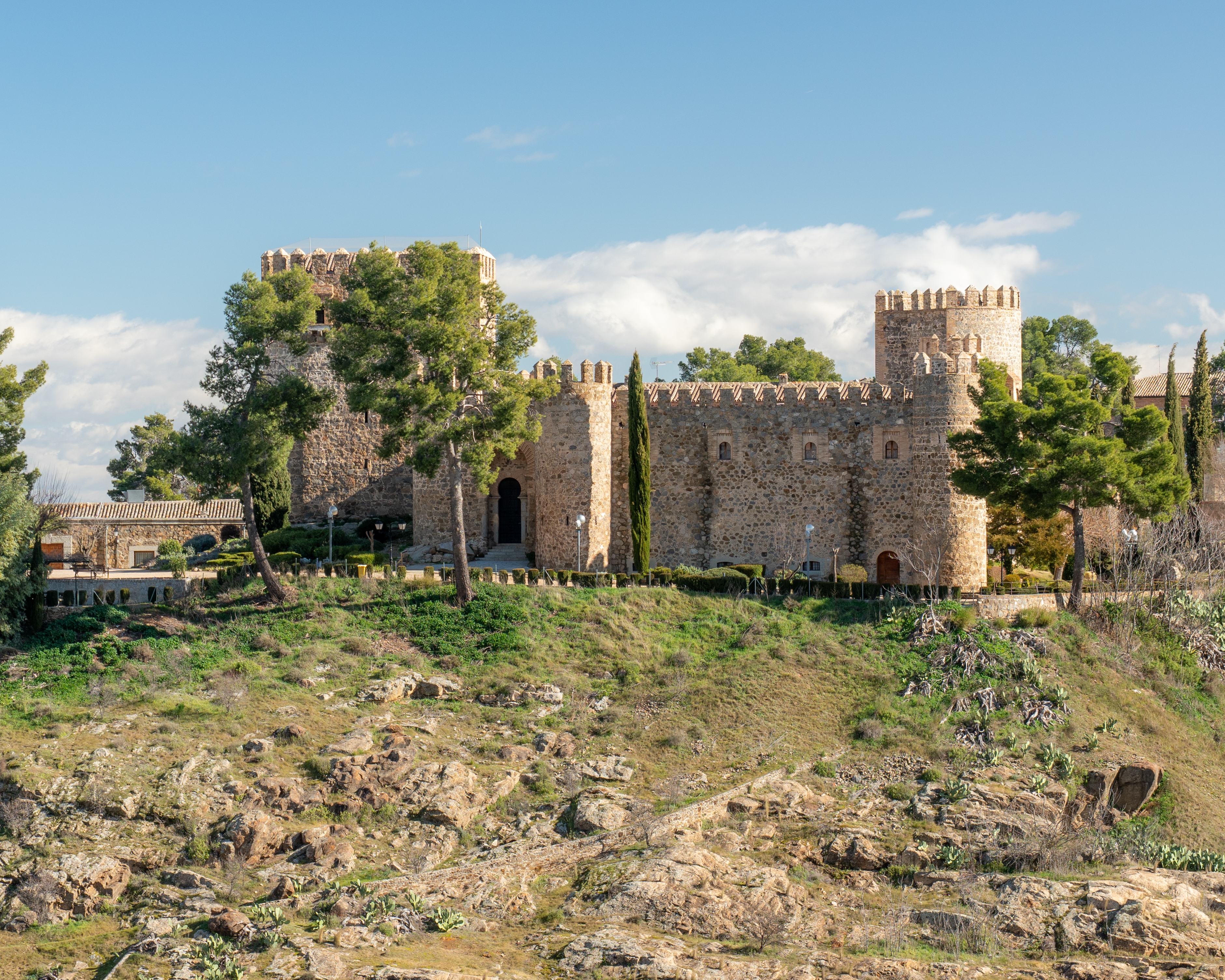
Castle of San Servando
You can sleep in a castle that El Greco painted. The Castle of San Servando rises above the Tagus River on the opposite bank from Toledo's old city, its crenellated walls and square towers appearing in El Greco's celebrated View of Toledo - that brooding, storm-lit landscape that made the city iconic. Today the fortress operates as a youth hostel, which means teenagers with backpacks bed down in a structure where Benedictine monks once chanted, Knights Templar once trained, and a papal legate once arrived to reshape the liturgy of an entire peninsula.
Before the Castle, the Monks
Evidence points to a monastery and basilica on this site possibly dating to the 7th century, during the Visigothic period when Toledo served as the capital of a kingdom that spanned most of Iberia. The monastery was dedicated to San Servando, but its early centuries are poorly documented - the centuries of Muslim rule that followed the Moorish conquest of 711 left few Christian records intact. What is known is that in 1080, Cardinal Richard of St. Victor, a monk from the ancient Abbey of St. Victor in Marseille, arrived as the legate of Pope Gregory VII. His mandate from the Council of Burgos that year was transformative: he was to ensure the adoption of the Roman Rite across Iberia, replacing the ancient Mozarabic Rite that Christians had used for centuries. San Servando received specific instructions for restoration and liturgical conversion. The old ways of worship would end here.
Conquest and Reconstruction
Five years after the papal legate's visit, everything changed. In 1085, King Alfonso VI of Castile conquered Toledo from its Muslim rulers, one of the most significant victories of the Reconquista. Both Alfonso and his wife, Constance of Burgundy, became generous benefactors of the basilica and rebuilt the monastery. The site's position - across the river from Toledo proper, commanding a view of the main approach roads - made it as much a military asset as a spiritual one. At some point, the Knights Templar took control, transforming a house of prayer into a fortified outpost. The Templars were soldier-monks, and the castle's defensive architecture reflects their dual nature: walls thick enough to withstand siege, positioned to protect a crossing point over the Tagus.
The Painter's Eye
El Greco arrived in Toledo in 1577 and spent the rest of his life there, dying in 1614. His View of Toledo, painted around 1596 to 1600, is one of the few pure landscapes in Western art before the 19th century - a vision of the city under a turbulent green-gray sky, with buildings rearranged for dramatic effect. The Castle of San Servando appears in the composition, part of the landscape that El Greco both recorded and reimagined. The painting hangs in the Metropolitan Museum of Art in New York, but the castle it depicts still stands on its hill above the Tagus, looking much as it did four centuries ago. In 1874, Spain designated it a national monument, recognizing what El Greco had already understood: this was a building worth preserving.
From Fortress to Hostel
The path from monastery to Templar stronghold to national monument to youth hostel traces an arc that is peculiarly Spanish. Many of Spain's medieval castles fell into ruin after their military purpose expired; some became quarries for building stone, others romantic backdrops for grazing sheep. San Servando survived intact enough to be repurposed. It sits on the eastern bank of the Tagus, connected to the Santa Barbara residential area by the Cuesta de San Servando, a road that climbs the hill from the river. From its walls, you can look across at Toledo's skyline - the cathedral, the Alcazar, the tight medieval streets - and see essentially what El Greco saw, minus the electrical lines. That a building founded for contemplation, fortified for war, and immortalized in paint should end up hosting backpackers feels less like a decline than a continuation. The castle has always served whoever needed it most.
From the Air
Located at 39.86N, 4.02W on the eastern bank of the Tagus River in Toledo. The castle is visible as a fortified structure across the river from Toledo's historic center, which occupies a dramatic hilltop position in a bend of the Tagus. The entire city of Toledo is one of Spain's most recognizable aerial landmarks - a medieval city on a granite hill nearly surrounded by the river gorge. Nearest major airport is Madrid-Barajas (LEMD), approximately 70 km northeast. Toledo's terrain is dramatic: the Tagus has carved a deep gorge around the city, making the castle's position on the opposite bank immediately apparent. Best viewed at 2,000-5,000 feet.