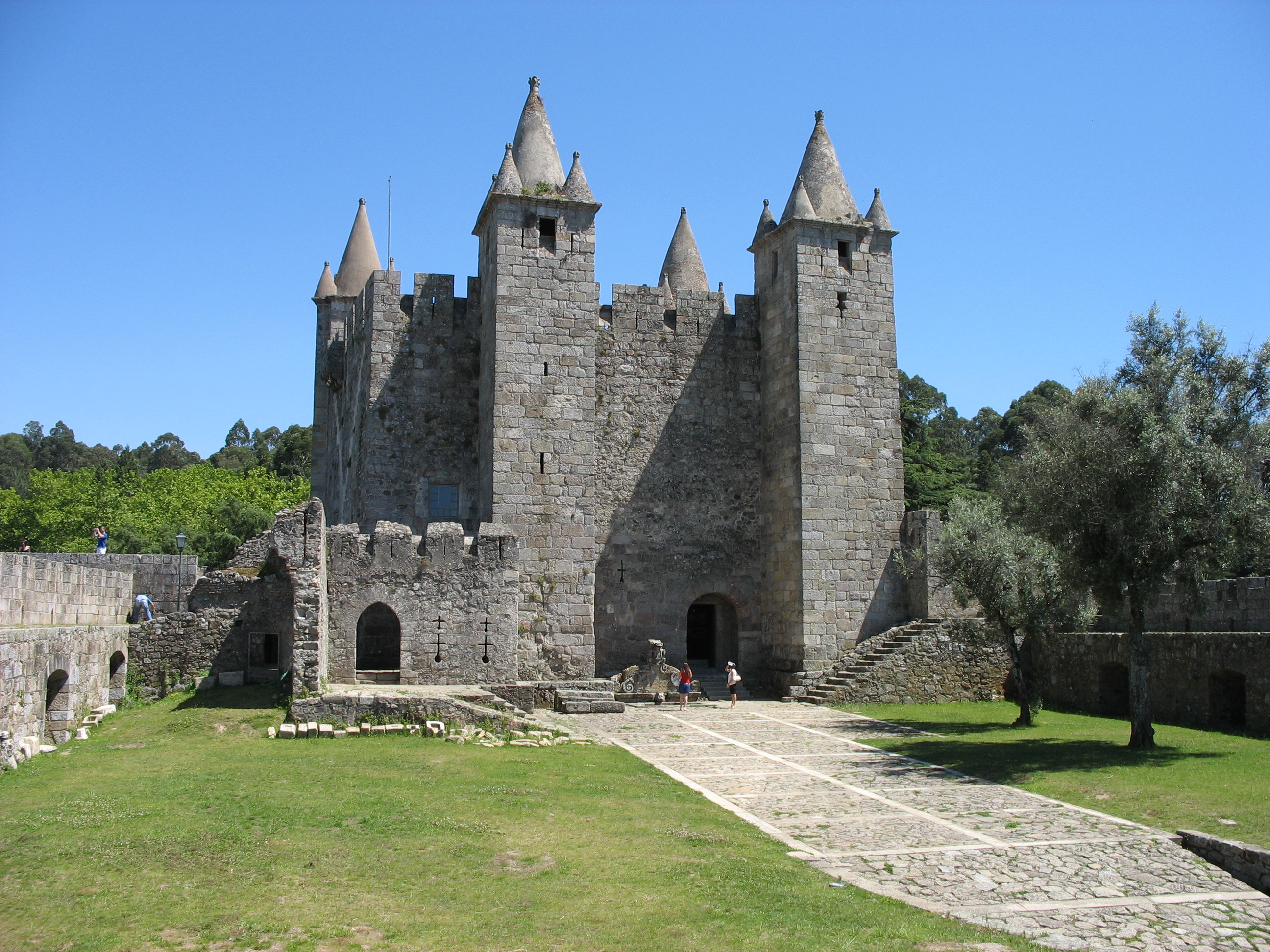
Castle of Santa Maria da Feira
In 1128, a son turned against his mother at the Castle of Feira. Afonso Henriques, who would become Portugal's first king, revolted against his mother Queen Teresa, Countess of Portugal, in a power struggle that would ultimately separate Portugal from the Kingdom of Leon and set it on the path to independence. The castle at the center of this family rupture had already stood for centuries, guarding a frontier that shifted with every battle of the Reconquista. Its walls tell a story that stretches from pre-Roman worship to medieval warfare to the birth of a nation.
Before the Fortress, a Temple
Long before any castle rose on this hilltop in the Aveiro district, the site held meaning. Tradition holds that an indigenous temple dedicated to Bandeve-Lugo Toiraeco -- a local pre-Roman divinity -- once occupied the spot. Archaeological evidence confirms Roman settlement here dating to the early empire, and a Roman road connecting Lisbon (Olissipo) and Braga (Bracara Augusta) passed through the vicinity. The sacred site was eventually transformed into a Marian temple, layering Christian worship over older foundations. This pattern of spiritual continuity, one faith building on another's sacred ground, runs through the castle's entire history.
Frontier Fortress of the Reconquista
In 868, Alfonso III of Leon established the administrative and military region he called Terra de Santa Maria, anchoring its defenses on the existing fortress at Civitas Sanctae Mariae. For generations, this was a forward base in the Christian campaign to reclaim Iberia from Moorish control. The castle faced south, toward the threat. A fair grew up in its shadow -- a market so significant that it eventually gave the town its name, Feira. By 1117, it had become one of the most important trading fairs in Portugal. The first reference to a formal built structure on the site appears in the 11th-century Chronica Gothorum, documenting the construction of the lower keep and fortress that formed the castle's earliest stone core.
A Millennium in Layers
The castle one sees today is not a single building but an accumulation of centuries. Romanesque foundations give way to Gothic walls, which in turn support Manueline additions. During the 14th century, likely under alcalde Goncalo Garcia de Figueiredo around 1357, the outer walls were finally completed. Under the Pereira family, the castle was transformed from a military fortress into a seigneurial residence, gaining the guard towers, turrets, and distinctive conical roofed defenses that define its silhouette today. A 17th-century palacete was built within the walls, though it has since been destroyed -- only a fountain survives from that era. The castle was classified as a National Monument in 1910, ensuring its preservation as one of Portugal's finest examples of evolving medieval military architecture.
Stronghold of Memory
What makes Feira exceptional among Portuguese castles is not any single architectural element but the sheer range of defensive strategies visible in one place. From its earliest Roman-era earthworks through its Romanesque keep, Gothic curtain walls, and late-medieval towers, the castle reads like a textbook of fortification across the Middle Ages. Each era left its mark without erasing what came before. Today, the castle hosts an annual medieval fair that reenacts the trading tradition that gave the town its name, bringing jousting, period crafts, and historical performances into the shadow of walls that have watched over this hilltop for more than a thousand years. From above, the castle's compact, turreted profile is unmistakable against the surrounding town, a reminder that some places accumulate meaning the way geological strata accumulate stone.
From the Air
Located at 40.92N, 8.54W in the Aveiro district of northern Portugal, approximately 30 km south of Porto. The castle sits prominently on a hilltop and is visible from altitude with its distinctive conical-roofed towers. Nearest major airport is LPPR (Francisco Sa Carneiro Airport, Porto, ~35 km north). The town of Santa Maria da Feira spreads around the castle hill. The River Caster runs nearby.