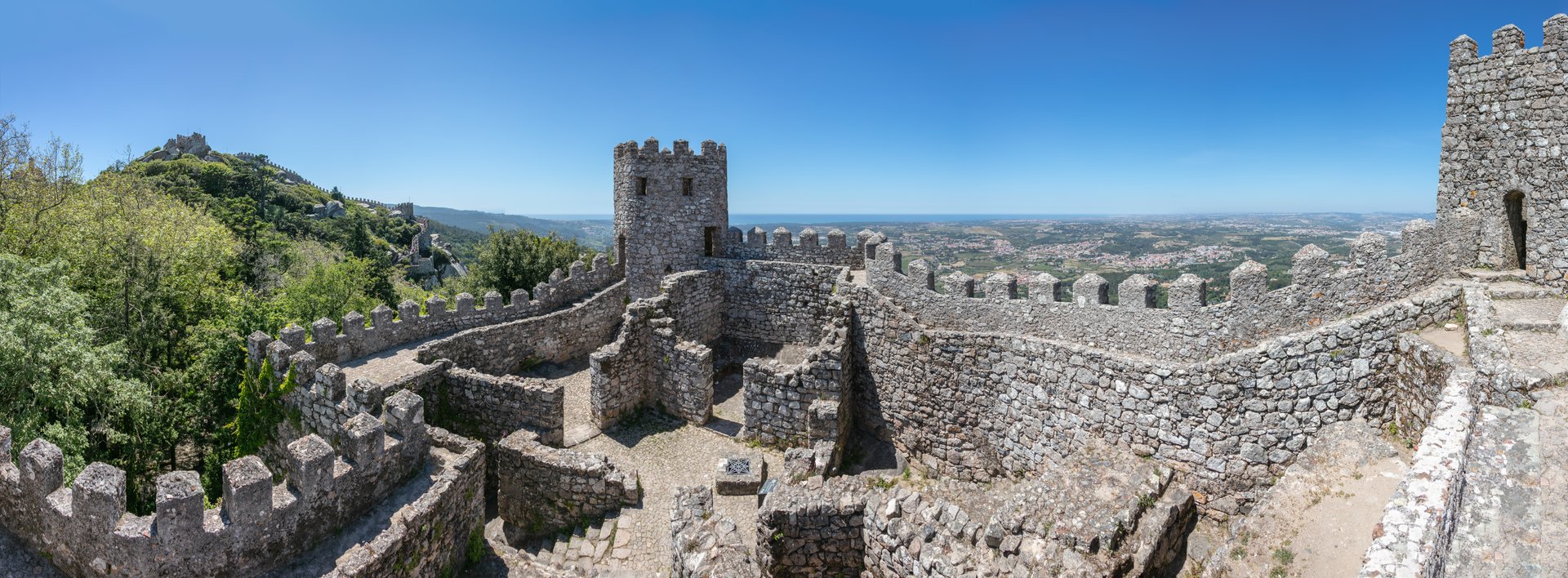
Castle of the Moors
Fog is the castle's most faithful companion. Perched in the Sintra Mountains northwest of Lisbon, the Castle of the Moors spends much of its existence wrapped in Atlantic mist that rolls up from the coast and settles among its ruined walls like a permanent resident. June brings the thickest fogs -- a phenomenon the Portuguese share with California, both coastlines subject to the same seasonal marine layer. On clear days, the castle's crenellated walls snake along the mountain ridge with views stretching to the Atlantic. On foggy days, which are frequent, the battlements dissolve into whiteness and a visitor might believe they have walked backward through twelve centuries.
A Fortress for Farmers
The Moors built this castle in the 8th and 9th centuries, during the period of Muslim Iberia known as Al-Andalus, but not as a military command post. The surrounding territory was primarily agricultural, and the fortress served to protect the farming population that worked the fertile slopes of the Sintra Mountains. It was a practical structure for practical people -- stone walls and watchtowers positioned to guard terraced fields and irrigation channels rather than to project imperial power. This agricultural character helps explain why the castle changed hands with relatively little drama. In 1031, after the fragmentation of the Caliphate of Córdoba into competing Taifa kingdoms, the king of Badajoz traded several territories on the Iberian Peninsula -- Sintra among them -- to Alfonso VI of Leon and Castile in exchange for a military alliance. Land for loyalty: the transaction of an era.
The Christian Conquest
The castle's decisive moment came in 1147, when Christian forces captured Sintra after the fall of Lisbon to Portugal's first king, Afonso Henriques. The conquest was part of the broader Reconquista that swept southward across the Iberian Peninsula over several centuries, replacing Muslim governance with Christian kingdoms. Unlike many fortresses that saw prolonged sieges and bitter resistance, the Castle of the Moors appears to have been taken as part of Lisbon's wider capitulation rather than through direct assault. Once in Christian hands, the castle served as a defensive position in the Sintra Mountains, though its military importance gradually diminished as the frontier of conflict moved south into the Algarve and beyond. What remained was a stone skeleton on a mountaintop, beautiful in its decay.
Frescoes in the Fog
Within the castle walls, a small chapel preserves traces of the devotion that followed the Christian conquest. Its main chapel features a cradle vault with remains of frescoes depicting a halo in the sky surrounding a figure believed to represent the patron saint, surrounded by floral and geometric motifs within a frieze of geometric designs. A small rectangular niche beside the oratory once held religious equipment. The northern facade retains a primitive doorway with a 1.5-meter opening, elevated above the steep terrain. An 1830 lithograph by the artist Burnett captured the chapel's place within the castle complex, documenting a building that was already ancient and declining. At the end of the 19th century, the administrator of the Forestry Service, Carlos de Nogueira, authorized several conservation projects that preserved both the castle and its chapel from further deterioration.
A Climate of Its Own
The Castle of the Moors occupies its own microclimate, distinctly different from the city visible in the distance below. Compared to Lisbon, the castle has cooler temperatures year-round, fewer sunshine hours, and significantly more precipitation, humidity, and fog. Winter daytime temperatures average around 12 degrees Celsius, dropping to 6 at night, though freezing is uncommon thanks to the Atlantic's moderating influence. Summers bring daytime temperatures of about 21 degrees -- pleasant by any standard -- with nighttime lows around 15. November and December are the wettest months. The castle is classified as a National Monument and forms part of the Cultural Landscape of Sintra, a UNESCO World Heritage Site that encompasses the mountain range's extraordinary concentration of 19th-century Romantic architecture, medieval ruins, and exotic gardens. On the slopes below the Moorish walls, the Palace of Pena rises in its Romantic extravagance, and the forests planted by King Ferdinand II create a green canopy that climbs toward the castle's ancient stones.
From the Air
Located at 38.79N, 9.39W in the Sintra Mountains, about 25 km northwest of Lisbon. The castle's walls follow the mountain ridge and are visible from the air as a serpentine line of crenellated stone among dense forest. The nearby Pena Palace with its colorful towers is the most conspicuous landmark in the area. Recommended viewing altitude: 2,000-4,000 feet. Nearest airports: Lisbon Humberto Delgado (LPPT), approximately 15 nm southeast; Cascais aerodrome (LPCS) about 8 nm south. Fog is extremely common in the Sintra Mountains, especially in summer mornings; the castle may be obscured.