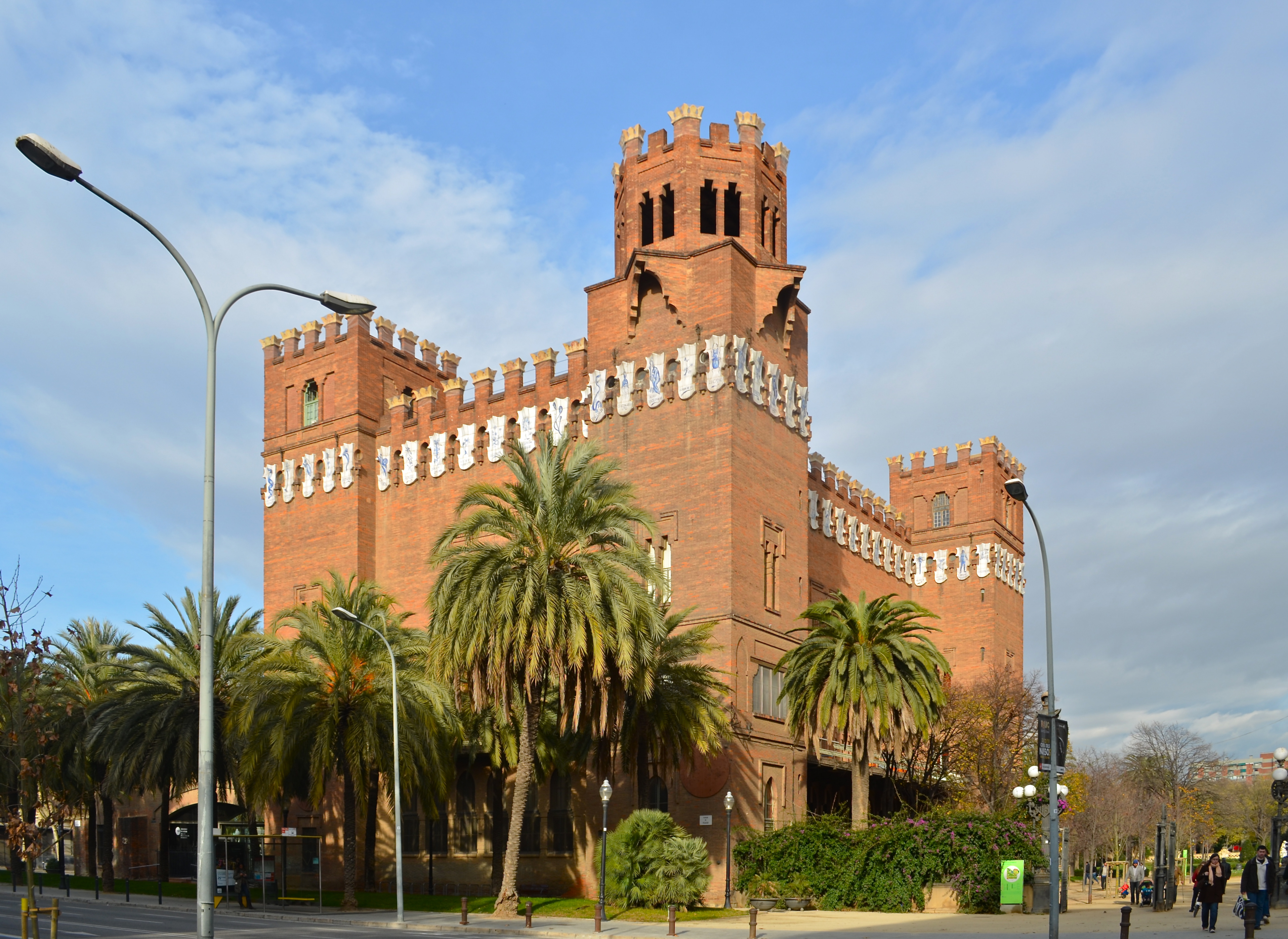
Castle of the Three Dragons
The architect resigned before the building opened. Lluis Domenech i Montaner had been working on the Cafe-Restaurant for Barcelona's 1888 Universal Exposition since September 1887, but construction delays pushed the completion from the inauguration on 8 April all the way to 17 August. By then, Domenech had quit in frustration. The building survived his departure and outlived its original purpose, acquiring along the way a nickname borrowed from an 1865 play by Serafi Pitarra: the Castle of the Three Dragons. It is one of those rare structures whose afterlife has been more interesting than anything its creator intended.
A Castle Made of Brick and Iron
Domenech i Montaner designed the building as an exercise in Modernisme, the Catalan architectural movement that was Barcelona's answer to Art Nouveau. But where other Modernisme architects leaned toward organic curves and floral ornament, Domenech built something that looked medieval from the outside and industrial on the inside. The plan is nearly square, with four corner towers and battlements that give it the silhouette of a fortress. Between the exterior walls runs a perimeter walkway, and the structure itself is a transparent framework of brick and exposed iron, a technique that anticipated the work of Dutch architect Hendrik Petrus Berlage in his Amsterdam Stock Exchange. The decorative program is rich: ceramic paintings by Joan Llimona and Alexandre de Riquer, sculptures by Antoni Vilanova, and blue-on-white shield-shaped panels on the battlements depicting plants, animals, and, charmingly, various drinks and liquors, a nod to the building's original purpose as a place to eat and drink. The stained glass windows, partially lost now, were by Antoni Rigalt i Blanch.
From Cafe to Laboratory
When the exposition ended, Domenech returned to the building he had abandoned in frustration. He installed an industrial arts workshop focused on architectural crafts, possibly collaborating with Antoni Maria Gallissa i Soque. The space became a laboratory for the techniques that would define Barcelona's Modernisme movement: ceramic work, ironwork, stained glass. It was here, in a building designed for casual dining, that some of the decorative methods used in Barcelona's greatest architectural achievements were developed and refined. The transformation from cafe to workshop was the first of many reinventions. The building later became a museum, housing collections in history, archaeology, biology, and natural sciences.
War, Soup, and Zoology
The Spanish Civil War brought bombs. Francoist aviation damaged the building, and it was closed for the duration of the conflict. Between 1942 and 1945, in the hungry years following the war, it served as a dining hall for Social Aid, feeding a population that Franco's victory had left impoverished. After the war's deprivations faded, the building returned to its museum function, serving as the Zoology Museum of Barcelona from 1920 to 2010, with interruptions for war and social crisis. Ninety years of natural history specimens occupied a building that had started life serving coffee. When the zoology collections were finally dismantled and relocated to the new Museum of Natural Sciences at the Forum Building, the Castle of the Three Dragons entered yet another period of transition.
Modernisme's Unassuming Masterpiece
The building sits at the edge of the Parc de la Ciutadella, at the end of the boulevard that runs from the Arc de Triomf, an axis designed for the 1888 exposition that still defines the neighborhood's flow. A major restoration in the 1980s by architects Cristian Cirici, Pep Bonet, and Carles Basso brought the structure back to something approaching its original condition. The Castle of the Three Dragons lacks the celebrity of Gaudi's buildings or even Domenech's own Palau de la Musica Catalana, but it holds an important place in Barcelona's architectural history. It was one of the first major Modernisme buildings, a proving ground for the techniques and aesthetics that would transform the city. That it was also a cafe, a workshop, a museum, a bomb target, and a soup kitchen only adds to its character. Barcelona builds monuments; the Three Dragons became one by accident.
From the Air
The Castle of the Three Dragons (41.39°N, 2.18°E) sits within the Parc de la Ciutadella in Barcelona's Ciutat Vella district, visible as a crenellated brick structure near the Arc de Triomf. Barcelona-El Prat (LEBL) is 14km to the southwest. The building is best spotted by locating the Arc de Triomf and following the promenade southeast into the park. The Barcelona zoo occupies the eastern portion of the park.