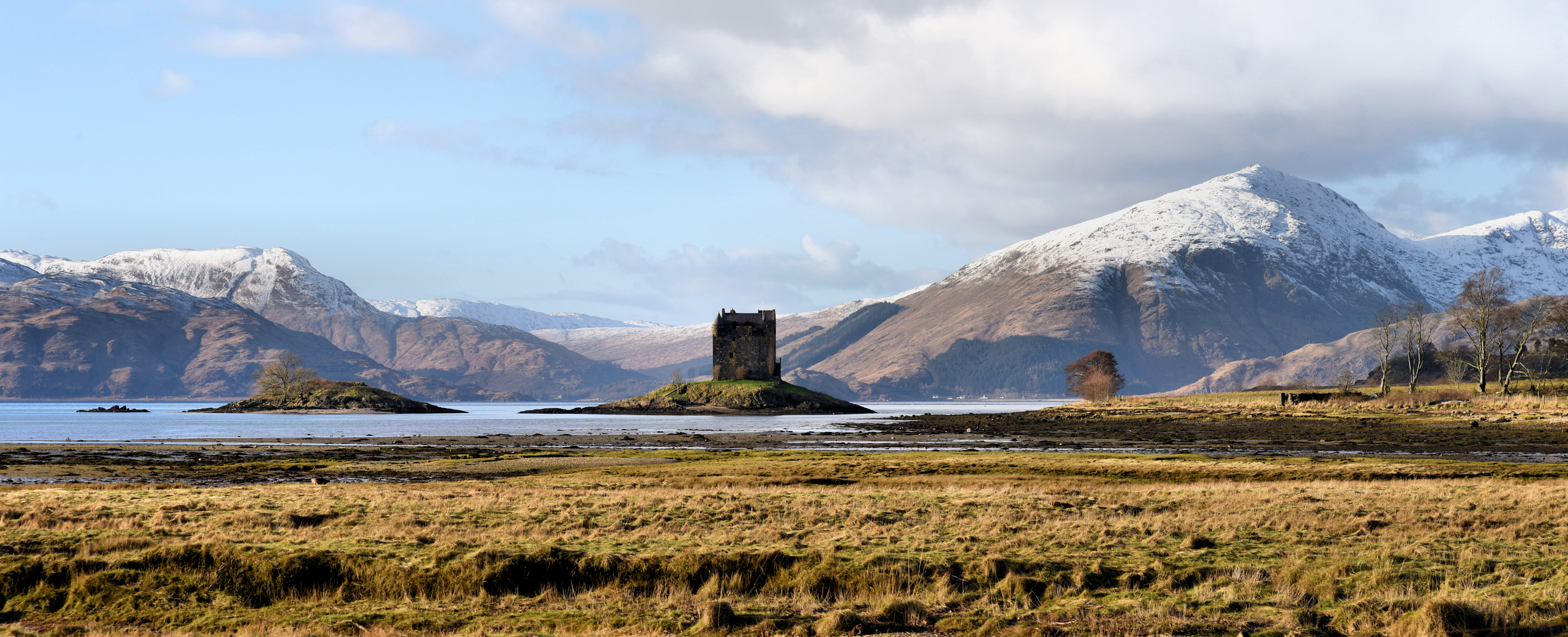
Castle Stalker
Around 1620, the Stewarts of Appin lost their castle in a drunken bet. The details are hazy -- as they tend to be when the story involves whisky and a wager -- but the outcome was definitive: Castle Stalker, the four-storey tower house the Stewarts had built on a tidal islet in Loch Laich, passed to the Clan Campbell. It is the kind of story that could only happen in Scotland, where clan politics, alcohol, and real estate have been entangled for centuries. The castle still stands on its islet, accessible with difficulty from the shore at low tide, visible from the A828 road midway between Oban and Glen Coe, and recognizable to millions as the final scene of Monty Python and the Holy Grail.
The Hunter's Castle
The name Stalker derives from the Gaelic Stalcaire, meaning hunter or falconer -- a fitting name for a castle built to command a landscape of water, mountain, and sky. The original structure was a small fort built around 1320 by the Clan MacDougall, then Lords of Lorn. When the Stewarts took over the Lordship around 1388, they rebuilt the castle in its present form during the 1440s. The result is one of the best-preserved medieval tower houses in western Scotland: four storeys of stone rising from a tidal islet in Loch Laich, an inlet off Loch Linnhe. The castle stands in the Lynn of Lorn National Scenic Area, and its setting -- framed by the mountains of Appin and Morven -- is as dramatic as any in the Highlands. King James VI of Scotland visited, though by then the Stewarts' tenure was nearing its alcoholic conclusion.
Lost, Regained, and Listed
The Campbell possession of Castle Stalker lasted until the Jacobite risings reshuffled Highland loyalties once again. The castle's subsequent history is one of the long, slow transitions that characterize Scottish tower houses: from military stronghold to gentleman's residence to romantic ruin to restoration project. By the time of the 2011 census, the National Records of Scotland classified the islet as an inhabited island with no usual residents. The castle itself is a Category A listed building, the highest level of architectural protection in Scotland. Its walls have survived the weather, the tides, and the particular Scottish habit of transferring property through impulsive gestures made after dark with a glass in hand.
Castle Aaaaarrrrrrggghhh
Castle Stalker's most famous appearance is as 'The Castle Aaaaarrrrrrggghhh' in Monty Python and the Holy Grail, the 1975 film that used several Scottish castles as stand-ins for Arthurian England. The castle also appears in Highlander: Endgame, the Netflix series Sense8, and the Black Mirror episode 'Loch Henry.' Susan Cooper used it as the inspiration for Castle Keep in her children's book The Boggart. The castle's photogenic quality is partly a matter of geometry -- a vertical tower on a horizontal islet, surrounded by water, backed by mountains -- and partly a matter of light. On a clear day, the castle against the water and hills produces an image so perfectly composed it looks artificial. On a grey day, wrapped in rain and low cloud, it looks like exactly what it is: a medieval fortress at the mercy of the Atlantic weather, holding its ground through stubbornness and stone.
Watching from the A828
Most people see Castle Stalker from the road. The A828 runs along the coast between Oban and Ballachulish, and there is a layby near Port Appin where drivers stop to photograph the castle across the water. The islet is accessible from the shore at low tide, though the crossing is difficult and not recommended without local knowledge. The castle itself is privately owned and opens to the public on a limited basis. For most visitors, the experience of Castle Stalker is the view: the tower house rising from the water, the mountains behind, the play of light on Loch Laich. It is a scene that has been photographed so many times it risks becoming a cliche, yet somehow resists it. The castle's presence on that islet retains its capacity to surprise, perhaps because the idea of building a home in the middle of a tidal loch remains, after six centuries, an act of magnificent impracticality.
From the Air
Located at 56.57N, 5.39W on a tidal islet in Loch Laich, an inlet off Loch Linnhe in Argyll. The castle is a prominent landmark visible from the air -- a solitary tower house on a small island. Nearest airport is Oban Airport (no ICAO code); nearest major airports are Glasgow (EGPF) and Inverness (EGPE). Best viewed at 1,500-3,000 feet. The A828 road runs along the coast nearby, and the mountains of Glen Coe are visible to the northeast.