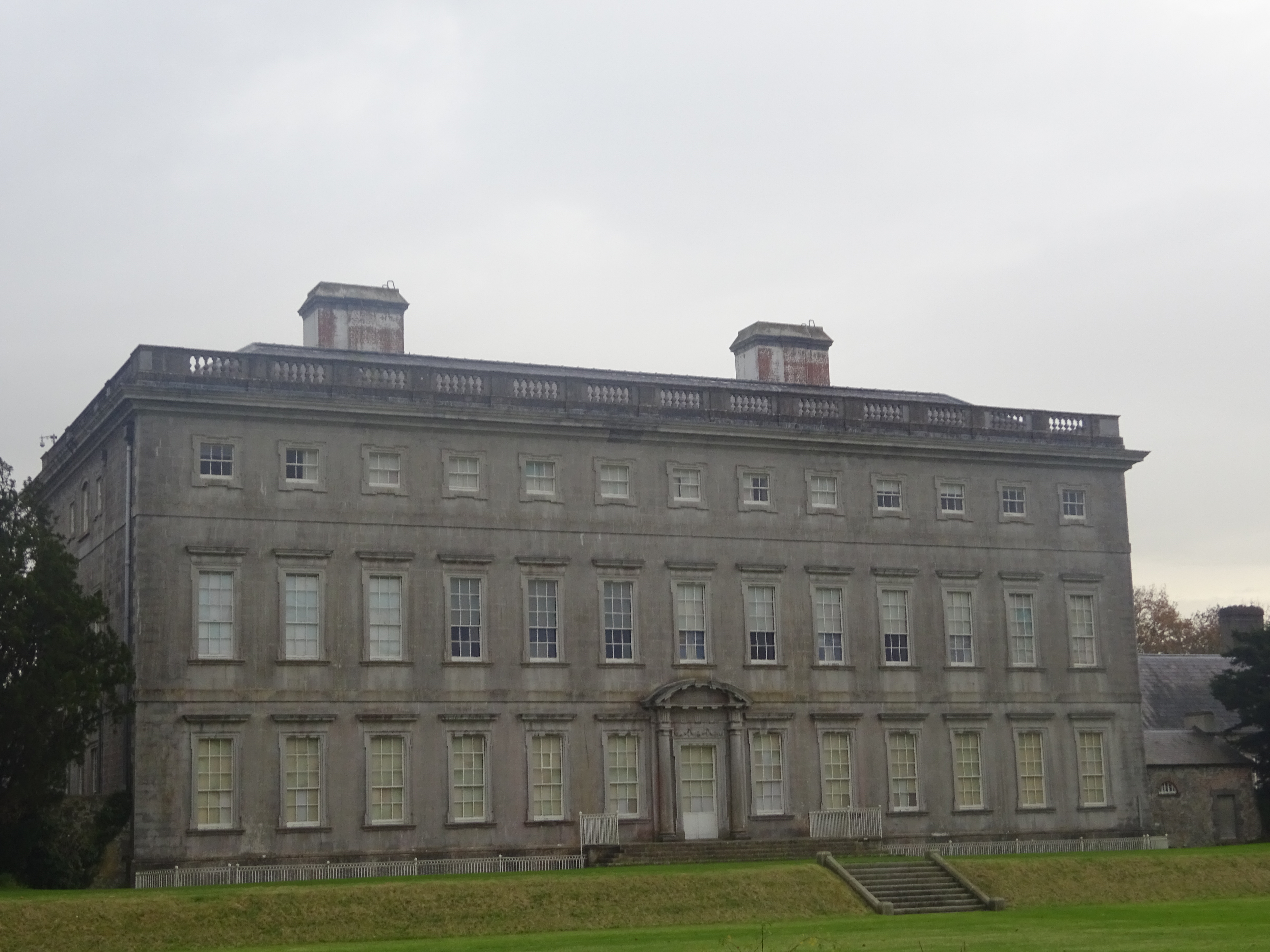
Castletown House
William Conolly was the son of an innkeeper from Donegal who became the richest man in Ireland. When he commissioned a new house at Celbridge in County Kildare in 1722, he was Speaker of the Irish House of Commons, and he wanted the building to say exactly that. Castletown House was designed on a scale that no Irish mansion had attempted before: a severe Palladian facade flanked by curved colonnades, 68 rooms across three storeys, and an entrance hall 60 feet long. It was a declaration of arrival, and it set the standard for every great Irish country house that followed.
The Architects
The facade of the main block was designed by the Italian architect Alessandro Galilei, whom Conolly had met when Galilei visited Ireland in 1718–19. When construction began in 1722, Galilei had returned to Italy, and the execution of the interior, wings, and colonnades fell to the young Irish architect Sir Edward Lovett Pearce, appointed to oversee the project in 1724. Pearce added the curved colonnades linking the east and west pavilions to the main block -- a feature that became the defining silhouette of the house. Two circular domed towers bookend the main facade, and a half-mile avenue of lime trees draws visitors toward the entrance in a calculated crescendo of approach. Inside, a cantilevered staircase of Portland stone rises without visible support, and the Long Gallery stretches 80 feet, decorated in Pompeian style with blue, red, and gold.
Lady Louisa's Print Room
The woman who gave Castletown its finest interiors was Lady Louisa Lennox, a great-granddaughter of Charles II of England and Louise de Kerouaille. She married Tom Conolly in the 1760s and immediately set about finishing the decoration that had languished since the original builder's death in 1729. Much of her interior work followed designs by William Chambers, but the most remarkable room is entirely her own: the Print Room, where she pasted cut-out engravings directly onto the walls in a fashion popular among aristocratic women of the period. It is thought to be the only surviving example of its kind in Ireland. Lady Louisa also redesigned the grounds, engineering an ingenious drainage system through the woodland that created dry walking paths on land that sits below the water table.
Sold for a Song
The Conolly family, later bearing the compound surname Connolly-Carew and the title Baron Carew, held Castletown for over two centuries. By 1965, the 6th Baron Carew could no longer sustain the estate. He sold the house, its contents, and 580 acres for 166,000 pounds -- a price that even then struck observers as astonishingly low for Ireland's grandest Palladian mansion. Two years later, Mariga and Desmond Guinness bought the house for 93,000 pounds specifically to save it from vandalism. It became the flagship project of the Irish Georgian Society and was eventually handed to the Castletown Foundation, though the wider estate was carved up between developers and the state forestry company Coillte.
Neglect, Restoration, and a Bitter Dispute
After the 1965 sale, lead was stripped from the roof and windows broken, leaving the house exposed to the elements for two years before the Guinnesses stepped in. The Castletown Foundation struggled to fund full restoration, and in 1994 the house and its remaining 120-acre demesne were transferred to the Office of Public Works. Restoration proceeded steadily -- the lake on the front lawn was rebuilt in 2012, the pleasure grounds behind the house in 2016 -- but a new crisis emerged in 2023 when the private owners of surrounding land closed the main access road and car parks, sparking local protests. The standoff lasted until November 2025, when the Irish state purchased the remaining 235 acres for 11.25 million euros. Full public access was restored on 22 December 2025, bringing the total state-owned demesne to 475 acres.
A Living Archive
Castletown today is both museum and working cultural space. The OPW-Maynooth University Archive and Research Centre, launched by President Mary McAleese in 2008, occupies the second floor and facilitates research into the history of Irish estates, their houses, and inhabitants. The Performance Corporation, a site-specific theatre company, established residency in 2007, running rehearsals and hosting an annual international cross-artform program called the SPACE Programme. Only two rooms remain furnished as they appeared when the Conolly family lived here; the rest of the ground and first floors now house retail spaces. But the approach from Celbridge's main street, along the half-mile drive lined with lime trees, still offers the same calculated drama that William Conolly intended three centuries ago.
From the Air
Located at 53.34N, 6.54W near Celbridge, County Kildare. From the air, the Palladian facade and curved colonnades are distinctive against the surrounding parkland and the River Liffey. The M4 motorway passes nearby to the north. Nearest airports: Weston (EIWT) 8km east, Dublin (EIDW) 25km northeast. Best viewed at 2,000-4,000 feet for architectural detail.