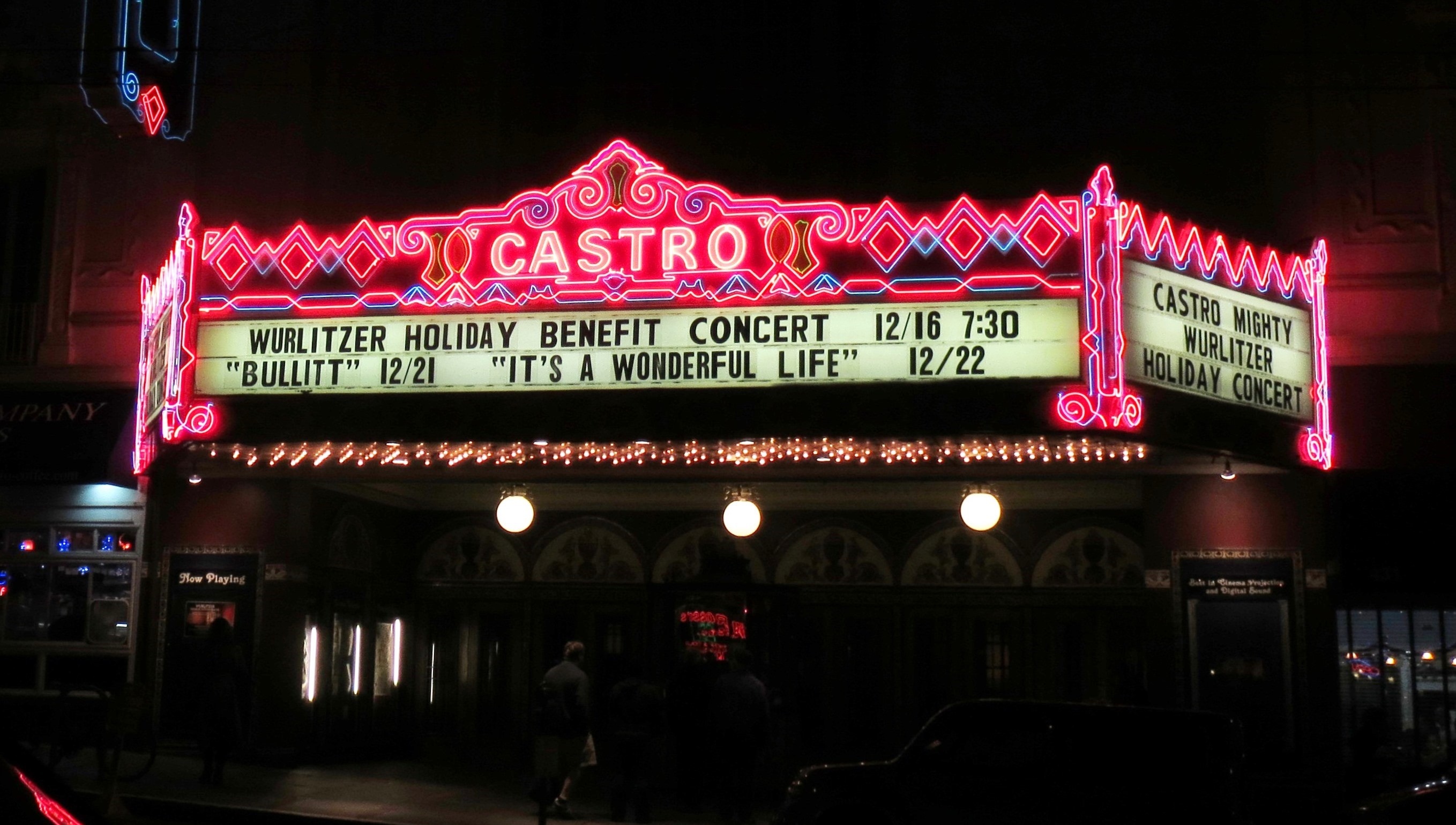
Castro Theatre
Before every film, the lights dim and the floor opens. A massive organ console rises into view, and the organist launches into show tunes while the audience sings along. This ritual has played out thousands of times at the Castro Theatre since 1922, making it one of the last places in America where moviegoing remains a communal celebration rather than a solitary transaction.
A Cathedral for Cinema
Architect Timothy L. Pflueger designed the Castro Theatre with a California Churrigueresque facade that deliberately echoes Mission Dolores, just blocks away. The great arched window, surmounted by a scrolling pediment, transforms a neighborhood movie house into something approaching sacred architecture. Inside, subtly convex and concave walls create intimate acoustics, while an ornate Art Deco chandelier by Phoenix Day Lighting presides over more than 1,400 seats. The Nasser brothers, who built the theatre and whose family still owns it, operated several movie houses across San Francisco, but the Castro became their crown jewel.
Opening Night, 1922
The Castro Theatre actually began life in 1910 at 479 Castro Street, a modest venue that proved too small for the neighborhood's appetite. When the new, grander theatre opened on June 22, 1922, Mayor James "Sunny Jim" Rolph himself attended the invitation-only premiere of Paramount's Across the Continent starring Wallace Reid. The general public filled the seats the following day. That original location at 479 Castro eventually became Cliff's Variety Store, which has occupied the space since 1971, just a few doors down from its cinematic successor.
Heart of a Movement
The Castro Theatre's neon blade sign towers over an intersection that became the symbolic center of LGBTQ rights in America. Harvey Milk's camera shop stood nearby; the theatre hosted the world premiere of the 2008 biopic Milk, for which Sean Penn won an Academy Award. The marquee and facade were restored for that film's production. Film festivals with LGBTQ and multicultural focus found their home here: Frameline, the San Francisco International Lesbian and Gay Film Festival, screens here each June. The theatre became San Francisco Historic Landmark #100 in 1976, but its cultural significance transcends official designation.
The Mighty Wurlitzer
The original Robert Morton organ was removed in 1962. A replacement Wurlitzer arrived in the 1980s but departed in 2015 when its owner moved to Sacramento, taking some of the pipework with him. The current instrument pushes the boundaries of organ engineering: seven manuals, over 400 registers, and approximately 1,200 physical pipes borrowed from Wurlitzer and Kimball instruments. The sixth manual controls a virtual orchestra through Audio Impressions technology, and the bottom manual extends to 88 notes for full piano capability. Despite this technological ambition, the theatre portion maintains the character of the 37-rank Fox Specials that Wurlitzer offered in the 1920s.
The Battle for the Seats
The COVID-19 pandemic shuttered the Castro for over two years. In January 2022, Another Planet Entertainment announced it would lease the theatre and pivot toward live music. Their proposal to remove the historic raked seating for standing-room concert floors sparked fierce opposition. The Castro Theatre Conservancy, the Castro LGBTQ Cultural District, and a coalition of preservationists argued that the 1922 seating configuration was integral to the theatre's identity. The "Save the Seats" campaign united film lovers and LGBTQ advocates in an unusual alliance, debating whether a century-old movie palace can survive by becoming something other than what made it beloved.
From the Air
The Castro Theatre sits at 37.762N, 122.435W in San Francisco's Castro District. The iconic neon blade sign is visible from low altitude, rising above the intersection of Castro Street, Market Street, and 17th Street. Look for the Spanish Revival architecture and the distinctive vertical 'CASTRO' sign. Nearest airports: San Francisco International (KSFO) 10nm south, Oakland International (KOAK) 12nm east. Best viewing altitude: 1,500-2,500 feet AGL on clear days.