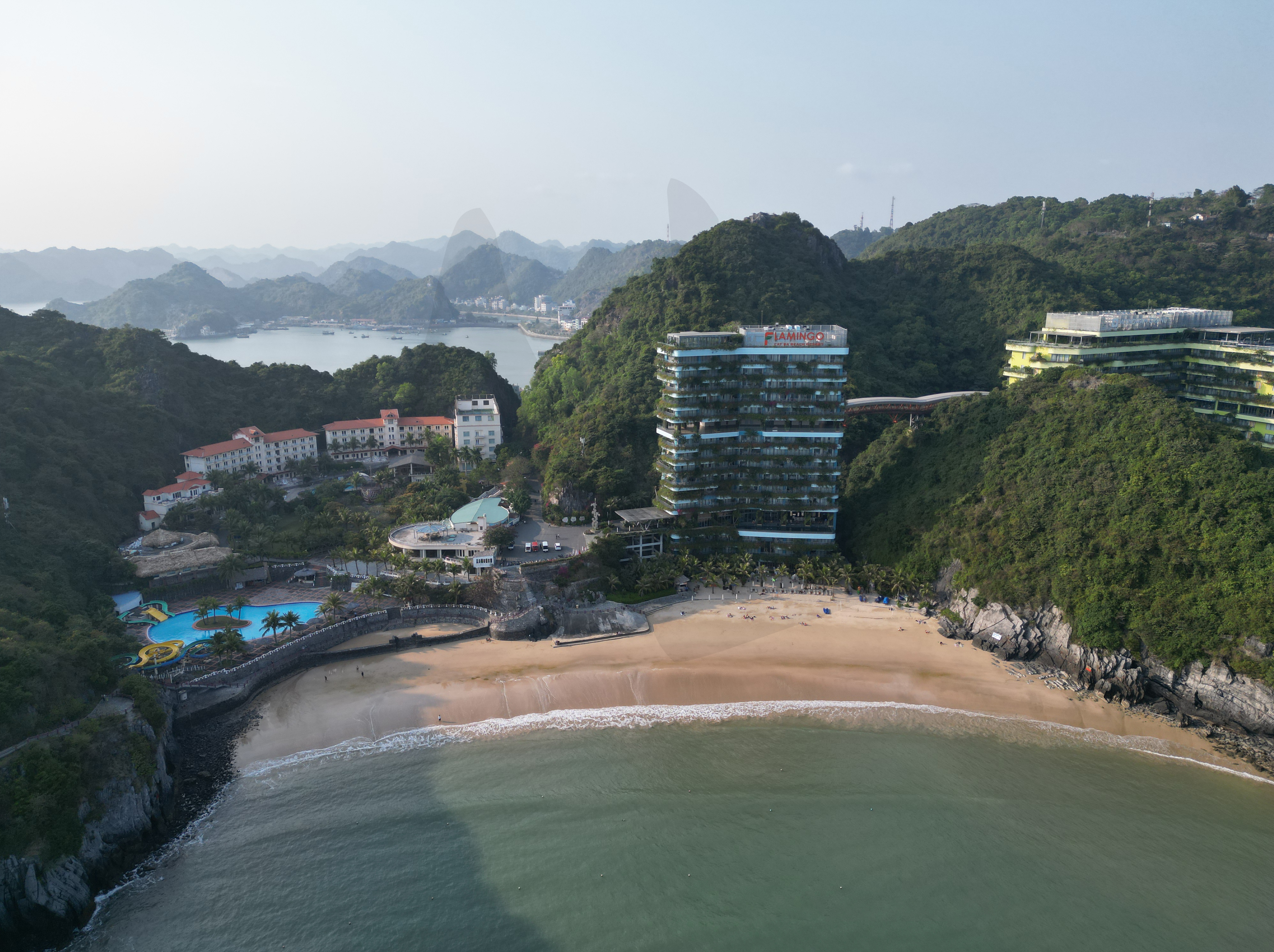
Cat Ba Island
Three women of the Tran Dynasty were killed, the legend says, and their bodies drifted across the sea until each washed up on a different beach of the same island. Local fishermen found all three and built a temple for each, and the island became Cat Ba - 'Women's Island,' from the Vietnamese words meaning 'all women.' Whether the story is true matters less than what it reveals: this has been a place of arrival for a very long time. Archaeological evidence at Ben Beo harbour on the island's southeastern tip pushes human habitation back nearly 6,000 years, to the Cai Beo people of the Ha Long culture, who may represent the first population to occupy northeastern Vietnam's territorial waters. The women of legend and the Neolithic settlers share a common thread - they came to Cat Ba, and Cat Ba kept them.
Caves of Refuge
Cat Ba's limestone landscape is riddled with caves, and in wartime, those caves became something more than geology. During both the French and American wars, bombing raids drove the island's residents underground. The most remarkable refuge was Hospital Cave, a three-storey bomb-proof facility carved into the rock ten kilometers north of Cat Ba town. Used as both a functioning hospital and a safe house for Viet Cong leaders, it operated from the war years until 1975. The engineering is striking - multiple levels connected by narrow passages, hidden from aerial observation, capable of sheltering patients and commanders while explosions shook the hills above.
Cannon Fort offers a different vantage. Perched on a peak 177 meters high, it preserves the old bunkers and helicopter landing sites from which the island's strategic position was exploited. From its summit, the view encompasses Cat Ba's coast, the town below, and the limestone karsts rising from the turquoise water of Lan Ha Bay offshore. What were once instruments of war have become instruments of tourism - a transformation the island has embraced with enthusiasm.
The Golden-Headed Ghost
The Cat Ba langur exists nowhere else on Earth. This golden-headed primate, Trachypithecus poliocephalus, is endemic to the island and ranks among the most critically endangered species alive. In the mid-20th century, the population numbered between 2,400 and 2,700 individuals. By the early 2000s, only around 40 to 50 remained.
The collapse was driven by poaching for traditional medicine - a trade that put subsistence hunters and international wildlife traffickers on the same supply chain - and by habitat fragmentation as human development carved the forest into isolated patches. Today, approximately 80 to 85 langurs survive in seven subpopulations scattered across five locations on Cat Ba, with only three groups actively reproducing. The genetic bottleneck is severe. The fragmentation makes recovery agonizingly slow, because isolated groups cannot exchange members or genes.
The Cat Ba Langur Conservation Project, a German-based NGO, works alongside park rangers and local government to protect both the animals and their habitat. The approach is deliberately in situ: no zoos, no captive breeding. Protecting the langur means protecting the forest, which means protecting every other species that lives in it. Conservation here is not about a single primate. It is about holding together an ecosystem that has been unraveling for decades.
The Biosphere and Its Borders
In 1986, roughly one-third of Cat Ba Island - 9,800 hectares - became Cat Ba National Park, the first protected area in Vietnam to include a marine component. The park was later expanded to 109 square kilometers of land and 52 square kilometers of inshore waters and mangrove tidal zones, staffed by 92 people including over 60 rangers. In 2004, the entire archipelago earned UNESCO Man and Biosphere Reserve status, and in 2023, Ha Long Bay-Cat Ba Archipelago was inscribed as a World Heritage Site.
The numbers tell a story of abundance: 1,561 species of flora from 186 families, 279 animal species including 53 mammals, 160 bird species, 900 species of marine fish, 178 coral species, and 23 species classified as endangered or critically endangered. The park is organized in concentric zones - a core area closed to human activity except research, a buffer zone permitting limited use, and a transitional area supporting local communities. On paper, the system is elegant. In practice, it must contend with a tourism industry that has transformed the island's economy and landscape at a pace conservation frameworks struggle to match.
The Thin Hotels and the Turning Tide
Cat Ba town received consistent electricity in 1997. Ferries capable of carrying trucks and cars arrived shortly after. By 2001, tourism was booming, and a strip of tall, thin, five-storey budget hotels had risen along the seafront like a wall of concrete ambition. Over 150 hotels now serve more than 350,000 visitors annually, and the island markets itself as Vietnam's adventure-tourism capital - kayaking through Lan Ha Bay, rock climbing on limestone karsts, trekking the national park, deep-water soloing above emerald water.
The island sits 50 kilometers from Haiphong and 150 from Hanoi, close enough for weekend escapes. Chinese visitors cross in summer to flee the heat. The appeal is genuine: Cat Ba offers what crowded Ha Long Bay town cannot - quieter waters, wilder terrain, the sense of discovering something before everyone else arrives. But that window is closing. Construction of the enormous Cat Ba Amatina resort complex promises to add seven resorts, 800 villas, three marinas, and six five-star hotels spanning 171 hectares of southern coastline. The island that sheltered women of legend and Neolithic settlers, that hid hospitals in its caves and harbored one of the rarest primates alive, now faces the most common threat of all: its own attractiveness.
From the Air
Cat Ba Island is located at approximately 20.80N, 107.00E in the Gulf of Tonkin, northeast Vietnam. It is the largest of 367 islands in the Cat Ba Archipelago, spanning about 262 square kilometers. From altitude, the island is unmistakable - a dramatic landscape of forested limestone karsts rising sharply from emerald water, with the town visible on the southern coast along a curved bay. Lan Ha Bay to the southeast displays hundreds of smaller karst islands similar to Ha Long Bay. The nearest major airport is Cat Bi International Airport (VVCI) in Haiphong, approximately 50km southwest. Noi Bai International Airport (VVNB) in Hanoi is approximately 150km to the west. Expect warm, humid conditions with frequent haze reducing visibility, especially in summer. The limestone terrain creates dramatic visual contrast from above - dark green forest atop grey-white karst towers emerging from turquoise water.