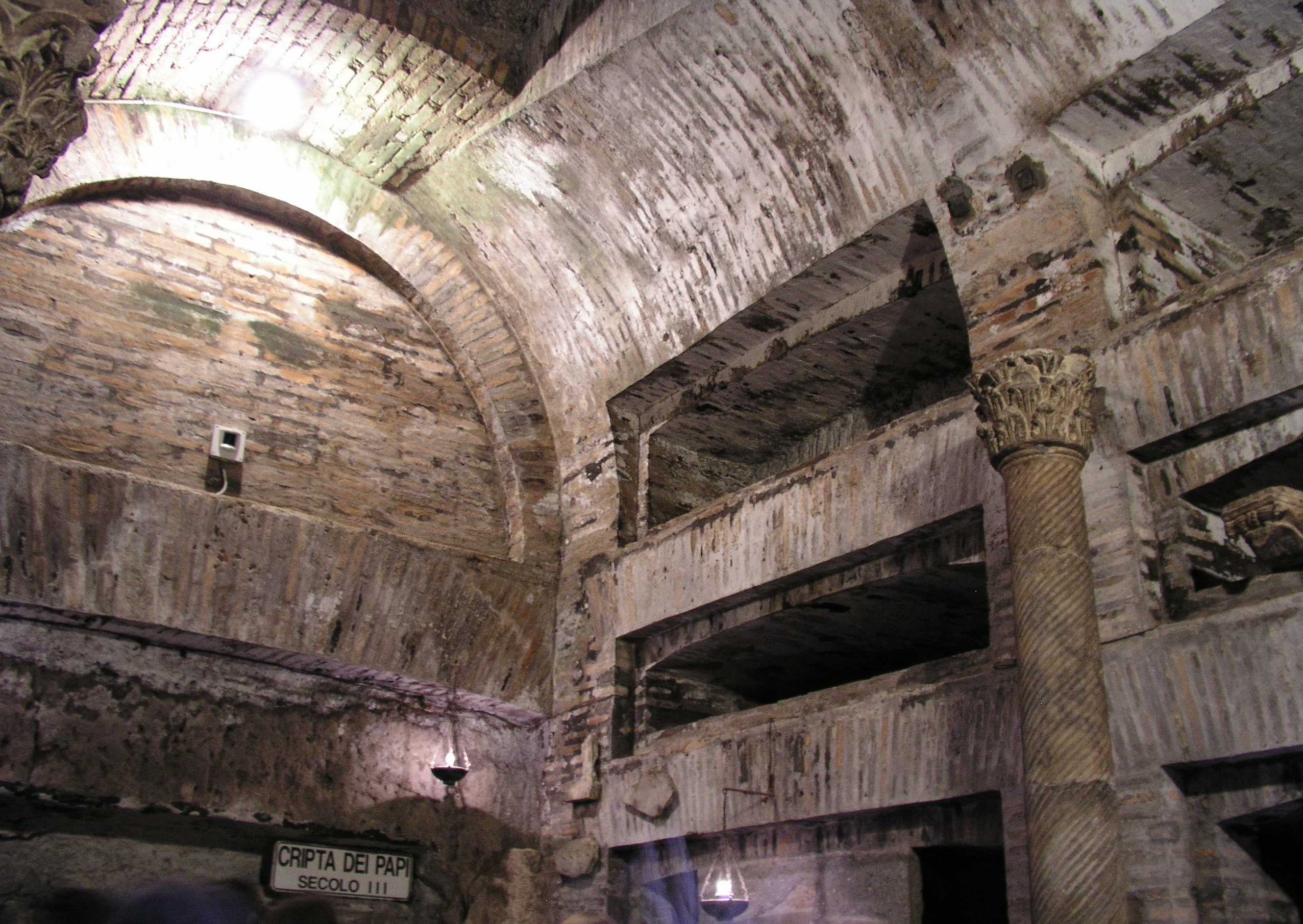
Catacombs of Rome
Forget what the movies told you. The Catacombs of Rome were never secret hideouts for persecuted Christians ducking imperial soldiers. That romantic story, repeated in countless novels and films, is -- as scholar J. Osbourne puts it -- as far from the truth as you can get. What the catacombs actually were is stranger and more human: communal burial grounds where families of every faith descended to share meals with their dead, just as their pagan neighbors did. And in doing so, they left behind one of the most extraordinary collections of early sacred art on the planet, painted onto tunnel walls by the dim light of oil lamps nearly two thousand years ago.
A City Beneath the City
More than fifty catacombs snake beneath Rome, their tunnels stretching over 150 kilometers through volcanic tuff -- a soft rock that hardens after excavation, making it ideal for carving stable passageways. The network began taking shape in the 2nd century AD, born from a collision of practical concerns: Roman law forbade burial within city walls, the city was growing fast, and land along the ancient roads was expensive. Christians and Jews, who rejected cremation in favor of preserving bodies for resurrection, needed an affordable alternative to the monumental roadside tombs that lined the Via Appia. The solution was to dig down rather than build up. The earliest tunnels actually predated Christian use entirely -- Etruscan miners had carved the original quarries centuries before, extracting limestone and sandstone. Romans continued mining the same deposits. It was the religious communities who repurposed these excavations as resting places for the dead.
Painted in Darkness
The art is what makes the catacombs irreplaceable. These tunnel walls contain the great majority of surviving Christian artwork from before 400 AD -- frescoes, sculptures, and gold glass medallions that document how an emerging faith expressed itself visually long before it could build grand churches. Early catacomb paintings borrowed freely from Roman domestic decoration, adapting secular imagery to religious purpose. A shepherd carrying a lamb became the Good Shepherd. Fish, already a dietary staple, took on layered Christian symbolism. Over centuries, the artwork evolved through distinct phases: an early decorative period, then scenes from the Old Testament -- Adam and Eve, Jonah and the whale, the three Hebrews in the fiery furnace -- and finally New Testament narratives. The Jewish catacombs, six in total, developed their own visual vocabulary. Temple menorahs and passages from the Hebrew Bible appear on their walls, offering scholars rare evidence of Jewish cultural life in Rome during the first centuries of the common era.
Meals for the Dead
What actually happened in these tunnels upends popular imagination. Families descended regularly -- not to worship in secret, but to hold funerary meals beside the graves of their relatives, a practice shared across Roman religious communities. As historian L. Michael White argues, the larger chambers with stone benches were used for these communal meals with the dead, not for eucharistic assemblies or clandestine worship. Christians did gather near the tombs of famous martyrs for memorial rites, but the catacombs were cemeteries first and always. Bodies were placed in stone sarcophagi, dressed in their clothes and bound in linen. Each chamber was sealed with a slab inscribed with a name, an age, and a date of death -- small biographical anchors that still connect us to individual lives across two millennia. The Catacomb of Callixtus alone, near the Park of the Caffarella, stretches across multiple levels and once held the remains of several early popes.
Abandonment and Rediscovery
The catacombs' decline was gradual. After the Edict of Milan legalized Christianity in 313, relic-hunting pilgrims ransacked the tunnels, and vandalism became rampant. When Christianity became the state religion in 380, some Romans still sought burial alongside the martyrs, but the practice slowly gave way to church cemeteries above ground. Ostrogoths, Vandals, and Lombards sacking Rome over subsequent centuries violated the catacombs looking for valuables. By the 10th century, the tunnels were largely abandoned, their relics transferred to above-ground basilicas. Then came the long forgetting. Some catacombs were rediscovered in 1578, but others remained hidden until the 1950s. The Catacomb of Domitilla, named after a Roman saint, stretches over 17 kilometers of caves and is now administered by the Divine Word Missionaries. Today, only a handful of the more than fifty catacombs are open to visitors -- many remain closed due to structural instability and the presence of radon gas.
Layers of Faith
What makes the catacombs remarkable is not any single community's use of them, but the fact that Christians, Jews, and pagans all buried their dead in this shared underground landscape -- sometimes in separate tunnel systems, sometimes mixed together. The six known Jewish catacombs, including those beneath Villa Torlonia discovered in 1918, extend over 13,000 square meters and date from the 2nd to possibly the 5th century. The Catacombs of Commodilla contain one of the earliest images of a bearded Christ. The Catacombs of Praetextatus, along the Via Appia, hold a rare early depiction of Christ being crowned with thorns. Each tunnel system tells its own story, but together they reveal something larger: a city where multiple faiths navigated the same practical problem of death and burial, and in doing so left behind an accidental archive of belief, art, and daily life that no one intended to preserve for posterity.
From the Air
Located at 41.89°N, 12.50°E in central Rome. The catacombs are entirely underground and not visible from the air, but their locations are marked along ancient Roman roads radiating outward from the city center -- particularly the Via Appia Antica stretching southeast. The nearest major airport is Rome Fiumicino (LIRF/FCO), approximately 30 km southwest. Rome Ciampino (LIRA/CIA) lies about 15 km southeast. Best viewed at 2,000-3,000 ft AGL to see the road network and green corridor of the Appian Way park.