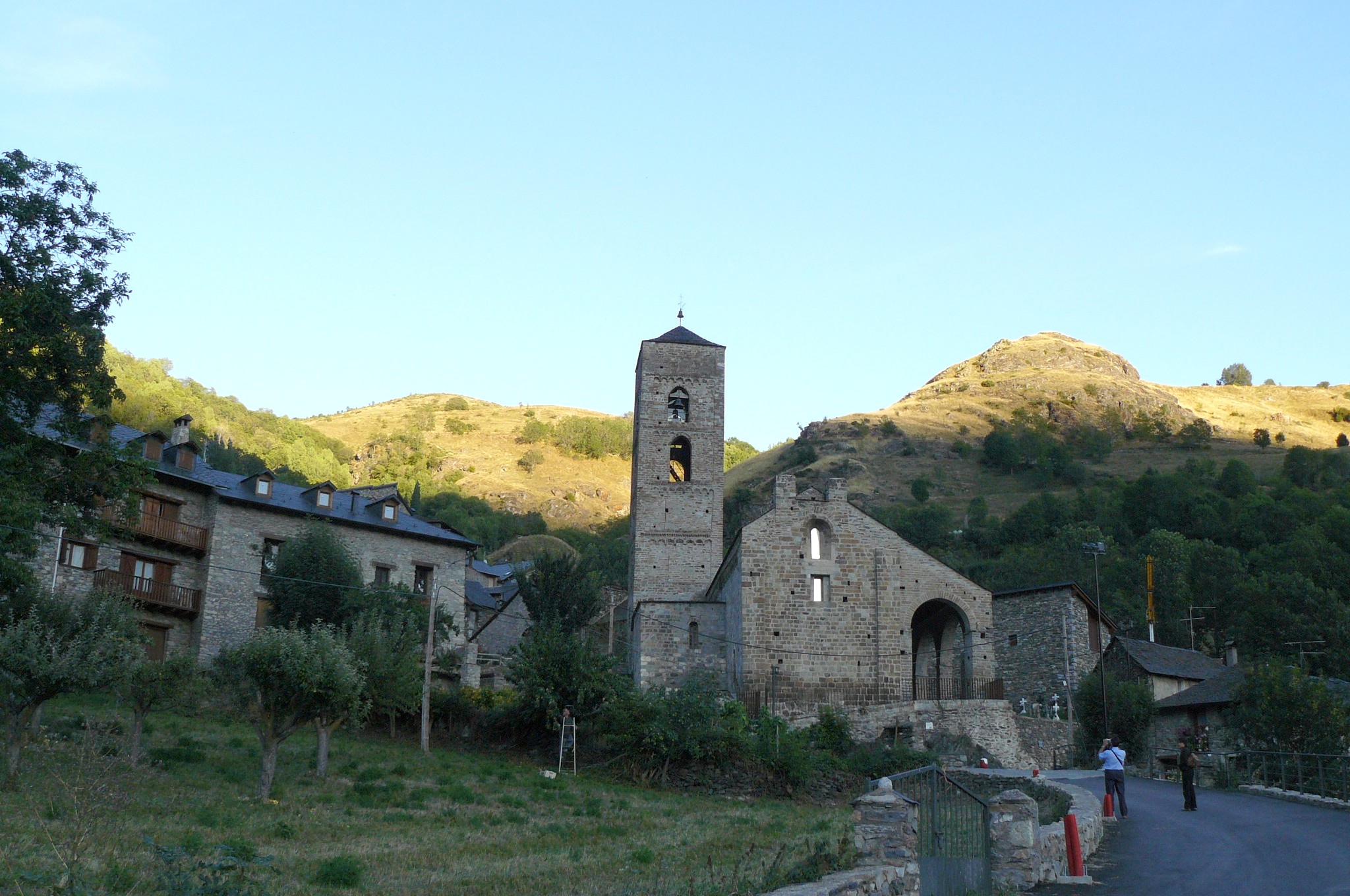
Catalan Romanesque Churches of the Vall de Boi
In 1921, a Barcelona industrialist named Lluís Plandiura hired Italian and Polish craftsmen to peel frescoes off the walls of remote Pyrenean churches and sell them to the Boston Museum of Fine Arts. The transaction was entirely legal. It was also the alarm that finally roused Catalonia to protect what it had: nine Romanesque churches scattered across the Vall de Boi, their interiors covered in some of the finest medieval wall paintings in Europe. The paintings were saved -- removed not by dealers but by authorized restorers and taken to Barcelona's National Museum of Catalan Art, where they have been ever since. The churches remain in the valley, their walls now bearing reproductions of the art that once defined them.
The Lombard Mark
The churches were built between the 11th and 12th centuries, during a period when Catalonia's wealth was growing from military victories against the Moors and the rise of powerful religious orders. The architectural style is Lombard Romanesque, imported from northern Italy and characterized by slender bell towers, blind arcading, and a structural simplicity that lets the stonework speak. The valley's nine churches represent the largest concentration of Romanesque architecture in Europe and a remarkably pure expression of the style -- no later Gothic or Baroque renovations diluted their original character. The churches at Boi were built around 1100 in a style connected to Aquitaine. Those at Taull followed in 1123, blending Lombard structure with sculptural influences from Toulouse.
The Pantocrator of Taull
Sant Climent de Taull is the masterpiece. Consecrated on December 10, 1123, by the bishop of Roda, it is the largest and best-preserved church in the valley -- a basilica with three naves separated by cylindrical columns, topped by three semicircular apses, with a six-story bell tower standing alongside. Inside, an unknown painter called the Master of Taull created the apse fresco that would become the symbol of Catalan Romanesque art: a Pantocrator, Christ in Majesty, staring out from a mandorla with an intensity that feels less devotional than confrontational. The figure's almond-shaped eyes, the bold black outlines, the flattened perspective that somehow amplifies rather than diminishes the power of the image -- this is medieval painting at its most assured. It now hangs in the MNAC in Barcelona, one of the most recognized works of European Romanesque art.
The Race to Save the Walls
The rediscovery began with hikers. In 1904 and 1906, the Hiking Club of Catalonia organized the first documented trips to the Vall de Boi, collecting photographs, plans, and notes. In 1907, the Institute for Catalan Studies sent a full expedition to study and photograph the churches. The resulting publications unleashed a desire among museums and private collectors to acquire the frescoes -- and by 1919, intermediaries were actively buying and selling them, mostly to American collections. Plandiura's brazen sale of the Santa Maria de Mur apse to Boston provoked an outcry from Spanish artists and curators that escalated to the Commonwealth of Catalonia and the bishop of La Seu d'Urgell. The resolution was radical: a team of Italian restorers systematically removed the paintings from the walls and transferred them to the MNAC, replacing some with in-situ reproductions. It was preservation through extraction, an acknowledgment that the only way to keep these works in Catalonia was to take them out of the churches entirely.
Stone Sentinels of the Valley
Visit the valley today and the churches still punctuate the landscape like stone sentinels. Santa Eulalia d'Erill la Vall stands with its 23-meter bell tower, a textbook example of Lombard design. Santa Maria at Taull mirrors Sant Climent's structure with its own three naves and apses. Sant Joan de Boi holds reproductions of 12th-century paintings depicting mythical animals. Higher up, at 1,386 meters, La Nativitat at Durro keeps watch over its village with a five-story tower that admits almost no light. The tiny hermitage of Sant Quirc, also at Durro, is so dimly lit that visitors must adjust their eyes to the darkness before the barrel-vaulted interior reveals itself. UNESCO designated all nine churches a World Heritage Site in 2000, recognizing them as a unique and irreplaceable record of 12th-century Catalonian culture. The frescoes may live in Barcelona, but the architecture remains exactly where medieval builders placed it -- in a valley that time forgot and art dealers nearly ransacked.
From the Air
Located at 42.50N, 0.80E in the Vall de Boi, Alta Ribagorca comarca, Province of Lleida, in the Catalan Pyrenees. The nine churches are scattered across several villages in the narrow valley. The area lies adjacent to Aiguestortes i Estany de Sant Maurici National Park. Nearest airports are Lleida-Alguaire (LEDA) approximately 130 km south and Toulouse-Blagnac (LFBO) approximately 170 km north. Approach from the south to see the valley's Romanesque bell towers rising among the mountain villages.