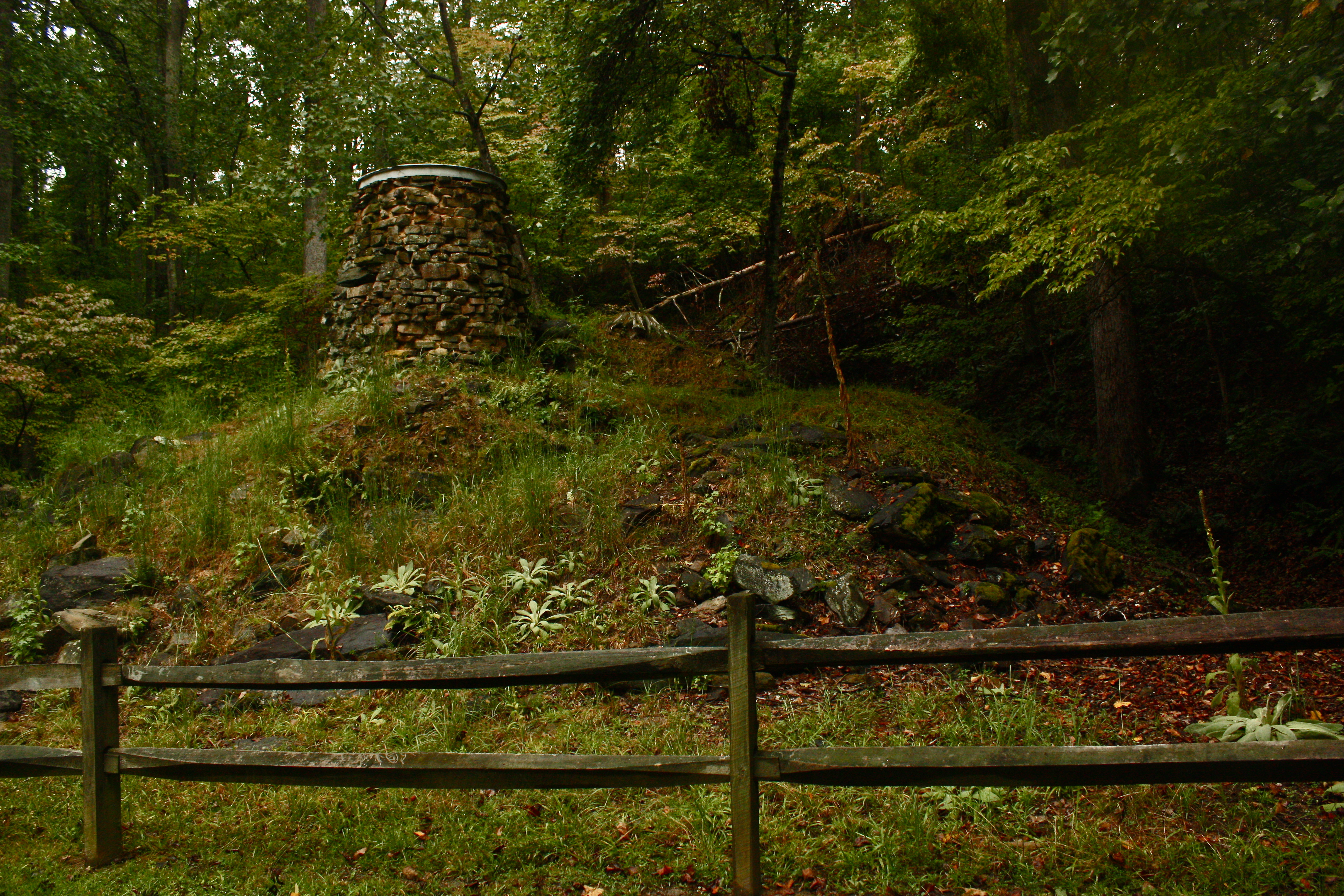
Catharine Furnace
Stonewall Jackson needed a hidden route. On the morning of May 2, 1863, with the Battle of Chancellorsville raging through the Spotsylvania County wilderness, Jackson planned to march 28,000 men around the entire Union army without being detected. The path he chose ran directly through the grounds of an old iron furnace, guided along its cart roads by a young man named Charles B. Wellford -- whose family had built the place and whose father had named it, simply and tenderly, after his mother. Catharine Furnace had already lived two lives by then: one as an ambitious antebellum ironworks, another as a ruin abandoned in the woods. The Civil War would give it a third, written in cannon smoke and blood.
A Mother's Name, a Father's Ambition
John S. Wellford was the kind of entrepreneur who ran on relationships. When the Fredericksburg Iron and Steel Manufacturing Company was chartered in 1836, Wellford became its financial backer, manager, and driving force. He named the blast furnace after his mother, Catharine, and by the spring of 1838 it was ready to fire. The timing was terrible -- the Panic of 1837 had devastated the iron market -- but Wellford's personal network kept the operation alive. Two of his co-owners sat on the board of Fredericksburg Union Manufacturing Company; another was president of the Tredegar Iron Company in Richmond. Through these connections, Wellford sold pig iron and secured government ordnance contracts. The Navy ordered tens of thousands of 32-pound cannonballs. The Army bought 8- and 10-inch artillery shells for delivery to Fort Monroe. The furnace property sprawled across 4,684 acres of Virginia woodland, powered by a 14-horsepower steam engine and a blast furnace that stood 36 feet tall.
Iron and Bondage
The furnace ran on enslaved labor. In 1838, at peak operation, 100 enslaved workers were hired from their owners to work the site -- mining ore, chopping wood, and tending the charcoal piles that fed the furnace. Skilled positions like colliers, who managed the delicate art of charcoal-making, commanded higher hire prices. Wellford sometimes rewarded enslaved colliers with small cash payments while paying substantial sums to their owners. Moulders were typically itinerant white workers, but the heavy, dangerous work of the mine and furnace floor fell to enslaved men. The lowest workforce count, 33 in 1844, represented the bare minimum needed to keep a blast furnace operational. Records show that some enslaved workers attempted escape, though none succeeded. When Wellford died in December 1846, the personal network that had sustained the business died with him. His son could not replicate those relationships. By 1847, the furnace stood abandoned, its buildings left to the encroaching forest.
The Flank March
War resurrected Catharine Furnace. In 1861, a consortium that included Charles C. Wellford -- John's brother -- purchased the property and relit the blast furnace to produce iron for the Confederate government. The Wellford family moved to the furnace complex after their Fredericksburg home was damaged in battle. Then came Chancellorsville. On May 2, 1863, Jackson's famous flanking column marched through the furnace grounds on cart roads that the elder Wellford had described to Confederate mapmaker Jedediah Hotchkiss. Young Charles B. Wellford guided the troops personally. When Union observers spotted the marching column, they assumed the Confederates were retreating and opened artillery fire. The Wellford women fled bursting shells while a small Confederate regiment held a defensive line among the furnace buildings, buying Jackson precious time. The flank attack that followed shattered the Union right and became one of the war's most celebrated tactical strokes.
Burned, Rebuilt, and Burned Again
The furnace survived Chancellorsville, was repaired, and returned to production by early 1864. But during the Overland Campaign that May, Union cavalry under George Custer clashed with Confederate cavalry under Fitzhugh Lee at the furnace on May 6, 1864. The engagement left the complex in flames -- the Confederate Army officially reported it "burned by the enemy." Remarkably, by January 1865, the furnace was rebuilt and hiring workers yet again. The end came not from fire but from peace. When the war concluded, demand for Virginia iron collapsed under competition from western Pennsylvania. The inventory was sold to buyers in Philadelphia, and the manager was instructed to sell the land. Today the ruins of Catharine Furnace sit within the Fredericksburg and Spotsylvania National Military Park, stone remnants of a 36-foot blast furnace rising from the forest floor -- a monument to industrial ambition, the labor of enslaved people, and the accident of geography that placed a mother's namesake at the pivot point of history.
From the Air
Catharine Furnace is located at approximately 38.29°N, 77.65°W within the dense woods of the Fredericksburg and Spotsylvania National Military Park. From the air, the site is difficult to distinguish from the surrounding forest canopy, though the cleared area around the furnace ruins may be visible at lower altitudes. The furnace sits along the route of Jackson's famous flank march, roughly 2 miles south of the Chancellorsville crossroads. Shannon Airport (KEZF) in Fredericksburg is about 10 miles to the east. The Rappahannock River is visible to the north. Best viewed at 1,500-2,500 feet AGL in clear conditions.