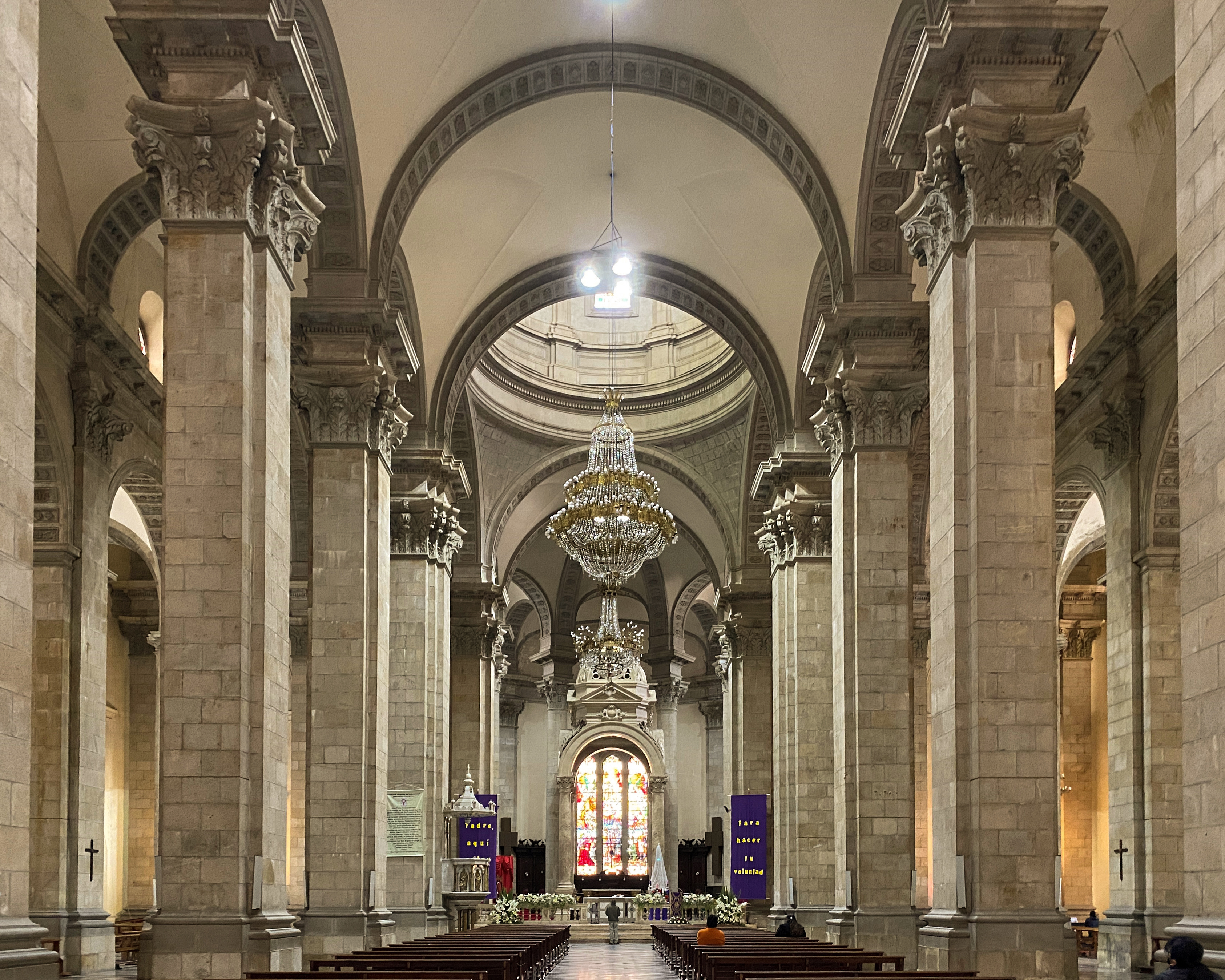
Cathedral Basilica of Our Lady of Peace, La Paz
Soldiers in crimson tunics still stand guard inside this cathedral. They are members of Bolivia's Colorados Regiment, and they watch over the tomb of Marshal Andres de Santa Cruz, the man who briefly fused Peru and Bolivia into a single nation. The Cathedral Basilica of Our Lady of Peace, rising from Murillo Square in the heart of La Paz, is not just the seat of the city's Catholic archdiocese -- it is a monument to Bolivian nationhood itself, inaugurated in 1925 to mark the first centenary of the republic's founding.
Seventy Years, Then Demolished
The first cathedral of La Paz was completed in 1692 after seventy years of construction. Built from stone, lime, and brick, it stood for over a century before structural failure made it untenable. By 1831, the collapse of its presbytery and spreading cracks throughout the building forced authorities to make a difficult decision: demolish the entire structure rather than risk catastrophic failure. The loss must have been staggering -- seven decades of labor reduced to rubble. But the decision cleared the way for something grander. On March 24, 1835, construction began on the replacement cathedral, a building designed in the neoclassical style with Baroque elements that would take even longer to complete than its predecessor.
A Cathedral for the Centennial
The timing of the inauguration was deliberate. When the new cathedral opened in 1925, Bolivia was celebrating one hundred years of independence, and the building became a symbol of national endurance. Yet even this milestone was provisional -- the interior ornamentation continued for another seven years, not reaching completion until 1932. The cathedral's interior consists of five naves arranged in layers, creating a sense of depth and grandeur that belies the relatively modest exterior. The neoclassical facade, with its columns and pediment, speaks the architectural language of European nation-states, a deliberate choice for a young republic asserting its place among them.
The Marshal's Rest
In a chapel on the left side of the cathedral lie the remains of Andres de Santa Cruz, one of the most consequential figures in South American history. A Bolivian of mixed Spanish and indigenous heritage, Santa Cruz served as president of Bolivia and later as Supreme Protector of the Peru-Bolivian Confederation, a short-lived union of the two countries that lasted from 1836 to 1839. The confederation collapsed under pressure from Chile and Argentine forces, and Santa Cruz died in exile in France. His remains were eventually returned to Bolivia and placed here, guarded by the Colorados -- the same regiment that has served as Bolivia's presidential guard since 1829.
Towers for a Pope
For over 150 years, the cathedral stood without its two lateral towers. Their completion came in 1989, timed to coincide with the visit of Pope John Paul II to Bolivia. The towers gave the building its final silhouette against the La Paz skyline, framing Murillo Square -- the same plaza where Bolivia's independence was first proclaimed. The square takes its name from Pedro Domingo Murillo, a leader of the 1809 uprising against Spanish rule, and the cathedral's presence there links the city's religious and political identities. From the air, the cathedral and its square are unmistakable, a neoclassical island amid the dense, steep urban fabric of one of the world's highest cities.
From the Air
Located at 16.50S, 68.13W at approximately 3,640 meters (11,942 feet) elevation on Murillo Square in central La Paz, Bolivia. The cathedral is visible from above alongside the Presidential Palace and other government buildings on the square. El Alto International Airport (SLLP) sits on the Altiplano rim above the city at 4,061 meters. The city's canyon topography makes approaches dramatic, with terrain rising steeply on all sides.