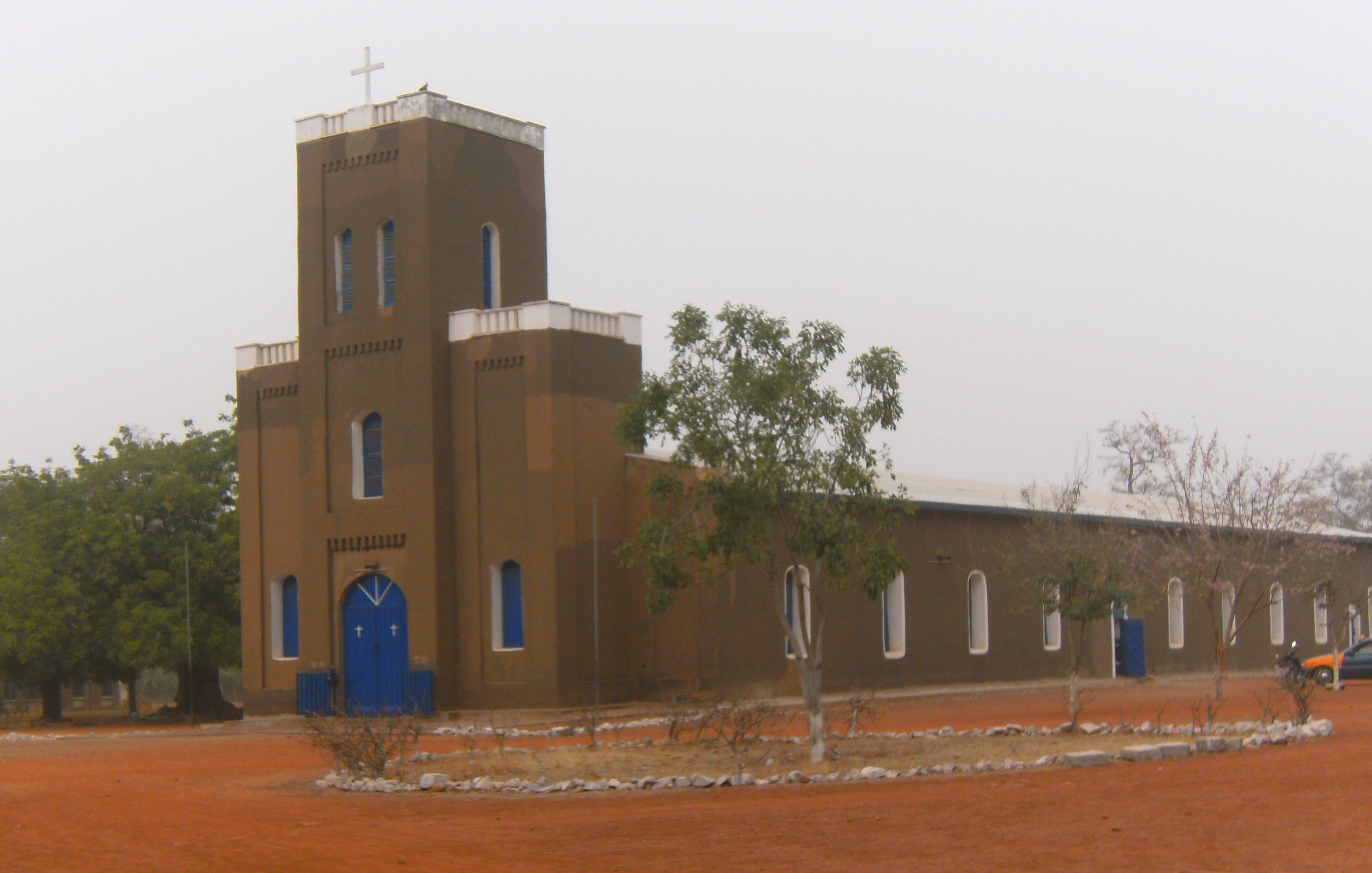
Cathedral Basilica of Our Lady of Seven Sorrows, Navrongo
Walk inside and look up. The walls of the Navrongo Cathedral are covered with paintings that should not exist together: the Last Supper rendered in the earthy reds, blacks, and whites of Kassena-Nankani tradition, alongside ancestral symbols and scenes of everyday village life. A crocodile shares wall space with the nativity at Bethlehem. This is not confusion. It is the visual record of what happens when two cultures decide to build something together rather than impose one upon the other. The Cathedral Basilica of Our Lady of Seven Sorrows, constructed entirely from mud in Ghana's Upper East Region, is one of the most remarkable churches in Africa -- not for its size or grandeur, but for the way it belongs to the place it stands.
Two Missionaries and a Mud Chapel
In 1906, Fathers Oscar Morin and Eugene Lutz of the Missionaries of Africa -- commonly known as the White Fathers -- arrived in Navrongo after an arduous journey into Ghana's far north. They found a challenging environment: harsh dry-season heat, languages they did not speak, and a population with deeply rooted traditional beliefs. Rather than importing European building methods, the missionaries made a decision that would define the cathedral's character for the next century. They built with what was available and culturally familiar: earth, wood, and grass. The initial chapel was humble, a small structure that served the earliest converts. But as the Catholic community grew, something larger became necessary.
Building Together
The cathedral as it stands today took shape during a major expansion in 1920, overseen by Father Ferdinand Gerard in collaboration with the local Kassena people. The building stretches 60 meters long and 14 meters wide, with a 13-meter bell tower -- proportions that are impressive for any church, let alone one made of mud bricks plastered with mud mortar. Originally, the roof was flat, following the local building pattern, until it was replaced with pitched corrugated iron sheets in 1928. Wooden beams support the structure from within. The collaborative construction fostered something that missionary projects often failed to achieve: genuine local ownership. The Kassena people did not merely provide labor. They contributed knowledge, technique, and the aesthetic sensibility that would eventually transform the building's interior.
The Women Who Painted the Walls
Beginning in 1973, women from the Navrongo community started painting the cathedral's interior walls. What they created is unlike anything in conventional Catholic church decoration. Using the traditional Kassena-Nankani palette of earth tones -- reds drawn from laterite, blacks from charcoal, whites from kaolin clay -- they rendered biblical scenes in a visual language that was entirely their own. Christian themes intertwine with animal forms and symbols from local cosmology. The paintings are not illustrations slotted into a European framework; they are a reimagining of sacred narrative through the lens of a culture with its own deep spiritual traditions. The murals remain one of the cathedral's most compelling features, a living dialogue between faiths painted directly onto mud walls.
Basilica in the Dust
On May 17, 2006, the Vatican elevated the Navrongo Cathedral to the status of minor basilica -- a rare honor recognizing exceptional historical, artistic, and pastoral significance. It was a formal acknowledgment of what locals had known for a century: this building matters beyond its congregation. The cathedral sits on UNESCO's tentative list for World Heritage status, recognized as one of the few large-scale mud brick churches still standing anywhere in the world. Its site includes a grotto and accommodation facilities for pilgrims. But the building's greatest significance may be what it represents architecturally: proof that sacred space does not require imported materials or imposed aesthetics. Earth, water, wood, and the hands of the community were enough.
From the Air
Located at 10.88N, 1.08W in Navrongo, Upper East Region, Ghana. The cathedral's corrugated metal roof and 13-meter bell tower make it one of the more prominent structures in the small city. Look for Navrongo along the main east-west road in the Upper East Region. Nearest airport is Navrongo/Paga Airstrip (ICAO: DGLN), just a few kilometers away. Tamale (ICAO: DGLE) is the nearest major airport, approximately 200 km to the south. Flat savanna terrain with seasonal green-brown variation.