Cathedral Basilica of Saint Louis: A Mosaic Masterpiece
Step inside the Cathedral Basilica of Saint Louis and the scale of what covers the walls, ceilings, and domes takes a moment to register. Mosaic. Everywhere. More than 41.5 million pieces of glass tesserae in over 7,000 colors cover 83,000 square feet of interior surface, making this one of the largest mosaic collections in the Western Hemisphere. The effect is overwhelming: biblical scenes, saints, and symbolic imagery rendered in shimmering glass that catches and scatters light from every angle. The building took seven years to construct, but the mosaics took 76 years to complete, a multi-generational artistic project that began when the cathedral opened in 1914 and continued until 1988.
Two Cathedrals
Planning for a new cathedral began under Archbishop Peter Richard Kenrick in the 1870s and 1880s. The previous cathedral, the Basilica of Saint Louis, King of France, sat along the Mississippi River in the heart of old St. Louis, but the city's center of gravity was shifting westward. Archbishop John Joseph Kain created a building fund, and a formal Cathedral Building Association was organized on April 28, 1871. The initial plan placed the new church on a block bounded by 22nd and 23rd streets, but the site ultimately selected was farther west, in what is now the Central West End neighborhood. Workers began clearing ground on May 1, 1907, and the superstructure was complete for dedication on October 18, 1914. Consecration followed more than a decade later, on June 29, 1926.
Glass by the Million
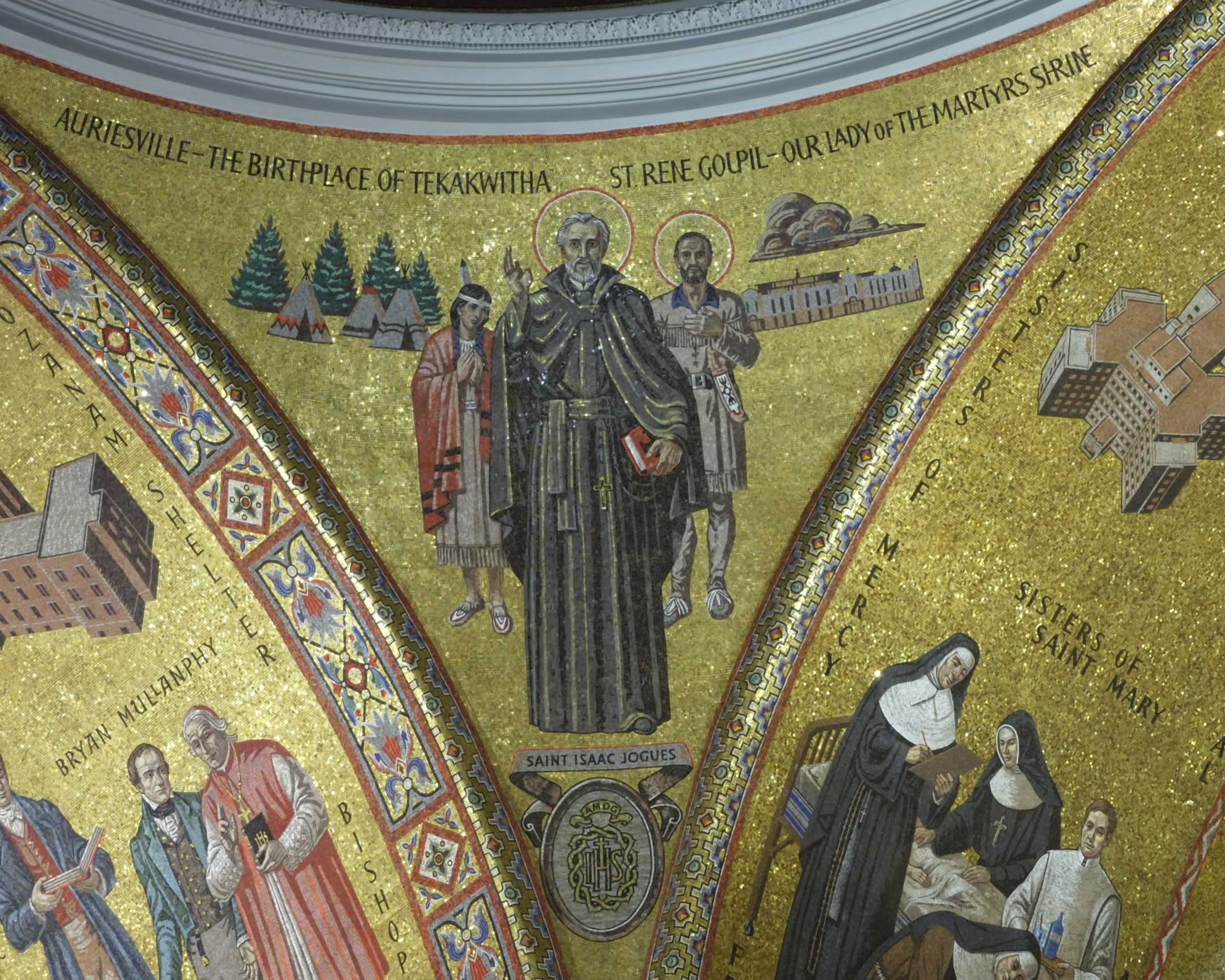
The cathedral's mosaic program represents one of the most ambitious decorative art projects in American history. Tiffany Studios designed and installed the mosaics in the side chapels and sanctuary walls, bringing the celebrated firm's expertise in glass to a religious setting. The mosaics in the main cathedral areas were designed by August Oetken and executed by Emil Frei, Inc., a St. Louis firm. The work proceeded in stages over decades, each generation of artists adding to the grand scheme. The result is a visual narrative that spans the Old and New Testaments, with pendentive mosaics depicting saints including Isaac Jogues, Frances Xavier Cabrini, and Rose Philippine Duchesne. The mosaic covering the narthex ceiling features a passage from 2 Timothy 4:7, rendered in gold and jewel tones.
A Cathedral That Speaks in Sound
The cathedral's organ has a history as layered as the building's mosaics. The original instrument, built by Geo. Kilgen and Son, Inc. in 1915, had two four-manual consoles. A new Kilgen organ replaced it in 1946 with 77 ranks of pipes, 14 salvaged from the original. In 1948, an Echo Organ from Carnegie Hall in New York City was installed. The Wicks Organ Company of nearby Highland, Illinois, undertook a major restoration beginning in 1997, expanding the instrument to 96 ranks and adding digital stops. The final chapter came in 2010, when a five-manual console from St. Bartholomew's Church in New York City was completely restored and installed in the gallery. Today, either the gallery console or the moveable sanctuary console can control every part of the organ, filling the cathedral's vast interior with sound that reverberates off those millions of glass tiles.
Byzantine on the Prairie
The cathedral's architecture draws on Byzantine Revival style, with a broad central dome, round arches, and an emphasis on interior surface decoration over external ornament. The design makes the exterior relatively restrained, a green-tiled dome and stone walls that hint at what lies inside without revealing it. This is deliberate: the Byzantine tradition treats the church interior as a sacred space apart from the world, and the mosaic-covered surfaces create that sense of entering another realm. Pope John Paul II designated the cathedral a basilica in 1997, recognizing its architectural and historical significance. The building also serves as a final resting place, with burial crypts beneath the nave, including the tomb of Cardinal John Glennon.
Light and Stone in the Central West End
The Cathedral Basilica sits on Lindell Boulevard in the Central West End, a neighborhood of stately homes, tree-lined streets, and cultural institutions. The building anchors the western end of a corridor that stretches to the Gateway Arch on the riverfront, a geographic span that traces St. Louis's growth from river town to metropolis. Visitors can walk through the nave, view the mosaic installations, and tour the basement museum where the original 1915 Kilgen organ console is displayed. The gallery organ features on many of St. Louis's cultural tours. Whether seen from outside, where the dome rises above the residential streetscape, or from within, where light catches 41.5 million pieces of glass, the cathedral stands as one of the most remarkable religious buildings in the United States.
From the Air
Located at 38.64N, 90.25W in the Central West End neighborhood of St. Louis, Missouri. From altitude, look for the green-tiled dome rising above the residential neighborhood on Lindell Boulevard, approximately 3 miles west of the Gateway Arch and the Mississippi River. The cathedral is one of the largest churches in the region. Nearest major airport is St. Louis Lambert International (KSTL) to the northwest. Forest Park lies just to the south and west.