Cathedral Basilica of St. Francis of Assisi (Santa Fe)
In a city where every building blends into the earth-toned palette of the desert, the Cathedral Basilica of Saint Francis of Assisi makes no such effort. Its yellow limestone walls, round arches, and Corinthian columns announce themselves as defiantly European -- a Romanesque Revival statement planted in the heart of adobe Santa Fe. This was exactly the intention of Jean Baptiste Lamy, the French-born bishop who arrived in 1853 to lead a diocese that stretched from the Rio Grande to the Colorado Plateau. Lamy looked at the modest adobe parish church on the plaza and envisioned something grander. What he built would become the mother church of the Archdiocese of Santa Fe and one of the most architecturally distinctive cathedrals in the American Southwest.
A Cathedral Built Around a Church
Lamy's construction method was as bold as his design. Beginning in 1869, he brought in French architects and Italian stone masons to erect the new cathedral literally around the existing adobe parish church, La Parroquia. Worshippers continued to attend Mass inside the old church while the new limestone walls rose around them. Only when the new structure was complete was La Parroquia demolished and its rubble carried out through the cathedral doors. A single chapel on the north side survived -- the only remnant of the 1714 adobe church that had itself replaced a 1626 mission destroyed during the Pueblo Revolt. Three centuries of sacred architecture are layered into this one site: the 1626 mission, the 1714 Parroquia, and Lamy's 1869 cathedral, each built on the bones of its predecessor.
Stone from Lamy, Glass from France
The yellow limestone blocks that give the cathedral its warm glow were quarried near a village that would later be named Lamy, New Mexico -- a town that took the bishop's own name. The stone lends the building a distinctly European solidity amid Santa Fe's earthen architecture. The large rose window above the entrance and the stained glass windows depicting the Twelve Apostles in the nave were imported from Clermont-Ferrand, France -- Lamy's home region. Two square towers flank the facade, though they were meant to be taller. The original plans called for steeples on each tower, but funding ran out before they could be built. One tower stands a single row of bricks taller than the other, an asymmetry that has become part of the cathedral's character.
The Tetragrammaton Mystery
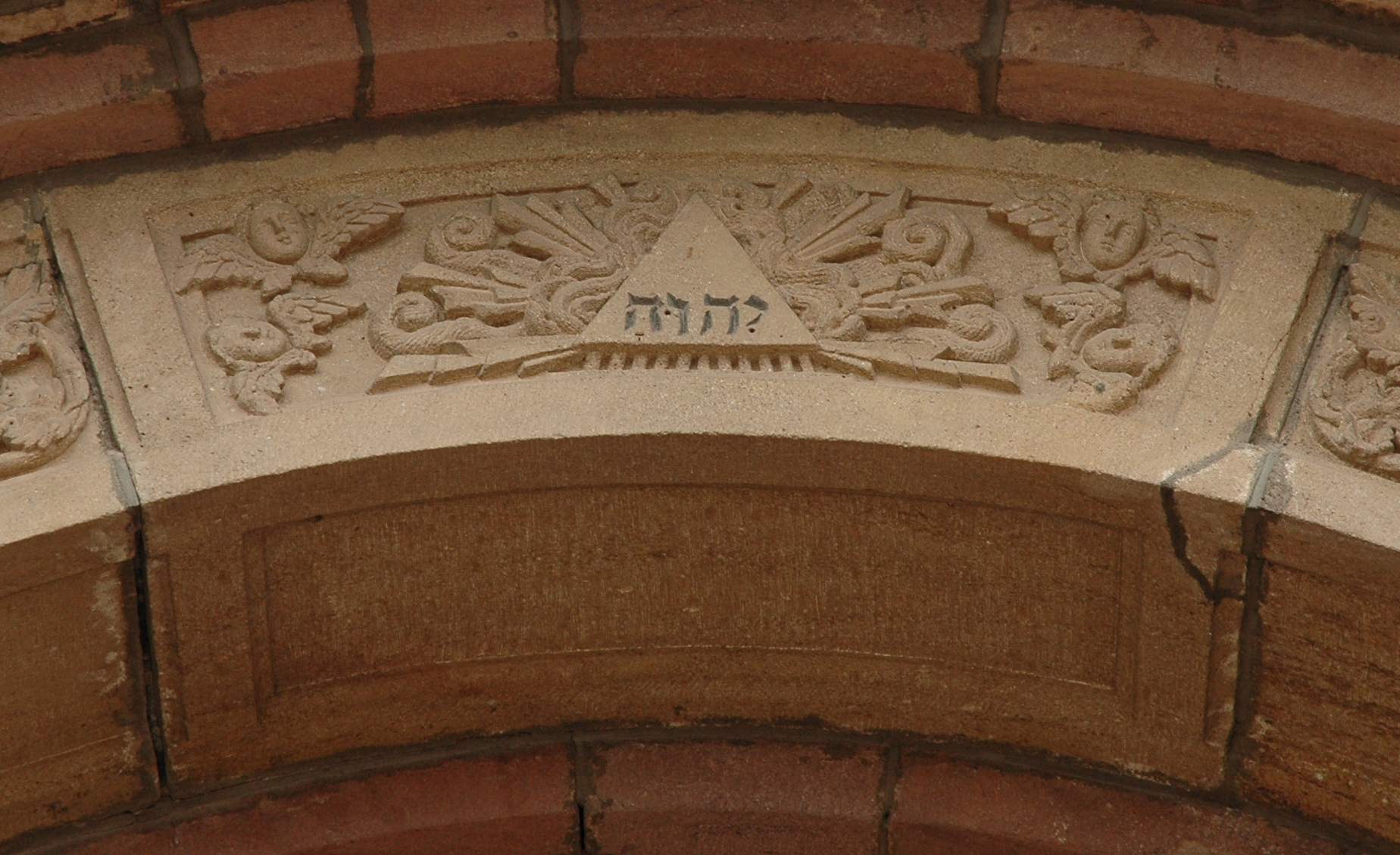
Look up as you pass through the main entrance and you will see something unexpected carved into the keystone above the arch: a triangle containing the Hebrew tetragrammaton, the four-letter name of God. A popular 19th-century story held that Lamy placed it there to thank Jewish merchants in San Antonio who had donated to the cathedral's building fund. The tale has never been verified, and scholars point out that Hebrew inscriptions appear on Catholic churches throughout Europe, where the tetragrammaton inside a triangle symbolizes the Trinity. Whether it reflects interfaith gratitude or standard Catholic iconography, the carving adds an intriguing layer of mystery to the building's facade.
La Conquistadora's Journey
Inside the cathedral's north chapel stands a wooden Madonna statue with a remarkable history. La Conquistadora was brought to New Mexico from Spain in 1626 by the Portuguese missionary Alonso de Benavides. When the Pueblo Revolt of 1680 drove the Spanish out of Santa Fe, fleeing colonists carried the statue with them into exile. Thirteen years later, when the Spanish returned in what they called the Reconquista, they brought La Conquistadora back. Behind her stands a carved and gilded wooden reredos assembled from two altar sections salvaged from the old Parroquia, dating to the mid-1700s. The archdiocese restored these pieces in 1957 and stacked them to form the chapel's current altar screen. Seven oil paintings within the reredos date from the 1700s, with four attributed in 1976 to the Mexican painter Miguel Cabrera.
Lamy's Enduring Presence
A bronze statue of Archbishop Lamy by the Hungarian-American sculptor Jeno Juszko has stood outside the cathedral's main entrance since its dedication in 1915. The bishop gazes outward from the building he willed into existence, his vision preserved in limestone rather than adobe. Willa Cather immortalized Lamy as the protagonist of her 1927 novel Death Comes for the Archbishop, a fictionalized account of his struggles to build a European-style church in the desert. Behind the cathedral, a prayer garden contains 14 life-size bronze Stations of the Cross by sculptor Gib Singleton, set among the remnants of Lamy's once-extensive gardens. The cathedral remains an active parish, its French-inspired architecture a daily reminder that Santa Fe's cultural layers extend far beyond the Spanish and Pueblo traditions that define the city's popular image.
From the Air
The Cathedral Basilica is located at 35.687N, 105.936W in downtown Santa Fe, just off the historic plaza, at approximately 7,000 feet elevation. Its yellow limestone facade and twin towers contrast sharply with surrounding adobe structures, making it identifiable from lower altitudes. Santa Fe Regional Airport (KSAF) is roughly 10 miles southwest. Albuquerque International Sunport (KABQ) is about 60 miles south via I-25. The Sangre de Cristo Mountains form a prominent ridge to the east.